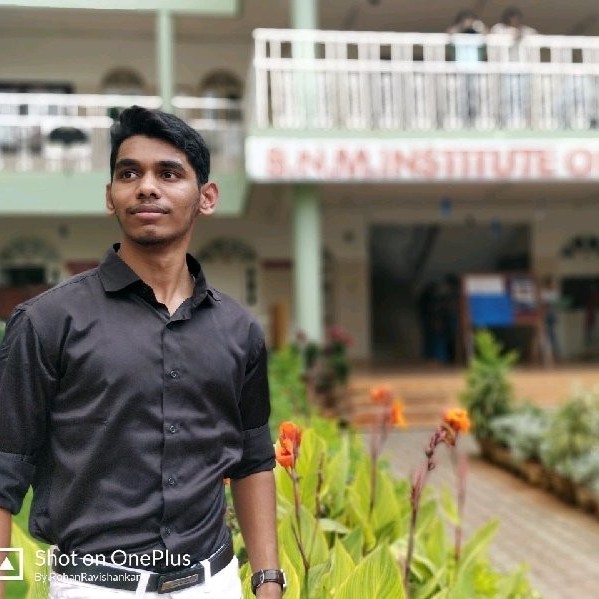
Agasthya Omkumar
Highly motivated ML Engineer with 1+ year of research experience in Deep Learning and Computer Vision seeking full-time Data Scientist or ML Engineer role to leverage my technical expertise and drive impactful results within collaborative team environment.
- Role
Forward Deploy AI Engineer
- Years of Experience
3.8 years
- Professional Portfolio
View here
Skillsets
- MLFlow
- Wandb
- vLLM
- Ultralytics
- Triton Inference Server
- Transformers
- TensorFlow
- Streamlit
- SQL
- Spatial data analysis
- R
- PyTorch
- Python
- OpenCV
- NLP
- Mmtrack
- Computer Vision
- MATLAB
- Machine Learning
- LLMs
- Kubernetes
- Keras
- Git
- GenAI
- DVC
- Docker
- C++
- C#
- Azure
- AWS
- Airflow
- Time Series
Professional Summary
3.8Years
- Oct, 2024 - Present2 yr
AI Engineer
CamCom - Jul, 2023 - Apr, 2024 9 months
Project Intern
Centre for Artificial Intelligence & Robotics, DRDO - Mar, 2021 - Sep, 2021 6 months
Intern
Cognizant - Jul, 2019 - Jul, 2019
Summer Trainee
Indian Institute of Science (IISc) - Jul, 2020 - Aug, 2020 1 month
HVAC Design Intern
Applications & Tools Known

Streamlit

SQLite3
.png)
Flask
C++

C#

Azure

AWS (Amazon Web Services)

Apache Airflow

PyTorch

MATLAB

SQL Server Reporting Services

TensorFlow Hub

Work History
3.8Years
AI Engineer
CamComOct, 2024 - Present2 yr
AI engineer for Urban and Housing Public Safety project; designed large-scale visual pollution detection workflow and architecture, optimizing automated urban safety inspections. Maintained the world's largest public safety inspection system, processing 6M–8M images/month and detecting 147+ urban safety and housing violations using production-grade ML pipelines. Designed business logic libraries to enforce violation-specific rules, protect PII, and minimize false positives; leveraged LLM-assisted rule interpretation and validation for faster iteration across cities and regulations. Developed violation geolocation estimation using lat/long, camera intrinsics, and GIS integration to support city-level urban planning and AI-generated compliance insights. Integrated depth models to filter distant objects, significantly reducing false positives in open-world detection. Curated training data with advanced techniques (negative data mining, synthetic data generation using GANs and generative augmentation), improving mean precision & recall across all classes by 47%. Built and automated Label Studio pipelines for pre-annotation and auto-annotation, reducing dataset curation time by 64%; integrated Segment Anything Model (SAM2) and GenAI-assisted mask refinement for rapid POCs. Maintained MLOps stack: Triton Inference Servers, Docker containers; enabled scalable deployment of both vision and multimodal (VLM) models in production. Worked on evaluation and integration of Vision-Language Models (VLMs) and LLM-based reasoning layers to support explainability, violation summarization, and next-gen analytics. Oversaw and optimized workflows of multiple annotation teams, ensuring rapid, high-quality dataset readiness aligned with GenAI-accelerated data pipelines. Delivered cross-vertical demos (defect detection in OEM pre-market segment) and led pilots for multiple cities in India and abroad. Contributed to research and integration of SOTA GenAI and multimodal models including Qwen, GLM, and advanced Vision-Language Models (VLMs) for next-gen system enhancements.
Project Intern
Centre for Artificial Intelligence & Robotics, DRDOJul, 2023 - Apr, 2024 9 months
Intern
CognizantMar, 2021 - Sep, 2021 6 months
Designed and maintained MySQL databases, implementing efficient schemas and relationships. Developed and optimized database queries to support web and enterprise applications. Gained hands-on experience in full-stack development fundamentals and database-driven application design.
HVAC Design Intern
Jul, 2020 - Aug, 2020 1 month
Summer Trainee
Indian Institute of Science (IISc)Jul, 2019 - Jul, 2019
Achievements
- Represented DIAT in West Zonals Chess Competitions
- Founded Robotics Club at BNM Institute of Technology
- Head Volunteer for ICDMAI 2023
- Team Lead for CHANAKYA at KAVACH Cybersecurity Hackathon
Major Projects
1Projects
Vittiya Anveshak
Developed a Fund Trail Analysis Platform using Flask and advanced Hidden Markov Models (HMMs) to identify irregular fund-flow sequences and infer latent behavioral states in transactional data. Implemented hierarchical and switching extensions such as Hierarchical / Regime-Switching HMMs (HSMMs) and Hidden Semi-Markov Models (HSMMs) to capture multi-state market and variable-duration financial regimes. Augmented training data with CTGAN-generated synthetic datasets to improve generalization under limited labeled data. Designed time-series feature pipelines and an interactive visualization layer for sequence analysis.
Education
M.Tech. in Applied Mathematics
Defence Institute of Advanced TechnologyB.E. in Mechanical Engineering
BNM Institute of Technology, VTU