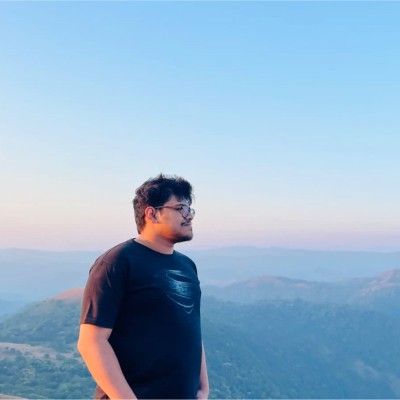
Subhankar Sen
To leverage expertise in Computer Engineering, AI/ML, and software development to contribute to innovative and challenging projects.
- Role
Data Scientist & ARM Developer
- Years of Experience
10.1 years
Skillsets
- Windows
- Matplotlib
- nginx
- NumPy
- OpenCV
- pandas
- PostgreSQL
- Scikit-learn
- TensorBoard
- TensorRT
- MATLAB
- AWS
- Boto3
- REST
- Shell
- Kubernetes
- CI/CD
- GCP
- Nvidia deepstream
- TensorFlow
- CSS
- Docker
- HTML
- Java
- LaTeX
- Linux
- Python
- PyTorch
- C
- Brew
- CUDA
- cuDNN
- Django
- Flask
- Git
- GStreamer
- macOS
Professional Summary
10.1Years
- Nov, 2019 - Present6 yr 11 months
Hospitality Manager
Rotaract Club MUJ - Jan, 2026 - Mar, 2026 2 months
AI/ML Engineer
TripFactory.com - Apr, 2025 - Dec, 2025 8 months
Data Scientist
Beatly.AI - Jun, 2022 - Dec, 2022 6 months
Summer Research Intern
National University of Singapore - Jan, 2023 - May, 2023 4 months
Data Science Intern
nference - Jun, 2023 - Apr, 20251 yr 10 months
Machine Learning Engineer
Dori AI - Apr, 2021 - Jun, 2021 2 months
Team Lead
COVID Relief MUJ
Applications & Tools Known

Python

LLMs
NLP
GCP
.png)
Docker
Next Js
C++
HTML
CSS

Javascript
React JS
Node JS
Linux

GitHub

Tensorflow

Keras

Google Cloud Platform

Work History
10.1Years
Hospitality Manager
Rotaract Club MUJNov, 2019 - Present6 yr 11 months
A blood donation camp was organized in Manipal University Jaipur on 15-11-2019 from 08:00 AM to 6:00 PM under the banner of Rotract-Green Club with a vision of providing red support to the needy people and social welfare. The total units of 1703 were collected from student, teaching and non-teaching staff of Manipal University Jaipur. Prof.(Dr.) Sandeep Joshi event coordinator organized the event with the support from students volunteers and faculty members. The venue of the event was the Old food court. A team of doctors and nurses from the 15 different hospitals had come. President Prof. (Dr.) G.K Prabhu inaugurated the Camp. Blood donation by President Prof. (Dr.) G.K. Prabhu was an encouraging moment for all. In this camp, the overwhelming number of volunteers of Manipal University Jaipur has participated with Vivacity. Camp was duly appreciated by hospitals that were present there.
AI/ML Engineer
TripFactory.comJan, 2026 - Mar, 2026 2 months
Data Scientist
Beatly.AIApr, 2025 - Dec, 2025 8 months
Leading an R&D team of AI/ML engineers in architecting and deploying CRAVE (Cardiac Rhythm AI Visualization Engine), a production-grade, device-agnostic ECG arrhythmia detection platform processing 432,000+ beats from multi-day Holter recordings and achieving 92%+ real-world clinical accuracy on unseen patient datasets. Engineering a 1D pre-activation ResNet rhythm model (16 residual blocks, global temporal pooling), delivering 97% accuracy in Normal vs. classification on 10-second ECG segments. Designing and implementing BeatNet, a hybrid deep learning architecture combining multi-scale convolutions, Gaussian region pooling, and lightweight MLP layers, achieving 94.5% accuracy across N/S/V/F beat classes with adaptive rhythm orchestration logic. Orchestrating a comprehensive 6-stage ML pipeline integrating ConvBiLSTM-based R-peak detection, beat classification, PQST segmentation, arrhythmia sub-classification, and morphology-based clustering achieving >85% concordance with expert clinical interpretations. Developing an advanced ECG denoising framework leveraging NeuroKit2, PyWavelets, EMD, SSA, morphology-driven Wiener filtering, dynamic Kalman filtering, and DTW-based alignment, enhancing P-QRS-T wave delineation and diagnostic accuracy. Building a device-agnostic preprocessing framework using MNE for EDF parsing across multiple manufacturers, with automated resampling, sliding-window analysis, gap detection, and daily batch processing for 8,600+ ECG segments per day. Resolving critical memory and performance constraints by reducing RAM consumption from 15 GB to <3 GB and cutting processing time for 2-day recordings to under 20 minutes through adaptive caching, cleanup strategies, and dynamic batch scaling. Optimizing cloud deployment workflows by reducing Docker image size from 4 GB to 1.8 GB, applying multi-stage builds, layer caching, and PyTorch cleanup, while integrating real-time performance monitoring for GPU, VRAM, CPU, and latency. Architecting a fault-tolerant AWS infrastructure using Step Functions, AWS Batch, EKS, ECR, S3, and CloudWatch, ensuring parallel containerized execution, automatic recovery, and continuous observability in large-scale clinical data processing.
Machine Learning Engineer
Dori AIJun, 2023 - Apr, 20251 yr 10 months
Architected and deployed both static and dynamic kitting inference pipelines, automating kit processing and scan validation workflows, and delivering high-precision validation reports for internal and client systems achieving a 98% kit PASS rate and enhancing operational accuracy for a leading US-based machine vision filters manufacturer. Developed and implemented an end-to-end YOLOv8 segmentation + Google OCR service bundle for bolt serial number detection, monitoring the full lifecycle from Proof of Concept (POC) to Phase-1 production rollout, ensuring reliable, real-time performance in industrial environments. Applied unsupervised clustering algorithms, including Gaussian Mixture Models (GMMs) and K-Means, to detect and classify color anomalies in vitrified floor tiles, delivering a tunable anomaly detection system that enabled customizable precision in differentiating between original and faded variants. Integrated and enhanced OCR pipelines by combining EasyOCR for scene text recognition and ZXing for barcode/QR parsing, while replacing the default CRAFT text detector with a YOLOv8-based model trained from scratch using synthetic cross-domain datasets, resulting in significant accuracy improvements for industrial scene text detection. Designed and executed secure data exchange protocols between ML inference and application servers using PPP tunnels, ensuring end-to-end encryption, low-latency communication, and full compliance with enterprise data privacy standards. Developed a frame reader module utilizing Baslers pylon SDK, enabling dynamic configuration of camera parameters through Feature Stream file loading, improving usability and alignment with industrial imaging and control system workflows. Evaluated and fine-tuned YOLOv8 models across multiple industrial AI applications including kitting, PPE compliance, hazard detection, and worker safety, enhancing model precision and improving operational throughput through continuous retraining and optimization. Built and deployed an advanced face anonymization tool compliant with European data protection regulations (GDPR), ensuring ethical AI implementation and safeguarding worker identities. Led end-to-end testing and validation of ML inference servers, app servers, and data manager Docker releases; executed edge case simulations, authored unit tests, and ensured seamless deployment across x86 cloud and ARM edge environments. Mentored and guided three final-year engineering interns through applied AI projects, fostering technical growth, collaboration, and effective knowledge transfer within the ML engineering function.
Data Science Intern
nferenceJan, 2023 - May, 2023 4 months
Standardized histopathology datasets by converting them into the COCO JSON format, enhancing interoperability for machine learning applications. Developed innovative training methodologies by creating mosaic cut-and-mix AOIs with updated nuclei annotations to diversify training datasets. Adapted and optimized the StarDist model for multi-task learning, enabling simultaneous instance segmentation and classification of multi-organ nuclei types. Conducted detailed spatial analytics through cell statistics analysis, utilizing advanced data formats such as GeoJSON and HDF5 for comprehensive insights. Achieved a notable reduction in inference times for advanced models, contributing to more efficient processing and analysis of complex datasets.
Summer Research Intern
National University of SingaporeJun, 2022 - Dec, 2022 6 months
Designed a multi-task learning model aimed at improving surgical scene understanding, focusing on tool-tissue interaction detection and instrument segmentation. Collaborated with cross-disciplinary teams to integrate advanced machine learning techniques into surgical robotics applications.
Team Lead
COVID Relief MUJApr, 2021 - Jun, 2021 2 months
Our college team has prepared a verified and reliable Pan-India Compilation by clubbing all the good and verified pan India covid resources which were scattered online. This has helped several people till now when the second wave of COVID-19 pandemic is ravaging across the nation, taking toll over several lives. Serving all your emergency requirements. Has recieved an overwhelming outreach till now !! What we are doing : Our MUJ relief team has worked in three prime areas during such a crisis : 1) covid resource compilation, 2) one-to-one support team catering individuals , 3) making our own useful website/apps so that people may benefit from them. ▪️Collaborated with Indian Student Associations at Carnegie Mellon University(CMU), Oxford, UC Berkeley, and Jadavpur University Kolkata for a joint COVID India Endeavor ▪ Started our own university fundraiser for providing relief in the form of food and essential groceries to low wage-earners and people below the poverty line in India ▪️ Started University wide immunization drive link to our resource : https://linktr.ee/covidreliefmuj link to CMU's All India COVID resources website : https://bhiksha.github.io/IndiaCovidResources/ Link to slack channel for the joint India endeavor volunteership : https://join.slack.com/t/indiacovidresources/shared_invite/zt-pjqrtp82-mAxEas_Kcc77_L82KwQxcw
Achievements
- 1st Rank in Vision Beyond Limits, Techfest @IIT Bombay
- 4th Rank in Aasan AI
- 4th Rank in Datathon - KJ Somaiya, Datazen
- Runner-up in Code For Good
Major Projects
3Projects
Multi-Cam Re-ID
Jun, 2022 - Aug, 2022 2 months
Implemented multi-camera object tracking using Yolo-v4, Centroid tracker, IOU tracker, Sort, and Deep Sort algorithms. Developed a custom IOU prediction tracker for improved occlusion handling.
Sociablast-A Chat+Bot Application
Nov, 2021 - Jan, 2022 2 months
Developed a chat and bot application with features for creating and joining rooms, strong encryption, and database integration using MongoDB, React Js, Node Js, and Socket.IO.
Sketch-2-Paint
Aug, 2021 - Sep, 2021 1 month
Built a Conditional Generative Adversarial Network to predict colored images from black and white sketches using deep learning and Tensorflow.
Education
B.Tech. in Computer Science and Engineering
Manipal University Jaipur (2023)
Certifications
Linear algebra by gilbert strang - coursera
Discrete mathematics from university of pennsylvania
Algorithms through pact under dr. rajiv gandhi
Deep learning specialization by andrew ng - coursera