Snippet:
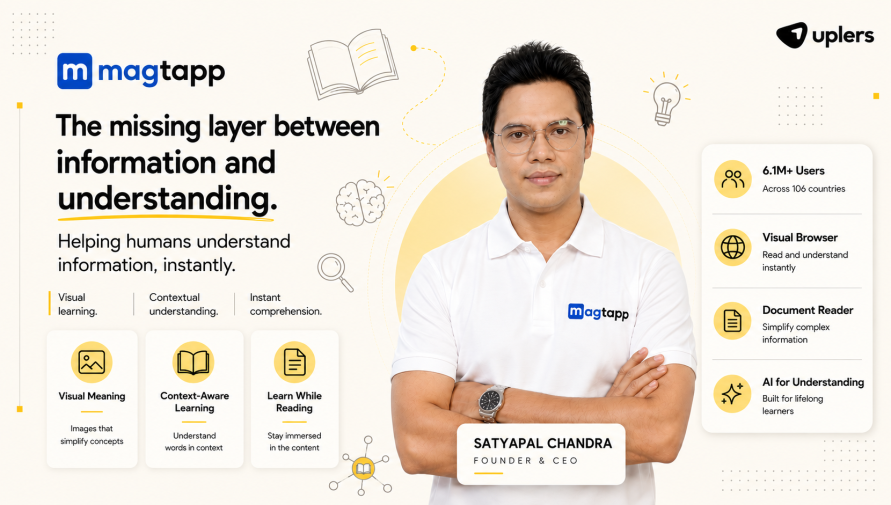
Satyapal Chandra can’t really write code, and he doesn’t keep a full-time engineering team. Yet 6.1 million people across 106 countries use the product he built. And he believes the day every browser ships free AI translation is the day MagTapp becomes even more relevant, because translation and understanding are not the same thing.. Here’s the bet underneath that, and the night in a Delhi restaurant where it started
Satyapal Chandra can’t really write code, and he doesn’t keep a full-time engineering team. Yet 6.1 million people across 106 countries use the product he built. And he believes the day every browser ships free AI translation is the day MagTapp becomes even more relevant, because translation and understanding are not the same thing.. Here’s the bet underneath that, and the night in a Delhi restaurant where it started.
The thing his school got wrong about him
Long before the restaurant, Chandra had noticed something about his own brain. He went to a vernacular government school, and the hard words never stuck, until he saw them.
“There was a word in geography, I was not able to understand anything. But if I saw the image of that particular word, my mind would retain it.”
So when he later sat down to prepare for the IAS, he did something most aspirants don’t. Every time he hit a word he couldn’t hold, he Googled it as an image. The picture stayed when the definition wouldn’t.
Then he read about a Harvard experiment run in Brazil, a country with the same English problem India has. Researchers took Hollywood films, sliced a 100-minute movie into twenty fragments, slowed the playback to a quarter speed so every sentence landed clean, ran subtitles in the local tongue, and let learners absorb it visually. They picked up English fast.
It confirmed the thing he already suspected about himself. The stat he repeats like a creed: a visual carries roughly eight times the information of a word, and the brain processes it tens of thousands of times faster.
The leap, when it came, wasn’t about him anymore. It was about a much larger question: if visual understanding helped one student learn faster, could it help millions overcome barriers to knowledge? India has some 300 million students. By his reckoning, the overwhelming majority of them are learning in a vernacular language, Jammu to Kerala, the Northeast to western Gujarat. “Let’s build a system that helps people understand what they’re reading, regardless of language, background, or educational level.” he decided. Not a course. A system.
No standing engineering team. 106 countries.
Here is the part that doesn’t compute on paper.
MagTapp, an app that has an inbuilt visual web browser and document reader hit its first million users in ninety days. Today 6.1 million people across 106 countries use it, and it carries more than 142,000 reviews on the Play Store. It got there on a little over a million dollars raised, with an average customer acquisition cost of about three rupees and roughly a third of its growth coming in purely organic.

And Chandra is the sole founder. There is no large standing engineering org behind this. The early build leaned on a launch crew and on friends “a lot of my friends are IITians,” he says; he’d written books, he had access to rooms most non-technical founders don’t. “I know how to build it. But I didn’t know how to make it live with the help of technology. So they helped me.” Today the work runs through strategic partnerships, outsourced Android and iOS teams, and a co-founder he brought over from an AI company, someone who’d built and sold a company before.
The most telling number isn’t any of the big ones. It’s this: more than ten thousand emails from Pakistan. A flood more from Nepal. A tool originally built to solve a local learning problem had quietly crossed borders and cultures, revealing that comprehension is a universal challenge., “We were shocked,” he admits.
The shock became the strategy. What users across countries seemed to value wasn’t translation alone. It was understanding. What started as “kill the fear of English” evolved into something much larger: reducing the gap between information and understanding. Language was only the first barrier. Comprehension was the deeper one.
Why he won’t fight ChatGPT
Every conversation about MagTapp lands on the same question, the one investors ask. Google Lens translates any word for free. ChatGPT does it with full context. So why does MagTapp still grow?
Most AI companies are trying to teach machines to understand language.
Magtapp took a different approach. It focused on helping people understand it.
At first glance, that may not sound like a particularly difficult problem. But anyone who has ever struggled through a textbook, research paper or article filled with unfamiliar words knows otherwise.
Knowing the meaning of a word is one thing. Understanding it in context is something else entirely.
A word like “cricket” can mean a sport to one person and an insect to another. Show the wrong image and you don’t improve learning, you create confusion.
That’s the challenge Magtapp set out to solve.
Over the years, the company has built a system that connects words with contextual visual meaning, helping readers instantly understand concepts through images, explanations and relevant context. Hundreds of thousands of concepts have been reviewed, mapped and refined to ensure that the right meaning appears at the right moment.
It’s not the kind of problem that attracts much attention in the AI world.
Most large AI companies focused on building systems that could answer questions, generate content, translate languages or automate tasks. Those are important problems to solve.
Magtapp chose a different one.
Its focus was understanding.
Not helping machines understand humans, but helping humans understand information.
That distinction may sound subtle, but it shapes everything the company builds.
Rather than trying to become another general-purpose AI assistant, Magtapp has spent years exploring how people learn, how they process information and why some concepts stay in memory while others are forgotten almost immediately.
The result is a product designed for students, readers and lifelong learners, one that helps people make sense of information while they’re consuming it, instead of forcing them to leave what they’re reading and search for explanations elsewhere.
For founders, there is a larger lesson here.
The biggest opportunities don’t always come from competing head-on with technology giants. Sometimes they come from noticing a problem everyone else overlooked.
While much of the AI industry was focused on generating information, Magtapp became interested in something equally important: understanding it.
That focus has led to years of specialised work, unique datasets and a category that remains surprisingly underexplored.
In artificial intelligence, scale matters.
But sometimes the strongest businesses are built by solving a problem that seems too small for everyone else to care about until millions of people start using it.Magtapp is betting that understanding may be one of those problems.
The two-year argument he had with himself
The discipline didn’t come naturally. It came from losing an argument with himself, slowly, over two years.
MagTapp had stumbled into something big on the B2B side. The pitch is elegant: a publisher like Times of India pulls 800 million visits a month and monetizes through standard ads. MagTapp integrates its API and ad network on top , and when a reader taps a hard word in an article, the visual meaning pops up with an extra ad inventory tucked beneath it. A hundred percent viewability, served at the exact moment of a user’s intent. “We’re not going to touch the lakh you already make,” he says. “We give you an extra monetization layer.”
It validated. It also nearly pulled the company apart. “We’re a small company. We’d raised barely a million and a half. The team wasn’t capable yet,” he says. B2C had a massive user base and an emotional mission. B2B had the revenue logic. For two years, he juggled building the publisher business or going deep on the consumer one.
The resolution was a constraint, not an expansion: focus entirely on B2C for the next six to eight months, get the core base right, then scale into B2B. One segment at a time.
The same instinct showed up when users kept asking for a browser plugin, just bolt MagTapp onto Chrome. Easy win, obvious demand. He said no. “If we became a plugin, the whole infrastructure collapses,” he says.

A note for the engineers reading this
There’s a reason this story belongs in front of builders and not just buyers. Chandra’s broader thesis is that India’s problem was never talent. It was access to understanding. It was the layer of friction sitting between talent and the world.
It’s the same friction that quietly underprices Indian engineers. The skill is abundant; the communication gap is what makes a brilliant developer read as junior on an international call, or get paid less than the work is worth.
 MagTapp has since been tapped by MeitY to help build a secure Indian web browser, and Chandra says the next builds will open up developer-facing tooling, including repositories of those 4-bit models for others to build on top of.
More broadly, Chandra believes the next phase of AI will not be defined by who generates the best answers, but by who helps people understand information most effectively. In that view, MagTapp is less a learning app and more an infrastructure layer for comprehension.
What the books were really for
Ask him to choose: novelist or CEO, and he won’t romanticize it.
“Every phase of your life helps you in a certain way, and it stays valid for a certain phase,” he says. The eleven books bought him a network he had no other way of buying: recognition, direct access to chief ministers and senior bureaucrats, and a pool of talented people who already knew his name and opened doors. “But right now, MagTapp matters. Not the books.”
Which is why his advice to a founder starting with no network and no technical chops isn’t a framework. It’s almost the opposite of one.
“There’s no particular pattern,” he says. You can build the idea and the network at the same time; there’s no empirical study that says which comes first. “But once you become genuinely passionate about figuring something out, your brain gets rewired. Some unknown alley connects with you. People you didn’t know start opening doors. It doesn’t mean it’ll work, mostly you go by your gut feeling.” Passion first, he says. Then you find your own weakness. Then you get your focus.
He is not betting that MagTapp out-features Google, or out-spends OpenAI. He’s betting that while the world’s largest technology companies compete to generate information, the bigger opportunity may lie in helping people understand it. The layer between information and comprehension remains surprisingly underbuilt. That’s the layer MagTapp intends to occupy.