Snippet:
- Product engineers own outcomes. Service engineers deliver to spec.
- A product-minded engineer asks why before how. A service engineer asks what was specified.
- Interview for ownership, curiosity, and judgment. Not just what they built, but what happened after.
- The service-to-product transition takes 4-6 months. Structured onboarding cuts that curve significantly.
- Early-stage startups don’t need a full team of ex-product engineers, one or two can shift the entire team’s culture.
Here’s a scenario that many founders may have lived through:
You hire an engineer with a spotless résumé: great college, 5 years at a well-known IT firm, technically solid. Three months in, you realize they wait for instructions before moving. They build exactly what’s asked, nothing more. They’ve never once questioned whether the feature should exist at all.
That’s not a skill gap. That’s a mindset gap.
A product-background engineer and a service-background engineer can have identical tech stacks. But their operating systems, how they think, prioritize, and take ownership, are wired differently.
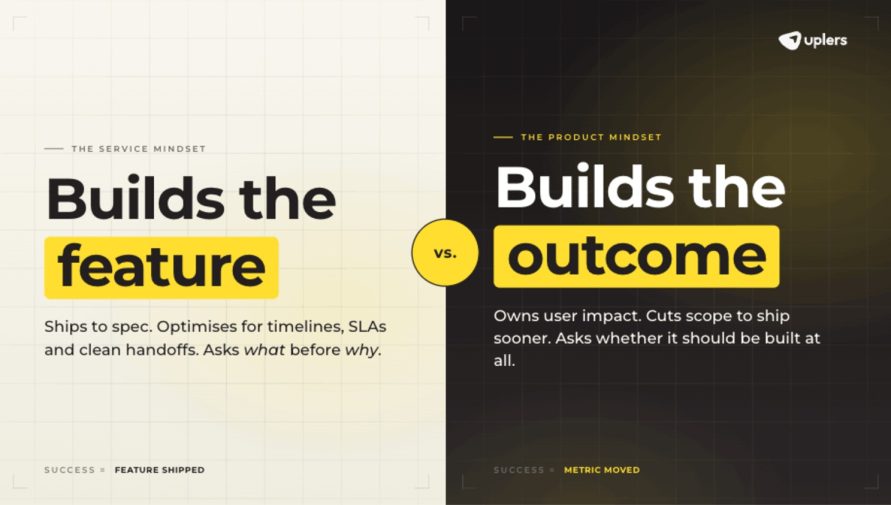
Service-background engineers are built to deliver what the client asks for. Product-background engineers are built to care whether it actually worked.
Both types of engineers are valuable. But for early-stage product startups, hiring the wrong one sets you back in ways that don’t show up until Month 3. This guide breaks it all down, from the mindset gap to the interview playbook, so you can hire with clarity.
The Two Ecosystems That Shape an Engineer’s Approach
Before you can assess and vet candidates, you need to understand what each ecosystem actually trains engineers to do. The difference runs much deeper than job titles.
What the Service Ecosystem Trains Engineers to Do
Engineers in IT service companies operate within a client-delivery model. They:
- Deliver to clearly defined requirements.
- Minimize scope creep and deviations.
- Optimize for timelines, SLAs, and client satisfaction.
- Work within structured hierarchies.
Success = Feature delivered on time, not product outcomes.
What the Product Ecosystem Trains Engineers to Do
Product-first companies operate completely differently. Here, engineers are co-owners of the product’s success. They:
- Build for users
- Ship, learn, and iterate.
- Own outcomes beyond assigned tasks
- Understand business + product tradeoffs
Success = metric moved, not feature shipped.
Why This Gap Runs Deeper Than Tech Stack
This isn’t about Java vs Python.
This gap shows up before a single line of code is written:
A service engineer asks: “What did the PM/client specify?”
A product engineer asks: “What problem are we solving? Is this the right thing to build?”
While one mindset optimizes for delivery, the other optimizes for impact.
What a Product-Minded Engineer Looks Like
Product mindset gets thrown around a lot. Here’s what it looks like in practice: specific, observable, and assessable.
The 5 Markers of a Product-Minded Engineer
- Asks why before how.
- Flags issues outside their scope (UX, flows, edge cases)
- Suggests scope cuts to ship faster
- Checks metrics post-launch
- Thinks in iterations, not final delivery
Coding Approach: Where the Difference Shows Up in Practice
Service engineer: Writes to requirements. Defensive, modular, optimized for team handoffs.
Product engineer: Writes for change velocity. Monitors what they ship. Optimizes for what the next iteration needs, not what the spec said.
The real test? Hand them a feature with ambiguous requirements. The service-background engineer will ask for a clearer spec. The product-background engineer will ask to talk to a user first.
System Design Mindset vs. Implementation Mindset
| Parameter | Service-Background Engineer | Product-Background Engineer |
| First question | “How do we build this robustly?” | “Should we build this at all?” |
| Primary goal | Reliable, scalable implementation | Fastest version that validates the assumption |
| Thinking style | Architecture-first | Tradeoff-first |
| Scope instinct | Build everything specified | Cut scope to ship sooner |
| Risk tolerance | Low: stability over speed | High: iteration over perfection |
| Definition of done | Code is deployed and tested | Feature moved a metric |
| Response to ambiguity | Asks for a clearer spec | Asks to talk to a user |
| Measures success by | Technical output quality | Business/user impact |
How to Assess Product Mindset: The Founder’s Interview Playbook
Most technical interviews evaluate what candidates know. For product startups, you also need to evaluate how they think.
The 3 Dimensions to Evaluate
Ownership: Do they feel personally responsible for outcomes? The red flag is “my team decided” with no personal stake in the outcome.
Curiosity: Do they care about users, business context, and the “why” behind their work? If they reply “I just built what was scoped” with no mention of whether it worked, that’s not ideal.
Judgment: Can they make reasonable decisions with incomplete information? Replying “I waited for the PM to clarify” as the default response to ambiguity shows poor judgment.
Questions That Surface Product Thinking (With What to Listen For)
| Question | What to Test | Green Flag |
| “Tell me about a feature you built. Would you build it differently today?” | Reflection + outcome orientation | Ties changes to user/business impact, not just tech |
| “You’re given a vague requirement. Walk me through your first 48 hours.” | Ambiguity handling | Talks to users/stakeholders before opening IDE |
| “Have you ever pushed back on a PM or founder? What happened?” | Ownership + voice | Specific story, respectful but direct |
| “What metrics did you track after your last major release?” | Product accountability | Named actual numbers, not “QA checked it” |
The System Design Twist for Product Startups
Skip the generic “design Twitter” prompt. Try:
“Design a feature that increases D7 retention by 10% for a B2B SaaS product with 5,000 active users.”
Watch for: Do they ask clarifying product questions first? Or jump straight to architecture?
Skills Product Startups Should Prioritize First
| Priority Tier | What It Covers |
| Tier 1: Non-Negotiable | Ownership mindset, comfort with ambiguity, cross-functional communication, trade-off awareness |
| Tier 2: Trainable | Specific frameworks, tools, and programming languages |
| Tier 3: Bonus | Prior product company experience, startup background |
Can a Service-Background Engineer Succeed at a Product Startup?
Yes, but not everyone makes the leap. Here’s a clear-eyed framework to help you decide.
The Work Culture Gap They’re Walking Into
| Dimension | Service Culture | Product Startup Culture |
| Roles | Defined, siloed | Fluid, overlapping |
| Decision-making | Approval chains, hierarchy | Direct founder access, fast calls |
| Success metric | On-time delivery, client SLA | User outcome, metric moved |
| Ambiguity tolerance | Low: specs are king | High: ambiguity is the job |
| Sprint rhythm | Predictable, process-heavy | Fast, context-switching |
| Feedback loop | Client review cycles | Real-time user data |
The Adaptation Timeline (And What Accelerates It)
| Timeline | What you see | What it means |
| Months 1 – 2 | Asking for more process, more specs | Normal disorientation |
| Months 3 – 4 | Starting to ask why, taking initiative, or requesting more structure | Signals whether the transition is happening |
| Months 5 – 6 | Productively autonomous OR a consistent productivity drag | The call needs to be made |
What accelerates the transition:
- Strong onboarding that explains the why, not just the what.
- A product-minded mentor.
- Early ownership of one small feature.
Green Flags That a Service Engineer Will Make the Leap
- Has shipped something independently: a side project, open-source contribution, or freelance product.
- Mentions frustration with not knowing how their work performed after delivery.
- Sought out user feedback even when it wasn’t part of their role.
- Describes curiosity about the business.
Conclusion
Hiring for a product startup isn’t just about finding technically strong engineers. It’s about finding engineers with the right operating system.
Product engineers drive outcomes, whereas service engineers execute well.
Both are good. But in early-stage startups, mindset compounds faster than skill. The founders who get this right find engineers who think like co-builders.