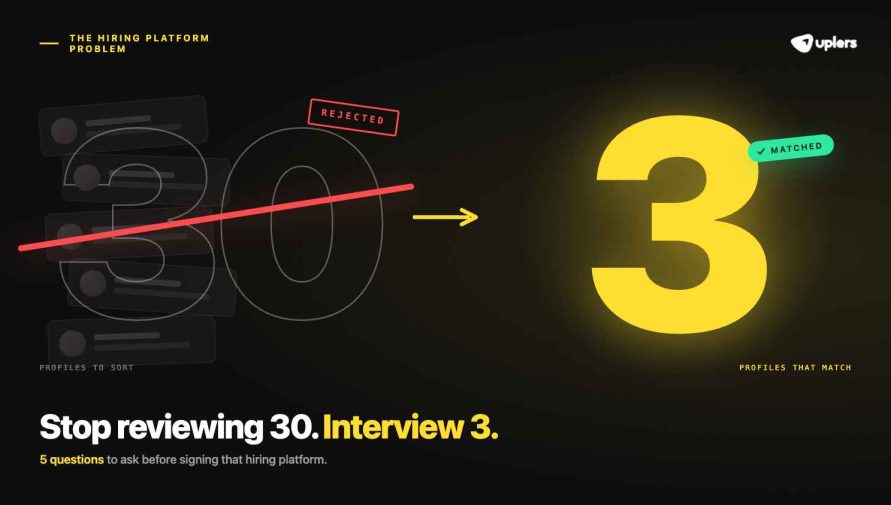
Snippet:
- Most hiring platforms optimize for volume, not match quality.
- Founders end up filtering profiles that the hiring platform should have removed.
- Weak intake = weak shortlist. Always ask how requirements are collected.
- Fewer profiles are a sign of better filtering, not limited options.
- If a platform can’t answer these 5 questions clearly, keep looking.
There’s a pattern most founders recognize quickly.
You explain the role clearly. The hiring platform says they “have great talent.” Then, a few days later, your inbox is full of profiles that barely match what you asked for.
Wrong tech stack, wrong experience level, wrong timezone. Sometimes, even the wrong role entirely. You wonder if they even read what you sent.
This is not a talent-shortage problem. It is a matching problem.
The difference between a hiring platform that sends you three great candidates and one that floods your inbox with thirty mediocre candidates is how they filter before anything reaches you.
The right question to ask any hiring platform is not “how many candidates do you have?” It is “how accurately can you match profiles to what I actually described?”
Most hiring platforms are built to maximize profile volume, not shortlist relevance. That results in founder fatigue, slower hiring, wasted interview bandwidth, and delayed product execution.
We are sharing 5 questions to ask before signing up with any hiring platform.
Why Most Hiring Platforms Keep Sending Irrelevant Profiles
Most platforms are built to move fast and submit profiles at the earliest. Their metrics measure the number of profiles sent and time-to-submission, not hiring outcomes.
When volume is the goal, keyword matching is the default filter. If there is “React” in the resume, it means you asked for a React native engineer. Profiles that mention React are sent. Nobody checked for:
- Startup readiness
- Ownership mindset
- Communication skills
- Hiring urgency fit
Without these filters, founders become the filtering layer. They receive 20 to 50 resumes quickly, but only 1 or 2 are relevant.
The Hidden Cost of Poor Shortlist
Reviewing irrelevant profiles looks harmless? It isn’t.
Every hour a founder spends filtering resumes is an hour not spent building. And the real cost shows up as delayed hiring, engineering slowdown, lost founder bandwidth, and longer time-to-hire.
When you keep seeing the wrong profiles, you start to wonder if the talent just isn’t there. It usually is. The platform is the problem.
5 Questions to Ask Any Hiring Platform Before You Proceed
The difference between a platform that shortlists and one that dumps profiles shows up in how it answers these questions.
Do you have experience with startup hiring? Do you understand the difference between a zero-to-one and a one-to-ten engineer?
This is the first question that helps filter out 90% of platforms before you go further.
Most recruitment companies are built for structured, established organizations. They fill seats using job titles and years of experience. Hiring engineers for startups is a different discipline entirely.
A hiring platform with genuine startup experience will understand the difference between a candidate who has operated in a zero-to-one environment (building from scratch, navigating ambiguity, doing things that don’t scale) and someone who has grown a team from one to ten, optimizing and managing within an existing structure.
These are different people with different profiles, and a platform that recruits across both without distinguishing between them will consistently send you the wrong type.
Use the language of startups and watch how they respond. If they go blank when you mention zero-to-one, or if they treat “zero-to-one experience” as a generic synonym for “early career,” you have your answer.
A good answer will mention specific things they look for, like proof of ownership, experience working in uncertain situations, and a track record of making decisions. If a platform doesn’t get your world, they can’t find the right people for you.
What requirements do you collect beyond the tech stack?
A two-minute intake form is a red flag. It means they will match on keywords.
Weak platforms ask for the job title, the tech stack, and years of experience, and then start sharing profiles.
Strong platforms treat it as a discovery session and ask relevant questions that run much deeper. What stage is the company at? What does ownership look like in this role? What kind of candidate hasn’t worked out in the past, and why? What does success look like in 90 days?
It’s not about how they collect requirements, but about the details they collect. The best platforms go beyond the resume to understand your team setup, how the founder works, and the problem this hire will solve.
The follow-up question is: “Walk me through a specific case where the intake conversation changed which profiles you sent.” If they can’t, the intake is generic, which means the shortlist will be too.
How do you screen for ownership and soft skills, not just technical stack?
This is where most platforms fail. Every platform will tell you they check for the right tech stack. But what separates a useful shortlist from a keyword dump is whether anyone is filtering for what’s harder to see on a resume. Ownership assessment requires judgment.
Try to understand how an AI-driven hiring platform works. Ask them: How do you evaluate if a candidate has genuine ownership experience versus someone who was present when good work happened? How do you assess communication skills, how candidates explain trade-offs, and if they have operated with real autonomy? Do you distinguish between domain expertise and startup adaptability? Do your screeners have experience in startup hiring themselves?
A weak answer talks about “culture fit” without specifics. That phrase, on its own, means nothing. Expect that soft-skill assessment will get passed on to you.
A strong answer describes a specific process. A structured conversation, a case or scenario, and defined signals they look for.
How many profiles will I receive, and how quickly?
These two questions belong together because speed without relevance is just a faster version of the same problem.
If a platform sends 20 to 30 profiles, the shortlisting hasn’t happened yet. They have only sourced, while you will spend hours sorting before you interview anyone useful. You’re not paying for access to a database. You’re paying for someone to decide, before anything reaches you.
Getting three spot-on profiles is better than thirty that barely fit. Ask what a typical submission looks like, how many profiles, and how long it takes. Then ask about the match rate for that first batch. Yes, startups want to reduce time-to-hire but speed only matters if the profiles are a good fit.
What happens when the first shortlist doesn’t match?
Every platform may miss sometimes. What matters is how they respond. This question tests accountability.
Weak platforms will send you more resumes. More profiles without changing the criteria is the same problem at a higher volume. But reliable platforms have a feedback loop, shortlist recalibration, and iterative refinement.
Ask specifically, “Do you revise based on founder feedback, or just send more profiles?”
What Good Shortlisting Looks Like in Practice
For reference, here is what a well-built shortlisting process looks like from start to hire. Not every platform does all of this, but this is the standard to benchmark against.
| Stage | Weak platform | Strong platform |
| Intake | 5-field form, job title and stack | Structured conversation, role context, team structure, what past hires missed |
| Screening criteria | Technical stack, years of experience | Hard skills plus soft signals: ownership history, startup adaptability, communication under ambiguity |
| Profile volume | 20 to 30 profiles per submission | 3 to 5 matched profiles |
| Miss handling | Sends more profiles | Recalibrates criteria based on specific feedback |
| Accountability | Time-to-submission | Match rate on first submission and hiring outcomes |
Uplers is built around shortlist relevance, not profile volume. Here’s how it works:
- A founder shares detailed hiring requirements, including role context, team structure, time zone, and ownership expectations.
- AI filters out irrelevant profiles from a 3.5M+ talent network.
- Human experts select the top 3 profiles that best match the full context of the role.
- The founder reviews 3 profiles, no sorting, no filtering required.
- A 90-day replacement guarantee, so if a hire doesn’t work out, Uplers finds a replacement at no additional cost.
The goal isn’t to flood inboxes but to reduce review time and improve hiring quality.
Before You Sign Anything
Run every platform through these seven questions. A platform that answers them clearly has built a real shortlisting process. One that pivots to database size or submission speed has not.
The real question is not which platform has the most candidates. It is which one makes the effort to decide which candidates are not right for you. That filtering decision, made before anything reaches your inbox, is what you are actually paying for.
If you are spending more time filtering profiles than interviewing qualified candidates, your chosen platform is solving the wrong problem.