You need a job description. You have got ChatGPT open. Easy, right? You type “write me a JD for a backend engineer,” hit enter, and get something back in 10 seconds.
Then you actually read it.
It’s fine but it’s also generic. It could be any company hiring any backend engineer anywhere. It doesn’t know you’re pre-seed with 3 people. It doesn’t know the person you hire will own architecture decisions that stick around for years. It doesn’t know your stack, your stage, or what “good” looks like 90 days in.
So now you’re editing. You’re adding context. You’re cutting the parts that sound like every other JD on the internet. That 10-second win just turned into an hour.
See the thing with LLMs is that it only knows what you type. If you want a JD that fits your company, you have to feed it things about your company. Every time. The stage, the team size, the problem you’re solving, the kind of engineer who survives your environment. ChatGPT starts from zero on all of it, so you carry that load yourself.
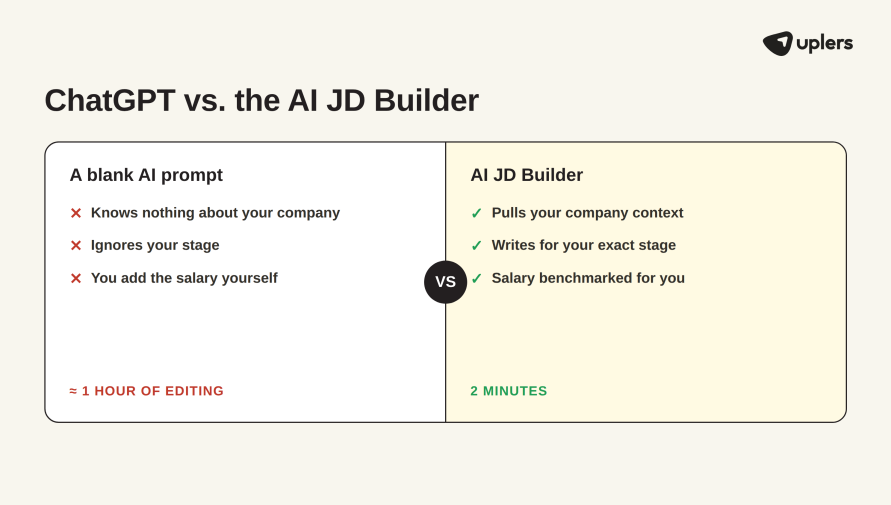
Here’s the difference laid out plainly:
| Blank AI prompt (ChatGPT) | AI Job Description Builder | |
| Knows your company | Only what you type | Pulls it from your email automatically (different tools have diff mechanisms) |
| Handles your stage | You have to explain it | Writes differently for pre-seed vs. scale stage |
| Salary range | You look it up | Pre-benchmarked to the latest product market |
| 30/60/90 milestones | You write them | Auto-filled for the role |
| Soft skills for your stage | You remember to add them or you write based on what you think | Built in – tailored for every stage |
| Filters out wrong applicants | No | A fit section does this for you |
| Time to a postable JD | ~1 hour of editing | 2 minutes, 2-3 questions |
And most founders don’t have that hour. So they ship the generic version. Then they wonder why they’re getting applications from people who are technically qualified and completely wrong for a startup.
That’s the gap we built the AI Job Description Builder to close.
You drop in your work email. It pulls your company context on its own. What you do, the space you’re in. If you’re in stealth, it pulls nothing, and you just tell it a line about who you are. Then it asks 2 or 3 questions. What are you hiring for. How big is the team. What stage are you at. Etc.
That’s the whole input. No 15-field form. No blank box staring back at you.
From there it writes the JD. And how is it different? It writes job descriptions differently for a pre-seed team of 3 than for a Series A team of 15. Even if it is the same role there’s a different JD because who thrives at 0 to 1 is not who thrives at scale.
Uplers’ AI JD Builder is built for hiring India-based engineering talent, with the salary benchmarked to the Indian product market.
One takes an hour of your editing. The other takes 2 minutes and a couple of answers.