Snippet
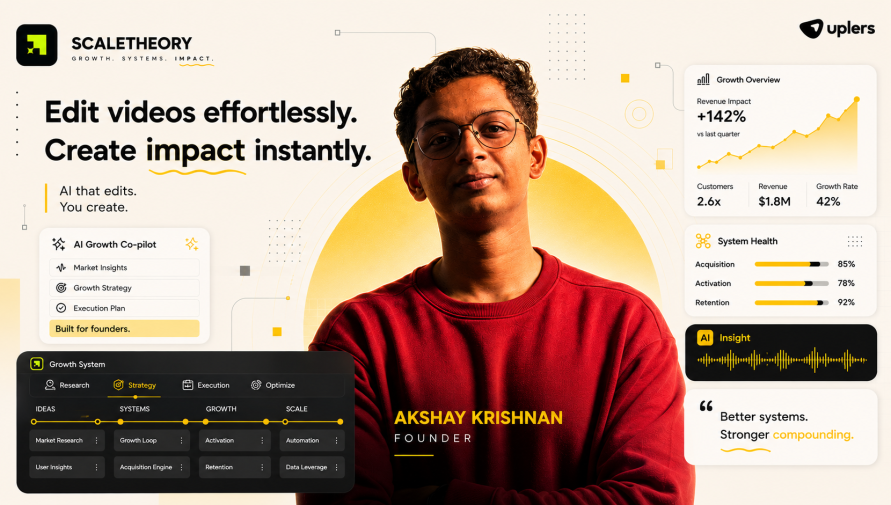
He left a successful company to build Scale Theory, the “system” that helped EdisonOS turn SEO as the biggest channel for their sales pipeline. Here’s how he thinks about the new search era.
Ask most B2B SaaS founders what’s happened to their SEO traffic in 2026, and they’ll tell you AI killed it.
Akshay Krishnan has a different explanation. “It wasn’t AI adoption that crashed traffic,” he says. “It was the quality of what people published with AI.”
He watched it happen from the inside. Before Scale Theory, Akshay ran B2B SaaS SEO programs at at Zoho and an agency. The work was technically competent, the volume was high, and somewhere in the middle of pushing out 30, 40 articles a month, he noticed a gap he couldn’t close from where he was standing: output kept climbing, pipeline didn’t follow.
He started consulting on the side; not with a plan, initially just to work on things differently than he could in his day job, in areas where the direction at the agency didn’t sit right with him. That consulting gained traction. And gradually, a clearer thesis took shape: the next era of search visibility wouldn’t be won by volume. It would be won by structured judgment, knowing what to write, what not to write, and how to measure both.
He left on good terms. What he took with him was the question, and over the following year, the tooling to answer it.
A system. Not an agency. Not a Platform
He won’t call Scale Theory an agency. He won’t call it a platform. He calls it a system, and the distinction is load-bearing.
The system tracks B2B SaaS brand visibility across Google and AI surfaces: ChatGPT, Perplexity, Google AI Overviews, and acts on what it finds. The dashboard consolidates Google Search Console, GA4, and Looker into a single view, and monitors two distinct metrics that most founders treat as interchangeable.
The first is presence: how often your brand is mentioned in the answer text of an AI-generated response.
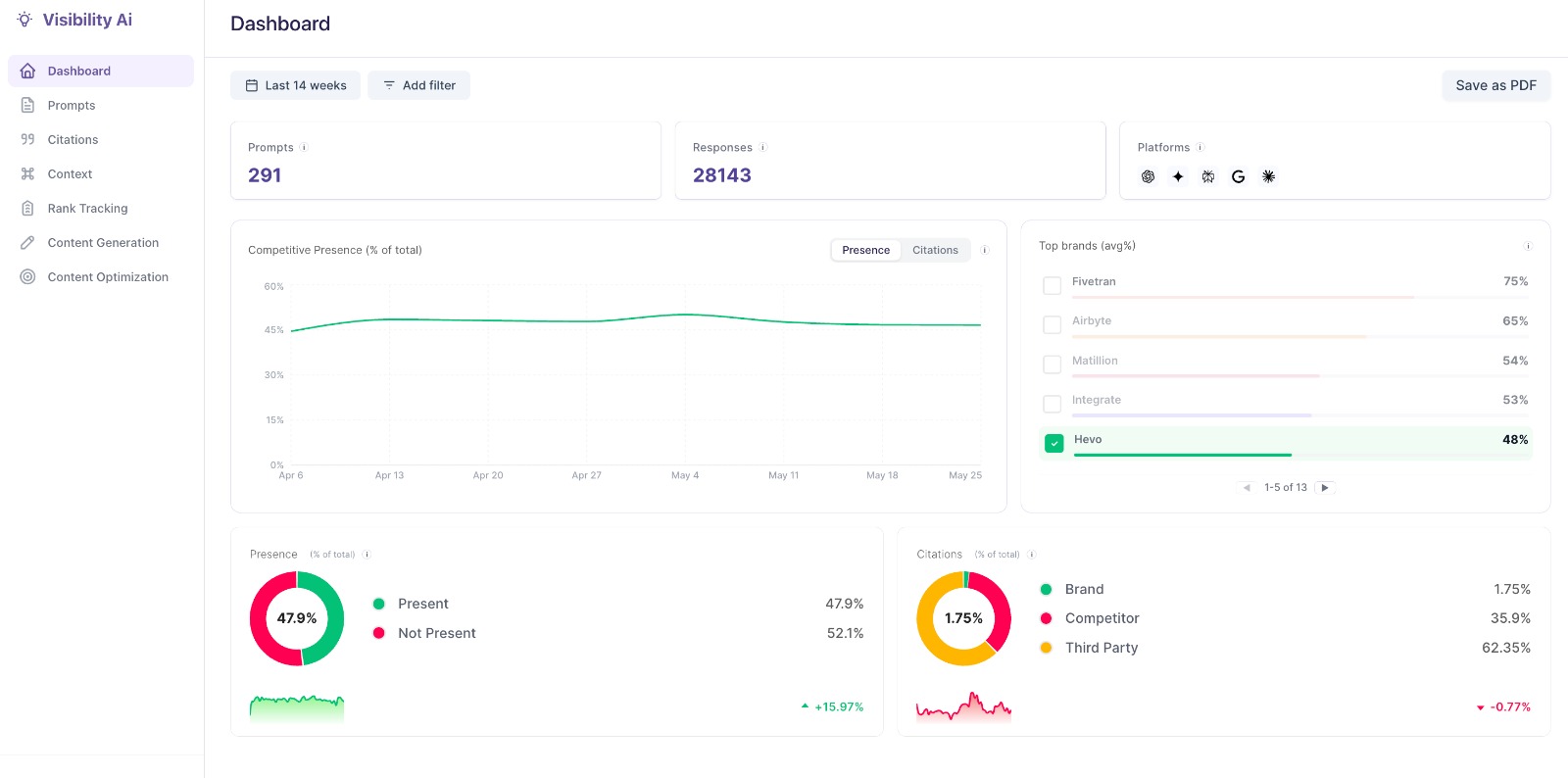
The second is citation: how often your URL is listed as a source. Akshay thinks conflating them is one of the most expensive mistakes in the AI-era SEO.

What the EdisonOS numbers don’t show
EdisonOS is a B2B platform serving SAT, ACT, and SHSAT tutoring institutes in the US, a niche narrow enough that most agencies would have steered away from. When they started with Scale Theory, SEO contributed 33% of their pipeline. By Q1 2026, that number was 100%. They hadn’t scaled content production. They’d cut it; publishing fewer, more targeted articles, eventually stopping almost all outbound work as SEO took over the pipeline entirely.
What the result doesn’t show is the discipline underneath it. For every client, Akshay sets OKRs: clear goals for the quarter, and a short list of actionables tied directly to each one. With EdisonOS, that list had four items. That was it.
“If there is an action which cannot be tied down to a goal, there is no need to pick it up.” When two weeks pass with no movement on an actionable, that’s the signal that something isn’t being prioritised, or the brief needs to change. The result looks clean from the outside. The mechanism is just that constraint, applied without exception.
“Nobody is searching ‘CRM software’ anymore,” he says. “They’re searching ‘Best CRM software for a fintech company with visitor intelligence feature.’ If your USP is visitor intelligence, that’s the topic you should own. Not the generic one.”
EdisonOS is the case he returns to when founders ask whether AI-era SEO can still carry pipeline. But it also raised a harder question about Scale Theory itself: how do you build a team capable of that kind of discipline without eventually reintroducing the volume instinct you left behind?
You can only hire for it
Scale Theory has 5 full-time team members. Every one of them came from somewhere Akshay had already seen them work: a previous employer, a referral from a colleague he trusted. He has never made a LinkedIn hire.

Before any full-time offer, there’s a paid consulting project. Defined goal, no instructions on method. What he’s watching for during that period isn’t whether the person gets it right. It’s whether they push the work forward without being prompted and whether they tell him when the brief is wrong before they’ve spent two weeks on the wrong thing.
He calls it responsibility.
Not proactivity, not ownership, responsibility specifically. The willingness to take authority over the outcome, including the parts that aren’t going well. People who wait for feedback before moving, or complete a task without flagging it was the wrong task, don’t go further. There have been a lot of those conversations over the past year.
“You can’t supervise judgment. You can only hire for it.”
It’s the same principle that made him walk away from volume-driven SEO. Quantity without judgment produces the same failure both ways, in the content you publish, and in the people who publish it.
The gap that closes
His two-year view on where the industry lands is direct. The SEO job title, he believes, disappears, folded into content marketing, where the role belongs to someone who knows what to write, why they’re writing it, and how to measure whether it worked. The analytical layer of SEO and the creative layer of writing, closing toward each other as AI makes both more accessible.
He’s living proof of the direction. “I am a person who is very bad at writing,” he says without hesitation. “I do the whole research, figure out exactly what needs to be written for each section, but I’m very bad at converting that into proper sentences. For that I use AI.”
It’s the clearest illustration of his thesis. He doesn’t use AI to generate ideas or set strategy. He uses it to do the specific thing he can’t do. The judgment stays with him. The output doesn’t have to.
The rest follows from that. Fragmented stacks consolidate. Workflow builders stay too technical for most marketers to adopt at scale. What replaces them is a system that understands the product, reads the current SEO health, and suggests the right velocity,while keeping a human in the loop at every decision that matters.
“The moment you give AI full authority over the marketing strategy, it crashes. The system should suggest. Experts should decide.”
Scale Theory is building toward that. The question Akshay is still working out is whether the judgment layer holds as the company grows… whether you can scale the team without scaling the same volume instinct he left the first time.
For now, the answer is the same one he applies everywhere else: slowly, selectively, only with people who’ve already proved they’ll push back on the brief.
That’s the bet, condensed into one sentence.