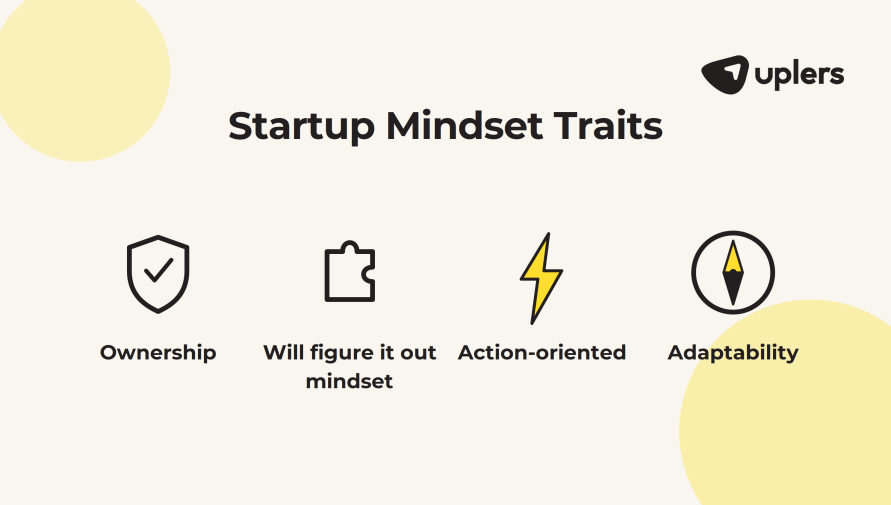
When you are trying to evaluate a startup mindset, you are essentially looking at certain behaviors, traits, and learning habits that predict success in uncertain, unpredictable, and dynamic environments.
What are some of the traits that separate a candidate that is fit for a startup from someone who is not fit for a startup? It is their mindset.
Now, here is what we mean, what traits to look for, and how to evaluate whether somebody is startup-ready or not. These are not foolproof methods but in our experience they have definitely helped bring out the good candidates to the front so we don’t spend a lot of energy on candidates who don’t fit the bill.
1. Ownership
Do they own things end-to-end or wash their hands off once their work is done?
- Resume: look for “I noticed X was broken and fixed it” type stories, not just “I did what my role said.” Harder to screen in resume but these kinds of phrases help filter.
- Interview: ask about a time they fixed something nobody asked them to fix. Ask them about a project they worked on and what exact steps were they accountable for? Ask them if they know the purpose of the project, what was the expected outcome of the project, whether it was achieved, and if not, then why not. These questions tell you their exact contribution.
- Practical test: give them a slightly open-ended task but something that is related to a similar problem in your industry/company. And see if they just do the minimum, or if they poke at the bigger problem behind it.
- After they join: do they flag or fix things outside their lane without being told to, in the first couple of months?
2. Will figure it out mindset
Paul Graham, co-founder of Y Combinato says: “Not merely relentless. That’s not enough to solve novel problems. You have to be resourceful… you don’t know whether you’re about to plow through a block of foam or granite.”
In plain terms: This trait is just: when they hit a wall, do they try another angle, or do they say “can’t be done” and stop?
Hard to screen in other parts of the hiring process so assess this in the interview.
- Interview: Give them a vague problem unrelated to the role/industry. See if they ask any clarifying questions. For instance, if you asked them to count the number of wheels in a city. Do they ask you if you mean just vehicles or does it also include wheels of luggage or a kick skate scooter etc.
3. Action-oriented
Amazon believes: “Speed matters in business. Many decisions and actions are reversible and do not need extensive study. We value calculated risk taking.”
In plain terms this just means: can they make a call with 70% of the information, instead of waiting weeks for 100%? In a startup, waiting for certainty usually means you lost the window.
Gauge this in practical tests and keep checking once they join too.
- Practical test: When given an assignment that is clocked, there is little time for candidates to go back and forth, see how they make assumptions and decisions there. The answer will be something like “here’s my call, here’s what I’d double check next,” not a perfectly hedged answer.
- After they join: do they ship a first version and improve it, or do they wait for SOPs and procedures and perfection? Perfection can kill a startup pace. See how they take feedback. Does it make them think “Wish I knew this before” or “Let’s change it now.” Startups are always a work-in-progress even when they scale.
4. Adaptability/Comfort with Ambiguity
Strong opinions won’t work in a startup. Things change fast. Experimentation is key. Also things change in a startup overnight, do they bend or do they break?
When the ground shifts like say, a new priority, new manager, new tool overnight, do they adjust, or does it throw them off for weeks?
- Interview: Hand the candidate one real, messy business problem and spend the whole interview watching how they think it through. Also, throw in a curveball (“what if X changes?”) midway to see if they adjust, or push back directly to see if they get defensive or actually reconsider. The idea is there’s no “right” answer, it’s a discussion, and how they handle being challenged tells you more than a correct answer would.
- Practical test: change one requirement in the middle of the test and see how they react. Nothing major, just give them some new info to work with.
Certain questions or things to look out for additionally are
- Does the candidate ask you about the overall business vision and the business goals? Or do they only care about their role?
- Have they built something on their own? Do they have an independent project to show something that they built and executed on their own? Maybe check their GitHub link and ask them questions related to that project in-depth.
- Ask them a question like, “How would they do a project they have already done differently if somebody asked them to do that again?” This opens up questions on the things that they have actually learned from the existing project and things that they will apply should they have to do the same thing again.
Conclusion
This is not a scientific framework to follow that will give you the most perfect candidates from your hiring process. Treat this as a filter so that you spend time on better candidates and can quickly filter out the noise. We have learned this after 5+ years of startup hiring so let us help you save time on it with these tips.