Snippet:
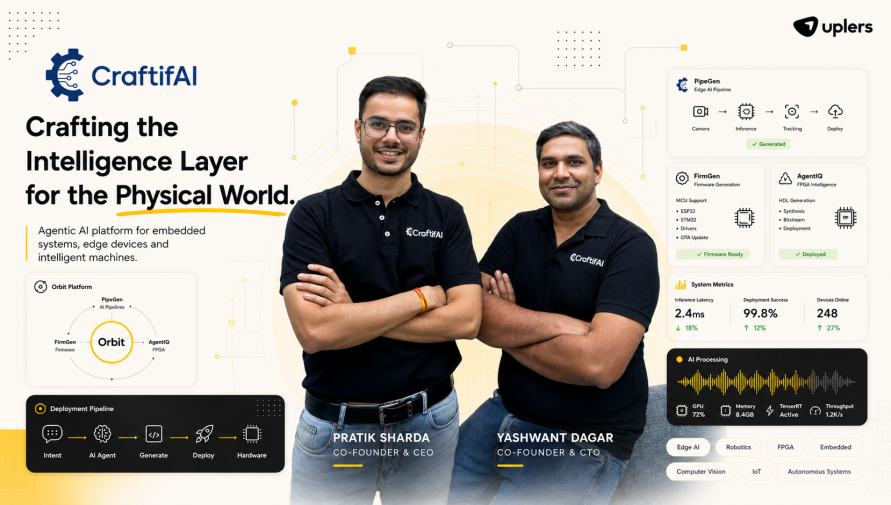
Pratik Sharda spent years at PhonePe leading the Payment devices product development and R&D programs, over twenty million devices deployed across India, a hundred-plus vendors, semiconductor suppliers across three continents. He learned what happens when a firmware doesn’t work or when chip goes out of stock: you don’t wait. You keep debugging the firmware at scale issues or end up rewriting the entire firmware stack for a different chip and try to make the launch window. He started CraftifAI with his engineering batchmate Yashwant Dagar, who had spent years at AMD (Xilinx) and Sima.ai seeing the same problem from inside the chip companies. Three products. $3M in seed funding, Ankur Capital led. And a spot on the RBR50 at the Boston Robotics Summit alongside Waymo.
In May 2026, the RBR50 Innovation Awards gala was held in Boston as part of the Boston Robotics Summit- one of the biggest robotics conferences globally, fifteen years running. The award recognizes the top technical innovations in the industry each year. The 2026 list included Waymo, Amazon. Names that have been in the room for a decade.
And CraftifAI, an twelve-month-old company from Bengaluru.

The answer starts at PhonePe.
The firmware that doesn’t work and the chip that ran out
Pratik led PhonePe’s payment devices program: the SoundBox, the Dynamic QR, the hardware in more than twenty million stores across India. He ran the R&D from the first prototype through distribution, working with Chinese manufacturers, over a hundred vendors, and directly with the semiconductor companies supplying the chips.
And he hit the same wall, repeatedly.
“When you can’t get the firmware running or not enough supply of one chip, your device is on the receiving end. You can’t launch.”
The standard response is to find an alternative chip. The cost most people don’t see: you relearn the entire software stack from scratch. Every chip vendor has its own toolchain. Switching chips means rebuilding the firmware, often with engineers who don’t know the new chip’s environment, at the exact moment a launch is already late.
“That’s the pain point no one was able to solve, across so many vendors in India, China, Southeast Asia. I realized it’s going to be a big opportunity.”
He started CraftifAI with Yashwant Dagar, his engineering college batchmate, someone he’s known for over twelve years. Yashwant had spent his career as a system architect at AMD (Xilinx) and Sima.ai, watching the same problem from inside the chip companies. When they reconnected, there wasn’t much to debate. “One looking at it from the tech side, one from the business side, we knew it was going to work.”
The 2.5 million gap
There are roughly fifty million software engineers in the world. About 2.5 million of them write code for physical hardware, the firmware and vision pipelines inside robots, IoT devices, drones, edge AI chips. In the next three to five years, the number of intelligent devices needing that software is expected to cross tens of billions.
“You don’t have enough people who can potentially make it operational,” Pratik says.
In most industries, AI replacing jobs is the concern. In embedded engineering, Pratik’s read is the opposite: there aren’t enough engineers for the physical AI era to run at scale. AI has to fill the gap. CraftifAI’s three tools automate the most time-consuming parts of the work across different classes of hardware, the vision systems in robots, the low-level firmware in IoT devices, and the programmable chips used in aerospace and defense. The common thread across all three: move from one chip to another without rebuilding the software from scratch.
The months that became days
A robotics company in India was building a warehouse pick-and-place robot. Six to eight engineers had been working on the vision system, the part that lets the robot see objects and respond, for nine to ten months. Still no production-quality build.
With CraftifAI’s platform, the same pipeline went from months to weeks. Then weeks to days. From a team of six to eight, to one or two.
A second case: a German company building consumer electronics. A year and a half into firmware development, still not shipped. CraftifAI ran a demonstration. Production-grade code, working on their hardware, within the timeline of a proof of concept.
These are the cases behind the customer feedback Ankur Capital cited in their investment thesis: tasks that took days now take minutes. Pratik can now explain the methodology behind that claim in specifics.
Enterprise before developer
CraftifAI’s closest direct competitor in firmware generation is a US-based startup with similar positioning. Pratik’s read on the difference is concrete.
CraftifAI went to enterprise customers before going to developers. The distinction matters: “We know what it takes to productionize code to the end deployment at the customer site. We know what production grade actually means.”
The second difference is breadth. When a robotics or drone company talks about software, they’re rarely asking about one layer. They want the full stack. CraftifAI covers the entire embedded architecture with the three different tools in a single conversation. A firmware-only product leaves the customer to assemble the rest.
Who builds this
Yashwant owns the full tech and R&D. Pratik owns the business and product. Twelve years of knowing each other from the same college means the split was clear before the company was.
The first hires came from IITs, given real problem statements, assessed on how they handled them. “Whatever problem we gave them, they were able to build on top of it.” PhDs in Machine Learning technology joined early, drawn by the problem area.
The Bengaluru embedded engineering pool is better than anywhere else in India, and still thin. After closing the $3M seed, filling the right roles took longer than expected. The embedded-plus-AI combination is rare enough that even with funding, closing those hires takes time.
The twelve-month-old company whose name appeared on a screen in Boston alongside Waymo isn’t the biggest player in the room. It’s building the part of the stack the room runs on. And the two founders have spent long enough inside the problem to know exactly which part of it has been broken for fifteen years.