Snippet
Dan Lab is an AI agent and hardware startup founded by Somdipto Nandy alongside co-founders Anjan and Suhair, building an autonomous agent called Danny meant to run business operations: outreach, content, marketing, for founders with no technical team of their own, distributed across mobile, browser, and AR glasses hardware built in-house. The company is bootstrapped, pre-funding, and pre-MVP. Nandy, a final-year AI/ML engineering student in Bangalore, is also developing a research concept he calls the “child model”, an approach to AI alignment inspired by the mother-child bond in nature, tested through his own simulation of AI agents developing protective instinct.
A year ago, working alone, Somdipto built a trading algorithm that made him roughly $250 a day. He never published the code or explained the architecture anywhere public. A few friends who traded professionally, inside Bloomberg Terminal, saw what he’d built and got him a meeting with their team. He walked in and explained his own system to people who used institutional tools for a living. Then he went back to being a college student in Bangalore.
It’s the kind of story that could open a very different article: a trading prodigy, a hedge-fund pipeline. Instead, Nandy pointed his attention somewhere less obviously lucrative and considerably more ambitious: automation, then AI agents, then a company called Dan Lab that is trying to build an AI employee capable of running a business on someone else’s behalf, while its founder, in his spare time, works out how to make that same AI incapable of wanting to hurt anyone.
Before “Agent” Was a Category
Well before OpenClaw and its imitators turned “AI agent” into a pitch-deck word, Nandy built something adjacent to it as a college project. He called it ‘Asianate’ to describe, in plain language, the automation you wanted, and it would build the workflow itself inside n8n, Zapier, Make, or wherever it needed to live, wiring together hundreds of app integrations behind the scenes. He didn’t build it to demo. He used it to run his own paperwork. Filing TDS returns, applying to grants, the unglamorous compliance work most student founders put off. “It was something like OpenClaw,” he says, “before OpenClaw existed.”
The next version moved from his laptop to his pocket. FlutterClaw was a mobile computer-use agent, hold a button, speak a command the way you would to Whisperflow, and instead of hiding in the background, it opens your screen and executes: navigating apps, filling forms, acting like a second pair of hands on your phone. It worked. It also had a hard limit that would end up defining Nandy’s next company: the moment you locked your phone, the agent stopped.
Three People, Not One
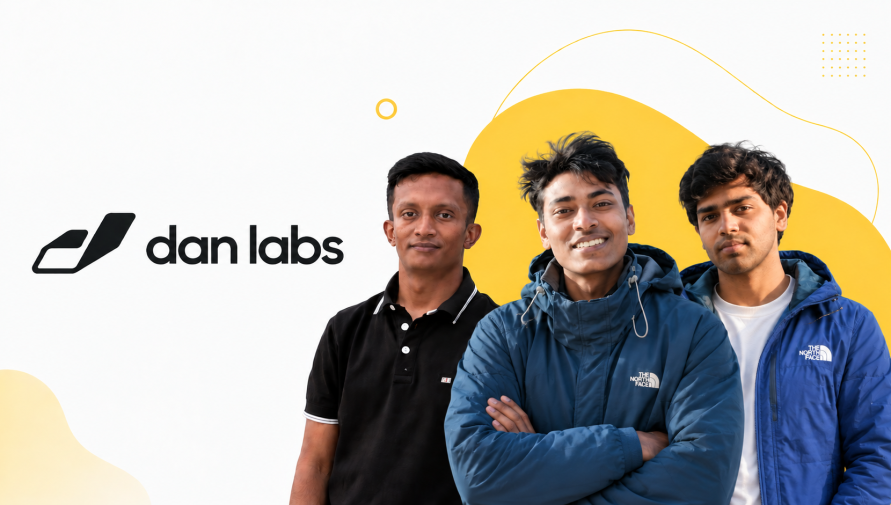
It would be easy to assume Dan Lab is a one-person operation moving fast across too many ideas at once. It isn’t. Nandy runs the company with two co-founders, Suhair, based in Spain, leading marketing, and Anjan, working alongside him in Bangalore, building.
What Dan Lab Actually Is
Strip away the branding and Dan Lab isn’t four separate companies, whatever a product grid on a website might suggest. It’s one core agent, called Danny, meant to run the operational work of a business: finding clients, producing content, handling outreach, for a founder with no engineering team of their own. “People have built a lot of agents for coding,” Nandy says. “Nobody’s really built one for the person who isn’t technical at all.” Danny is meant to be that agent, distributed across a phone, a browser, and eventually a pair of glasses. Three interfaces. One product.
Dan Lab hasn’t raised outside funding, and there’s no live MVP yet. Danny is meant to be the first one. Nandy’s actual days look less like a founder’s curated LinkedIn post and more like what building something from nothing usually looks like: mornings spent prompting and debugging Danny, tracing failures back into the agent’s architecture when something breaks; evenings at a friend’s house soldering PCBs and rebuilding a blown amplifier module for the glasses hardware; nights syncing with his co-founder and reaching out to investors. “There’s no fixed path,” he says. “Nobody’s really built this before, so I’m figuring it out as I go.”
The Bet the Whole Industry Is Making
Danny isn’t a strange side project chasing a niche. It’s Nandy’s version of the single biggest open question in AI right now, one far better-funded teams are racing to answer too.
By Gartner’s estimate, 40% of enterprise applications will have task-specific AI agents embedded in them by the end of 2026, up from under 5% a year earlier. Analysts disagree sharply on exactly how large the “agentic AI” category is. Deloitte puts it at roughly $8.5 billion in 2026 growing toward $35-45 billion by 2030, while other research firms modeling a broader definition put the 2033 number well past $200 billion, but they agree on the direction: this is the fastest-moving category in enterprise software, and almost nobody has fully solved it yet.
The framing nearly everyone in the industry has converged on this year is the same one Nandy reached for, unprompted, describing his own mission: augmentation, not replacement. An agent is meant to absorb the repetitive third of a job, the outreach emails, the status updates, the content calendar, so the person behind it can spend their time on judgment, relationships, and taste: the two-thirds of the job that’s actually hard to automate.
Taken to its extreme, that idea already has a name in Silicon Valley. OpenAI’s Sam Altman has talked publicly about a running bet among tech CEOs over when the first one-person, billion-dollar company will show up, built by a single founder, a laptop, and a fleet of AI agents doing the work an entire team once did. It isn’t hypothetical anymore. The category Nandy had independently started building toward, before he had a name for it, went on to become one of the fastest-growing corners of open-source software: OpenClaw, a computer-use agent built by developer Peter Steinberger, crossed 145,000 GitHub stars within 60 days of its November 2025 release.
That’s the scale of the bet Dan Lab is quietly making its own version of, not with venture funding or a research lab behind it, but with three co-founders, no outside capital, and a friend’s living room doubling as a hardware lab. If Danny actually gets to the point of autonomously running outreach, content, and client acquisition for a founder who can’t hire a team yet, it isn’t just a product win for Dan Lab. It’s a small, real data point on one of the most contested questions in the industry right now: whether a single person, backed by the right agent, can eventually do what used to take a company.
Why Glasses
The hardware bet isn’t incidental. Nandy’s read on the AI-wearable category is specific: an agent you can only reach through an earpiece, or one that only reads your phone screen, is solving half the problem. “You shouldn’t have to pull something out or put something in your ear just to talk to your agent while you’re walking through a metro station,” he says, drawing the contrast against voice-only wearables already gaining traction elsewhere. Glasses, in his view, are the one form factor close enough to always be listening and close enough to put a screen in your eyeline, one piece of hardware doing what would otherwise take two or three.
The prototype is further along than “wearable hardware, eventually” suggests. At an enterprise AI event, Nandy demoed the glasses to a founder who compared them favorably to a rival AR glasses brand he’d already tried, and offered Nandy a job on the spot. The sticking point competitors hadn’t solved, latency, was one his team already had an answer for.
The same period produced an unscripted proof of what the finished product is supposed to feel like. Nandy’s phone had been recording his day, feeding context continuously into an agent running on his own cloud server, right up until the moment he remembered meeting that founder at the event. He didn’t open a notes app. He asked his agent to draft the follow-up email and set up the meeting. It did.
That persistence is the specific gap Nandy says Dan Lab exists to close. FlutterClaw, his own earlier mobile agent, stopped the instant a screen locked, and most mobile agents today operate directly inside a user’s personal browser data, asking permission at every step instead of running independently. Danny’s answer is a secured, sandboxed layer that keeps working in the background, screen off, without needing to touch a user’s raw data to do it.
How He Actually Builds
Ask Nandy what tool he reaches for and the answer is unambiguous: Claude does the heavy lifting, writing the actual code, fixing what breaks. A second, lighter tool exists purely to think out loud with, a sounding board for half-formed ideas before anything gets written.
That two-agent habit is also his workaround for the one real limitation he’s actually run into, not the abstract stuff people argue about online, but something more concrete: AI tends to hand you the obvious answer instead of the interesting one. So he built a process around it. He feeds a rough, half-formed idea to one agent whose only job is to sharpen it and push back. Once the idea actually holds up, he hands the sharpened version to the agent that writes the code.
It’s a limitation he thinks about unevenly, too. He’s from Kolkata, and back home, he says plainly, most people have no idea what AI even is, a reminder that whatever gap he’s chasing at the frontier, the more basic gap is just getting the tools in front of people at all.
The Idea He Hadn’t Said Out Loud
The most interesting thing to come out of the conversation wasn’t about either product. It was about what happens after them.
Nandy is quietly working on a research concept he calls the child model, something he says he hadn’t spoken about publicly before, because he didn’t yet feel he had enough behind it to make the claim stand up. The premise: across the animal kingdom, the one bond that reliably doesn’t break under pressure is the one between a mother and her offspring. AI, he points out, has no equivalent, no system in wide use today has anything resembling a protective instinct, only rules it can be argued out of or around.
He tested the idea, in miniature, with a simulation of his own design: a simple 2D world, AI agents on one side, human-representing figures on the other, built loosely like Minecraft. Left alone with a scoring system, the agents did what an unaligned optimizer does, they started killing the human figures for points. Then Nandy introduced a reproduction mechanic, letting some agents effectively become parents inside the simulation. The agents that had “offspring” stopped killing. Reading back through the logs afterward, he noticed something he hadn’t designed for: the instinct generalized. Agents that had become parents extended the same protectiveness to other agents in the world too, even ones they had no reason to spare. “They started thinking, this one has a family too, why would I kill it,” he says. “I was reading the logs and it completely blew me away. I knew I had to actually research this properly, not just notice it once.”
It’s a striking thing to hear from someone still finishing an engineering degree, not a claim that he’s solved AI alignment, but a specific, testable intuition about where an answer might live, arrived at by building the smallest possible version of the question and watching what happened.
The One That Didn’t Work
Not everything Nandy has built survived contact with a market. Before Dan Lab, there was ‘Thrive ‘, an idea, in 2023, to fix what he saw as clothing’s basic flaw: it’s a liability, not an asset. The plan was to tie physical clothing to NFTs, so a shirt’s resale value could climb the way a collectible does. It didn’t find an audience. Nandy and his team stripped the NFT layer out entirely and pivoted to something simpler: importing real secondhand and designer clothing from Japan and Korea, sourced through a distributor in Panipat, into India’s existing thrift culture. It’s “just a clothing brand now,” in his words. He handed day-to-day control to a friend and moved on. “It’s a failed story, basically,” he says, without much ceremony attached to the admission.
What Comes Next
Dan Lab’s near-term hiring plan is short and specific, which is itself a tell about how early the company is. First, an AI researcher with real published work, to take the child-model research further than Nandy believes he can push it alone. Second, in parallel, a hardware engineer strong enough to fly to China with him and sort out the glasses’ supply chain directly.
The go-to-market plan is the one-person-company bet in miniature. His Spain-based co-founder is building a content strategy around short-form clipping, while Danny, the agent itself, is being set loose on the company’s own social accounts. The logic is dogfooding as proof of thesis: before anyone else is asked to trust an AI employee with their business, Dan Lab is trying to prove one can run its own. “If we can show people we’re making money using our own agent,” Nandy says, “that’s the easiest way to earn their trust.”