Snippet:
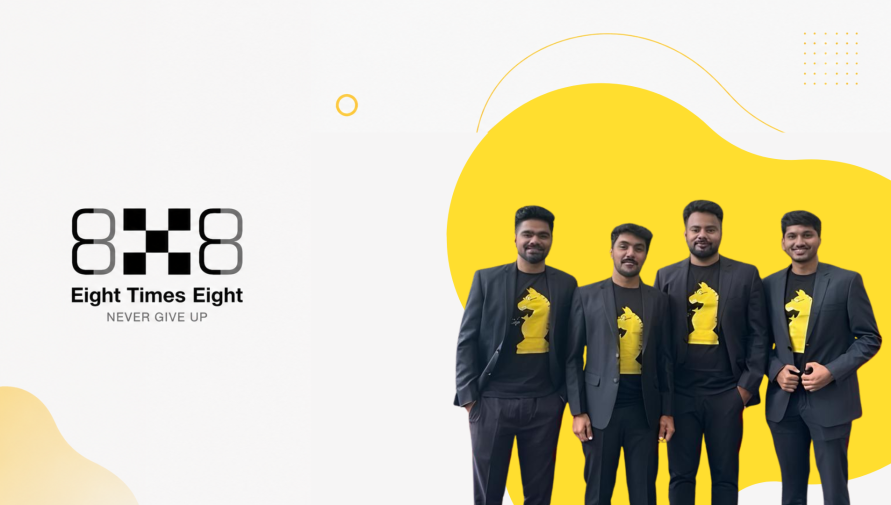
Arijith Mohan and three co-founders: Athul Krishna, Adesh Joshi, and Abhijith M; all international-level chess players who first met competing on the Kerala circuit as children, built Eight Times Eight in Kochi to solve a problem they watched get worse every year: shrinking attention spans and rising screen addiction in children. With a syllabus designed by Grandmaster S.L. Narayanan, 45 FIDE-rated trainers, and 90 percent monthly student retention, they have trained 5,000 students across 30 countries, closed FY26 at ₹2.7 crore, and appeared on Shark Tank India Season 5.
As kids on the Kerala chess circuit, being in the same group as your closest friends created a specific problem.
Whoever won between them decided the championship.
Arijith, Athul, Adesh, and Abhijith sat across boards from each other at district, state, and national tournaments from the age of seven. They traveled together across India for competitions. They were in the same squad at Delhi, two of them at Sri Ram College, another at Campus Law Centre. At some point in every tournament, one of them had to lose for another to advance.
They were rivals before they were co-founders.
The Cousin, the Algorithm, and a Chess Board
The idea did not come from a strategy session.
Athul’s cousin was struggling with Instagram addiction and a shortened attention span: the specific problem that became every Indian parent’s anxiety in 2020. Athul started teaching her chess.
That conversation, in a group chat during lockdown, became something else.
“We just started it randomly. It was COVID, we were not doing a lot of things. So we started it as a source of pocket money at that point.”
The feedback changed the math. Parents kept coming back. Students kept improving.
The problem they are actually solving
Most chess academies teach chess. Eight Times Eight is trying to do something different.
The real problem is not that children lack access to chess coaching. The real problem is what screens are doing to children’s ability to focus, sit still, and think in sequences. At this day and age, keeping children completely away from screens is not realistic. The question is whether that screen time can become skill time.
Chess, taught with structure and consistency, is their answer. Memory tests and pattern recognition assessments run alongside every class. The goal is not to produce grandmasters. It is to build the cognitive tools: focus, sequential thinking, delayed gratification; that carry into everything else a child does.
What makes Eight Times Eight different from other chess academies is how seriously they take the curriculum. They brought in Grandmaster S.L. Narayanan; Abhijith’s childhood friend and one of India’s top-rated chess players; to build the syllabus from the ground up. Graded, sequential, built for children across age groups. Not just coaching, but a properly designed learning progression.
Students who have come through include Advait Sankar from Florida, who earned the National Master title in the USA. Aaranya R from Tamil Nadu became the National Under-7 Chess Champion. Theertha Jotish became a Kerala state champion.
Shark Tank
On February 11, 2026, four founders from Kochi walked onto the Shark Tank India Season 5 stage.
They asked for ₹50 lakhs for 5 percent equity. To demonstrate what structured chess coaching does to a child’s focus, one of their own team members played a game blindfolded — live on national television.
It was the kind of product demonstration no deck can replicate.
The appearance put Eight Times Eight in front of an audience that most edtech startups spend years trying to reach. For a Kochi-based academy that built its entire customer base through referrals, the national stage was a different kind of validation.
The Year Everything Changed
In December 2024, D. Gukesh became the youngest World Chess Champion in history.
Praggnanandhaa Rameshbabu broke into the world top 10. Divya Deshmukh won the FIDE World Cup. In one year, Indian chess produced more elite achievement than it had in the previous decade.
Eight Times Eight closed FY26 at ₹2.7 crore.
Arijith separates the two things honestly. The Gukesh wave brought more aware parents. “Our target market has increased.” But three years of improving their retention systems and product also happened in that window. The demand arrived at a platform that knew how to hold it.
The biggest international market is not the United States. It is GCC — UAE, Qatar, Saudi Arabia, Oman. The Indian diaspora across the Gulf is currently the largest source of families sending children to Eight Times Eight.
Monthly retention is 90 percent. When a subscription period ends, 65 to 70 percent of students renew. The company is cash-flow positive on ₹35 lakhs of raised capital.
Who They Look For
Forty-five FIDE-rated trainers do not come from a job board.
Almost all arrived through referrals: from the founders’ competitive chess network, through GM Narayanan’s connections, and from trainers who joined and referred others in. Before anyone joins, they complete a four-step hiring process. Quality checks run continuously after.
A high FIDE rating tells you how someone plays chess. It does not tell you how they hold the attention of a seven-year-old in a 40-minute online class. That is the filter.

Where this goes
Chess is the entry point, not the destination.
The bigger goal is to become a one-stop solution for all skill development activities for children, a platform where chess is the first step in a broader system designed to build focus, discipline, and cognitive capability across different skills and disciplines. Screen time converted to skill time, at scale, across a range of what children can learn.

They were rivals on the board once, sitting across from each other since they were seven years old. They are still playing together. Just on a different kind of board, and this time nobody has to lose for the others to win.