Snippet
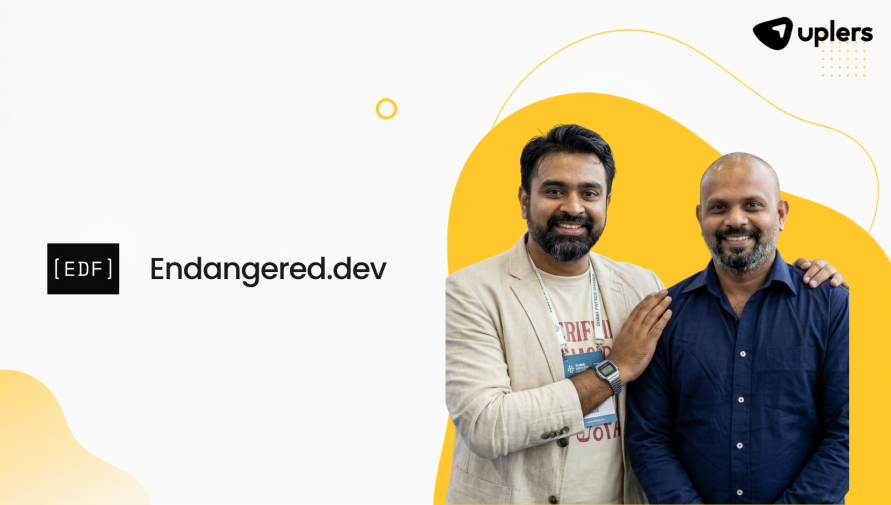
Mahboob Imtiyaz, founder of Endanger Developers Foundation and Sprintors, is building a community of developers to help traditional software engineers move beyond standard development work as AI makes it increasingly obsolete. A life sciences graduate who became a developer out of necessity while working on research bottlenecks, he has built ventures with his college buddy Gautham N across furniture tech, blockchain, decentralized science, and developer relations since 2012, and now runs offline think tanks, job fairs, and cross-country hackathons to show displaced developers what comes next.
AI Throttled the Development Services
Mahboob Imtiyaz, like many in Bangalore, had been running a development services company, taking projects from clients, hiring people across India and the world to work across multiple tech stacks. He noticed the demand for software services die in realtime, and noticed the same thing happen to other dev shops around him.
“Development has become cheap right now. Anybody who wants to develop a product can develop it in less than two weeks or three weeks’ time and even publish it. It no longer is the bottleneck it earlier was”
The network and clients stopped calling and instead started building themselves, (they did call when they got stuck). The skills that came after were for community building, marketing, product direction, etc were more in demand than ever. But most developers had spent years building exactly one type of skill: Development.
That observation became the Endangerd Developers Foundation.
The Background Behind the Naming
“Development as a career is dying and developers themselves are endangered right now.”
Mahboob chose the name deliberately. The Indian education system pushed an entire generation toward software development as the safe path. Biotech graduates, engineering students, everyone; the assumption was that learning to code meant having a career. AI is dismantling that assumption faster than anyone anticipated.
Endanger Devs is not an upskilling platform in the traditional sense. It does not train developers to get slightly better at the same thing they already do. The idea is to show them what else exists: augmented reality development, marketing, robotics, hardware, AI tools, and fields nobody thought to point toward before.
“It’s regrouping things. People need to look beyond what they have essentially been doing.”
The community currently has 10,000-plus developers. Offline meetups in Bangalore run to about 30 people, designed as think tanks rather than lectures. Events have spread through the network to Cairo, Singapore, and Kuala Lumpur, organized by volunteers who feel connected to what is happening to their peers. A job fair, running through co-working spaces in Bangalore, targets displaced developers specifically.
The next phase is cohorts with companies like Spectacle, the AR glasses company, so developers can build applications for hardware that is actually shipping. NVIDIA and Anthropic are conversations in progress. A planned permanent incubation space would give developers somewhere to build their own ideas and get help marketing them.
Everything is bootstrapped.
A life scientist who became a developer by accident
Mahboob did not start in software. He came out of life sciences, noticed the broken incentives of academic publishing immediately, and in 2011 built the Journal of Errology, a research journal to publish proven negative hypotheses, which would otherwise end up wasting more researcher time and money.
The journal gave him a chance to be invited to talk at an event at Google’s Mountain View campus in Silicon Valley. While there he spent most of his time visiting Stanford University and Berkeley, trying to convince researchers to publish their invalidated hypotheses. Silicon valley was an incredible place, everyone had ideas, that time development was the biggest hurdle, which led him to setup a development services firm in India and provide services to startups that desperately needed them. This eventually meant he had to learn to talk like a developer and as time went on he was a developer himself.
Six months in, the journal had to be shut down. “Whenever I used to go to talk to researchers, they used to take me to these huge dusty storage spaces where all their old lab notebooks were saved. And they said they don’t have any incentive or time to publish failed experiments.” The publish or perish model of academic research, gave little space for mistakes.
Mahboob realized one thing, if the research bottlenecks need to be resolved, they had to be done from the ground up, and targeting a single issue in research will not fix anything: Thus UnblockResearch.com (that’s a story for a different blog)
In 2014 he set up a co-working space, discovered that sourcing furniture for it was a nightmare, and built Zraya, a 3D customization platform for B2B furniture orders, end-to-end automated from order to delivery. He ran it for nearly five years until its acquisition talks began. Alongside that, he was a founding engineer at GetVentive.com in the US, working on dozens of applications. From 2017, most of his software development projects were in blockchain and web3: prominent among them were Fiduciary, a financial identity system of RWA tokenization, Folioex: riskfree crypto SIPs app, among many others. Most of them did well during the crypto bull run, but ended up drying up during the bear market. The pattern across all of it: broken systems, and solutions the existing infrastructure had no category for.
The Lion’s Protocol
Alongside Endanger Developers, Mahboob is building Sprinters, a different answer to the same problem.
“The lion only starts hunting when he’s hungry. Otherwise he just rests, he does whatever he wants. That’s what we are calling the Lion’s Protocol.”
Sprintors.com is a model for focused, short-term future of work. A developer or anyone who needs work takes a project that could span from anywhere between one to six months, works in-person with complete focus, delivers, and steps back. The client gets phenomenal and inspired output. The sprintor at this point gets paid, then has time to automate, build, or rest. No 40-year career. No performance reviews for a role that will not exist.
“People no longer want to work 40 years on the same job to retire and then try to look to see if they have any hobbies left.”
Endanger Developers and Sprintors together are an attempt to anticipate where work is going, nomadic, focused, flexible, and build the infrastructure for it before the people who need it run out of options.
Who he is building with
The full-time team is Mahboob and his partner Gautham, who manages content and day-to-day operations. What he looks for in people: the ability to focus entirely on one thing at a time. “If you’re working on one thing, just focus on that thing entirely.”
He is the first to admit it is the opposite of how he personally operates, across Endanger Developers, Sprinters, Unblock Research (a decentralized science platform), Folio X (a fintech application awaiting regulatory approval in India), and Lab Critics, a life science blog evolving into a lab equipment management platform.
He is building Sprintors partly for himself.
The work is early. The mission is not.