
Snippet:
Paras Rajput and his co-founder Vedant Kumar built a fintech that 40,000 flatmate groups loved, until a change in RBI rules switched it off. The product wasn’t broken; the users hadn’t left. What the two IIT engineers did next is a lesson in finding the side door when the front one is locked.
Sometime after Y Combinator, after 40,000 flatmate groups were running their shared money through the app, a change in RBI rules quietly switched off the thing Shelf was built on.
The product hadn’t failed. “The reason was RBI,” Paras Rajput says. “Not that it wasn’t working. Not that people weren’t loving it. Not that it wasn’t making money.” The regulator now required a company to hold its own banking or PPI license to run UPI within an app, and Shelf, built on co-branded bank accounts, didn’t have its own banking license. So they paused.
Most founders, handed that, start grieving the product. Paras and his co-founder Vedant asked the more useful question: if the users still want us, and only the regulator made us stop, where do these same people hurt next? That instinct, follow the user, not the product is the one worth stealing from this story.
It started at their own kitchen table
Paras and Vedant met at IIT Roorkee, same branch, same hostel, and had been building things together for years. They graduated in 2021, took jobs, banked a year of salary as runway, and quit. The first idea came from their own flat in Mumbai, where four of them argued every month about who’d overpaid. It couldn’t be that everyone had overspent, so where was the money going? Nowhere mysterious. They just weren’t tracking it. They pooled everything into one shared Paytm account, the hack worked, and that idea turned it into Shelf: a shared wallet with its own UPI and card.
YC took them into the S22 batch; they moved to Bengaluru; 40,000 flatmate groups came aboard.
The habit that mattered most, though, wasn’t the product. It was that they kept calling users and circling back weeks later; last time you said you were trying to move flats, what happened? The answer never changed: still looking, still a nightmare. They were quietly collecting a problem long before they’d need one.
When the front door is locked, find the side door
When Shelf paused, that problem was waiting. Finding a flat and a flatmate you could actually live with, was sharper and more universal than splitting a grocery bill, and nobody had properly solved it yet for the single open room in a shared flat without a broker skimming a month’s rent on the way in.
Here’s where the thinking gets interesting. Most founders would start by interviewing brokers and scraping listing sites. The easy, visible sources. Paras and Vedant did the opposite. They went hunting for the people the system keeps out of reach. They became brokers themselves. They took a flat off an owner and rented it out hands-on. They rode flat-hunters to viewings on the back of their scooters, wearing every role in the market, tenant to owner to broker, until they could see the problem from each seat.
They cracked multiple non-scalable hacks to reach out to the bachelors or flatmates: the people who hold the real truth about a building, but who sit behind locked society gates and suspicious watchmen. So they engineered their way in. They’d chat up the guard, sneak a glance at his register for a name and flat number, then knock, floor by floor. They learned to read a building from its parking lot. They picked leads off café and chai-stall tables, keeping it deliberately casual, because the second you sound like a salesman on someone’s chai break, the conversation dies. None of it scaled. All of it taught them things no dashboard ever would.
It also demolished their founding assumption. They’d arrived believing brokers were an efficiency problem that AI could fix. The ground told them otherwise. “These folks don’t want to become efficient,” Paras says. A broker’s math is fixed: a hundred leads or four hundred, he still closes the same two. It is very difficult to optimize someone who has no wish to be optimized. The takeaway wasn’t to build better tools for brokers. The broker was never the customer: so they cut him out of the picture entirely.
AI runs the marketplace. Shoe leather built it.
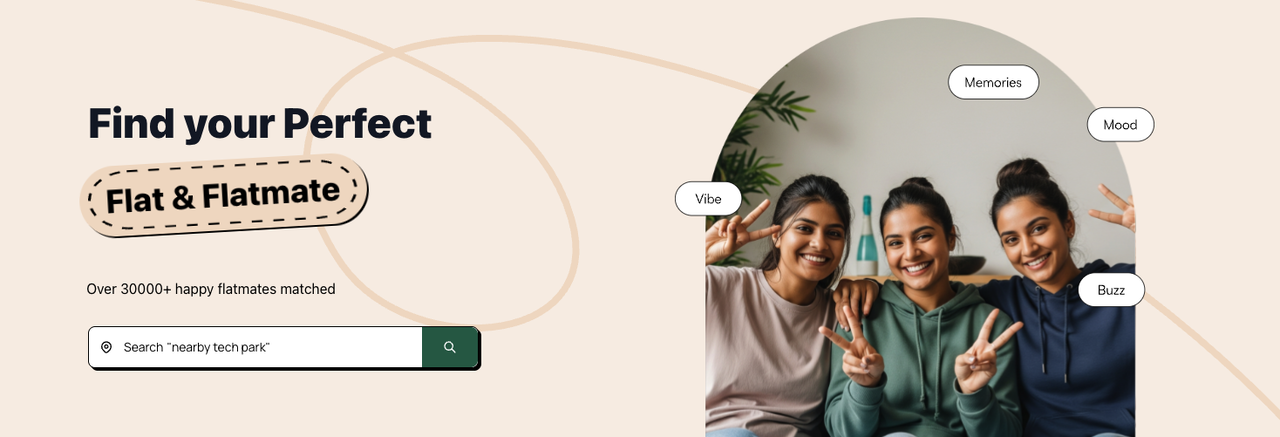
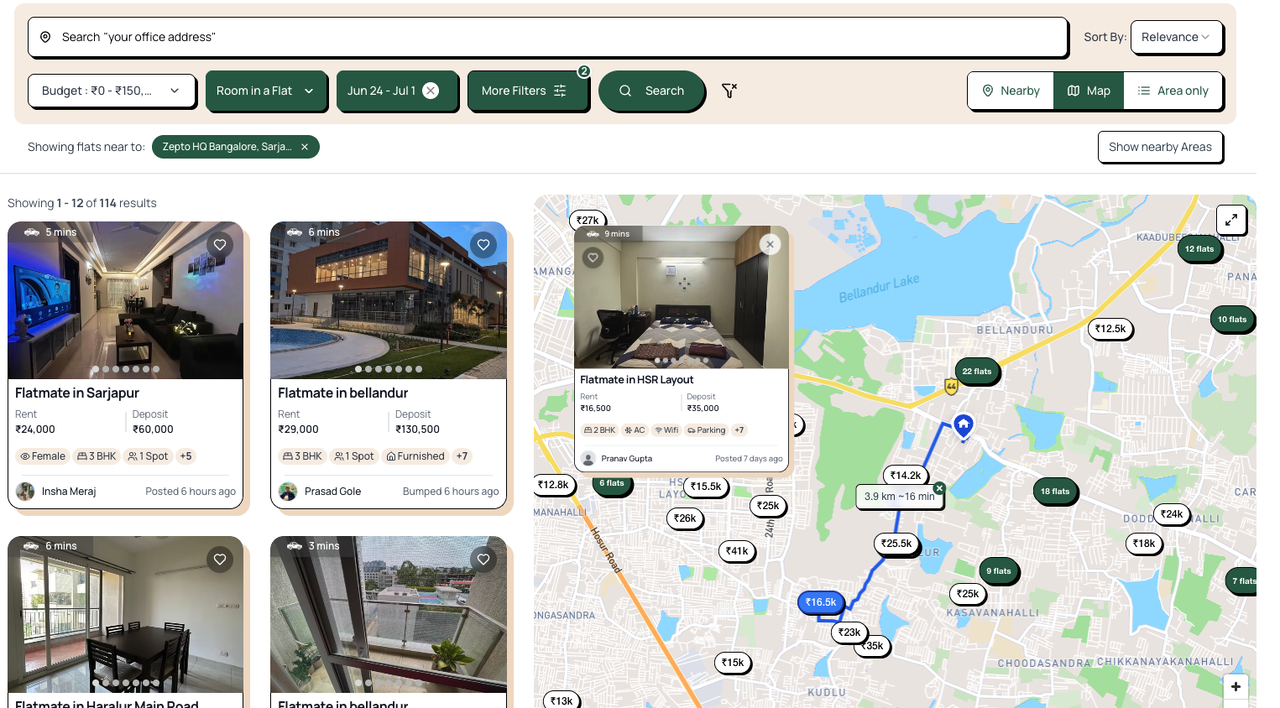
What came out of all that door-knocking is FlatX: a marketplace for no-brokerage flats and flatmates, where you filter on how people actually live: veg or not, smoker or not, a party house or a quiet one. Within a year it was carrying more than 6,000 new listings every month, upto 250 new flats a day, by his account one of Bengaluru’s largest no-broker inventories.
AI does the heavy lifting now: it writes the summaries, runs the compatibility matching, and every month rejects some 30,000 attempts by brokers to sneak back in “a battlefield,” he calls it. The whole thing runs on two founders, one engineer, and a bench of interns. Users average fifty-six minutes a day inside it.
The label says “AI-powered,” and it’s true. But the moat isn’t the model. Plenty of better-funded platforms have AI too.
The moat is that two engineers were willing to read a watchman’s register and ferry strangers to viewings on a scooter, the unscalable work no one else will touch. The AI only scaled what the shoe leather discovered.
Standalone warriors
The same bias, toward people who’ll do the hard, unglamorous thing, shows up in who they hire. They learned it the expensive way: on a small team, a bad hire doesn’t just underperform, it drags everyone and becomes your accountability. So for the first fifteen people, they trust the early read: two calls in, if the vibe is wrong, they pass.
The tells are specific. They look beyond intelligence and credentials. They look for honesty, independence and evidence that someone can take responsibility without waiting for constant instructions.

Above raw intelligence, he screens for honesty. And once you’re in, the grilling flips to grooming: no narrow tasks, always the whole arc, the purpose, where it leads, so people can argue back and own it. It works best on the overlooked.
Their first full-time hire was a converted intern; another turned down a forced campus placement just to stay.
What he won’t compete on
For two engineers who run a company “on AI to the fullest,” the punchline is almost contrarian: their real edge came from the part that couldn’t be automated.
Paras won’t compete on price, either. “People shouldn’t value us because we’re cheap,” so they raised the price to check the product’s quality and value. he says. “They should value us because we’re really good.”
The unit economics are already positive; a raise and an expansion into seven more cities are coming, one city at a time, because he refuses to break what’s working by growing too fast. And Shelf isn’t dead: Shelf also remains an important part of the story, not necessarily as a product being restarted tomorrow, but as the foundation for everything FlatX understands about young renters.
The longer-term goal is to make FlatX the full-stack rental platform for urban renters, covering the entire journey from discovery and connecting with listers to property visits, deal closure and move-in.
It’s the same move as day one. The regulator took the product. It never took the people. He just got on a scooter and went to find what they needed next.