Snippet:
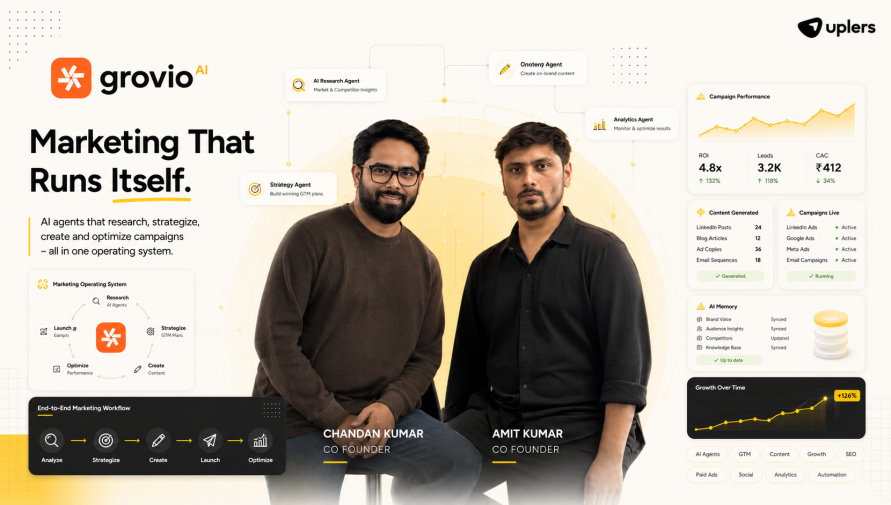
Chandan Kumar and Amit Kumar met at a community event in 2016. Chandan lived in Delhi and Amit in Pune, and spent six years doing small projects together before deciding to build something. What they built first wasn’t Grovio. The current product is the fourth or fifth version of the idea, and it took a complete exit from Web3, a market they found too small, to find where the problem actually lived.
Two of Grovio’s earliest customers are in their third month of paying. Each used to spend ₹50,000-60,000 a month on a marketing agency, limited creatives, a team of people managing platforms they could have managed faster. With Grovio, they spend ₹5,000-6,000. They’re producing two to three times the content. Engagement has doubled. One has grown from 2,000 to 1000000 followers.
Those are the numbers. The story is how it took four versions of the product to get there.
The fourth idea
Chandan was in Delhi. Amit was in Pune. They met at a community event in 2016, stayed in touch, collaborated on projects on and off, and in 2022 decided to build a company.
The first idea wasn’t an AI marketing OS. It was a community management tool for Discord and Telegram. Amit had spent years building communities for brands, events, activations, and engagement on the platforms where digital communities lived. The pitch was simple: give brands a product to manage all of it. It turned out to be a Web3 pitch.
In Web3, community is the product. You build the community before you have anything else, before the whitepaper, before the token, and often before the technology itself. The community tool resonated there immediately. But Web3 had a ceiling. “The market is pretty small,” Amit says. “Companies are either closing down or not able to launch tokens.” The platforms built on X APIs were being wiped out. The VC advisors they were speaking to, crypto-native funds who understood the space, kept asking the same question: why are you limiting yourself to Web3 when the whole market needs this?
Eight months ago, Chandan and Amit moved completely. Web2, all of it. The third co-founder & CTO, Akbar Sha , who owns product development, rebuilt with them.
What emerged across four or five iterations was a product built for a specific kind of company: too small to have a proper marketing team, too serious to ignore marketing. D2C brands, SaaS companies, and businesses with ten to twelve people that either hire an intern or outsource to an agency, and get limited output for high cost. That’s where the economics broke and where Grovio found its case study.
The loop
The question Grovio gets most often is whether it’s a wrapper. A wrapper, Chandan explains, is a five-step workflow with an API in front of it. Input, output, done. You still manage it, still prompt it, still decide what comes next.
Grovio is built as a system. The difference is the loop.
It starts with social listening: 24/7 monitoring of what’s being said about a brand, its competitors, and its category across every platform, including Reddit. That listening data feeds strategy. When Grovio generates content, it isn’t starting from a blank prompt. It already knows what topics are gaining traction, what the audience is talking about, what competitors are posting. The content it produces; images, videos, captions, the full creative package, is built on top of that first-party data.
After it posts, the loop continues. It watches what worked. One post got three times the engagement of the others. Why? Was it the headline? The hook? The format? Grovio tracks those variables and feeds them into the next round of content creation.

The other part of the wrapper distinction is prompting. Most AI tools require detailed prompts to produce useful output. Grovio is designed for 80% less prompting. You approve, you click, it runs. The system is built for the founder or marketing manager who doesn’t want to become a prompt engineer.
The next three months: unified inbox (all DMs and comments from every platform in one place), paid media (Shopify integration for cart-abandonment campaigns is already done), and the remaining pieces of organic social. After that: SEO and AEO. Then CRM and outbound. The long-term bet is on owning the entire GTM funnel. You tell Grovio you need ten leads in seven days, and the system works out how many to pull from organic, how many from paid, and which channels contribute which share. You review. It executes.
Building the operating system
Chandan writes a blog called The Autonomous Marketer. Weekly series: whatever he learned that week goes into a piece. He’s done industry research for FinTech, D2C, SaaS, and EdTech; spent four or five years in the EdTech boom when Byju’s and others were at their peak; and been the person companies entering India came to for market context. He’s direct about why the blog exists: writing it forces him to learn something worth writing about before publishing. He has not, he clarified on call, written a book. Not yet.
“Like Salesforce did for CRM, or HubSpot did for inbound,” Chandan says of the long-term vision, “we want to build the system for the newer age of companies.”
“AI Marketing OS” is a deliberate category choice. “OS” has survived every era of computing: DOS, Windows, iOS. The founders are betting it maps cleanly to what they’re building: infrastructure that runs underneath everything else, that everything else connects to, and that gets more capable the longer it runs.
Grovio is in the NVIDIA Inception program, benefits are real if modest at this stage: free cloud credits, GPU access, learning resources for engineers. NVIDIA invited them to its event in Taiwan. The team couldn’t make the trip. “Once we stand out, they definitely see,” Chandan says of the VC network NVIDIA monitors through the program.
On funding: We are bootstrapping ourselves so far; Now we have started our conversation, for seed round Amit describes the first week of real pitching as “lots of insights coming.” Marketing’s specific workflows, learning loops, and integrations are a 0.001% slice of that surface area. General intelligence is infrastructure. Grovio is an application built on top of it.
The product thinker, not the coder
Ninety-five percent of Grovio’s hires are engineers. Marketing and sales, Chandan and Amit handle themselves. The profile they hire for isn’t a technical checklist.
“Not just a coder-coder,” Chandan says. “A product thinker.”
The reason: 50-60% of the code written at Grovio is already done by AI. What engineers actually need to do is understand how systems work, make architectural decisions, build the development process, then use AI to move fast. The hire who succeeds is someone who can think through what a feature should do, build it, and know whether it worked.
Amit adds the other filter: speed. Build, rebuild, observe, quickly. A campaign that used to take three days should take an hour. The team runs the same loop.

Four iterations to get to the current product. A complete pivot from Web3 to Web2. A blog that gets published only when the author has genuinely learned something that week. The learn-and-unlearn frame is everywhere in how they talk about the company, the product, the category, the team.