
Snippet
Bradley Jacobs founded Mylance in 2020 as a LinkedIn content platform for B2B founders, fractional executives, and independent consultants, after several years of running his own solo consulting practice post-Uber. The company went through multiple early iterations, a coaching program, a bookkeeping line, an invoicing tool, a marketplace, a community, before AI made it possible to build the product Bradley had actually been trying to build the whole time. Bradley runs the company as a solo founder with a four-person team, and is an outspoken advocate for pursuing your interests and building your own company, rather than being miserable at your W2 job that probably doesn’t need you anyways
When Bradley Jacobs left Uber, he had no business plan. What he had was a conviction that he wanted to build something, and a track record of launching markets that he suspected someone, somewhere, would pay for.
He wanted to see if he could offer his experience part-time while he figured out what company he wanted to build. He messaged twelve companies directly and offered to help part-time, here’s what I did at Uber, here’s what that might look like for you.
Eleven never got back to him, or said no outright.
The twelfth said: “tell us more.”
That single reply became a proposal, then a contract, then twenty-five hours a week of consulting work for $25k / month that immediately paid him more than his old job had. It was the first evidence for something he’d only suspected, that there was real, standalone value in the specific thing he knew how to do, detached from any employer’s org chart.
The Practice That Became a Question
For the next two years, consulting was the whole business. He picked up clients, did the work, and got very good at being the expert in a room he’d walked into as an outsider. It was flexible. It was lucrative enough to live on comfortably. And it was, by his own account, an education in a completely different way of working than anything a W-2 job had taught him.
The entire time, he was writing about it publicly on LinkedIn. What he was learning. Where he’d gotten it wrong with a client. How a particular engagement was actually structured, warts included.
People started reaching out, people who wanted to know how he’d built this life for himself. He got on calls with them, unpaid, just talking through what he’d figured out.
Somewhere in the accumulation of those calls, the real idea surfaced. He wasn’t just an independent consultant anymore. He was standing at the edge of a much bigger shift. More people were going to want to work this way, on their own terms, monetizing what they actually knew, and almost nobody was building the infrastructure to support them.
That recognition, in 2020, became Mylance.
Five Wrong Shapes Before the Right One
The version of Mylance that exists today is not the version Bradley started with. Not close.
Across six years, the company took the shape of a coaching program, then a bookkeeping service, then an invoicing tool, then a turn-key landing page for consultants, then a marketplace, then a community. Each one solved a real piece of the independent-consultant problem. None of them was the whole answer, and he built and dismantled each one when the evidence said so.
It would be easy to describe this as a strategic iteration. It’s more honest to call it what early founders actually live through: building something, watching it plateau or fail to click, and starting again with slightly better information: for years, without the comfort of knowing the fifth attempt would be the one that worked.
The one thread that survived every version was the writing. He never stopped publishing on LinkedIn, on his blog. He eventually started a podcast and showed up weekly no matter how many listeners he got. And every incarnation of the business, however different, was fed by the same audience he’d been building post by post since the consulting days.
What Changed the Shape of the Problem
The breakthrough wasn’t a new market insight. It was a new set of tools.
As AI models became genuinely capable writers, Bradley saw the piece he’d been missing across five earlier attempts: the hard part was never publishing more content. It was helping people say the right thing in the first place and actually show up online. Most of his consulting clients, and most of the strangers who’d called him over the years, weren’t short on expertise. They were unable to see their own value clearly enough to write about it well.
That is the problem Mylance exists to solve now, not “post more,” but “know what you’re actually saying, and say it like yourself.”
Why the Product Starts With a Conversation, Not a Prompt
Before any content gets generated, Bradley personally gets on a call with every new user. He pulls apart their positioning, pushes them to go narrower than they want to, and gets specific about their buyer, their differentiation, the pain they actually solve.
He’s blunt about why this step can’t be skipped.
“Almost nobody has their own positioning figured out, and it’s not a competence issue. You can sharpen someone else’s story in twenty minutes. Your own, you’ll struggle for years. The tool is only ever as sharp as what you feed it, and what most people can feed it, unprompted, is vague and misdirected.”
He knows this doesn’t scale as a personal habit forever, and he’s already decided not to fix that yet.
“It’s not a hard role to eventually hire for. I keep doing it myself for now because the person I’ve spent thirty minutes with is the one who tells me the truth about what’s working and what isn’t, weeks later. It’s about building a relationship with the customer, getting feedback from their honest opinion and experience. That’s worth more to me right now than my time back.”
Not a Wrapper, but An Orchestra
Ask Bradley whether Mylance is “just a AI wrapper,” and he’ll walk you through why that framing misses what actually took years to build.
The system runs natively across multiple AI models, different ones handling different jobs, because in his experience the models simply aren’t interchangeable. One is better at drafting. Another is better suited to generating ideas. Another handles imagery. As the underlying models change, so does which one does which job.
Layered on top of that is the part that took the longest to get right: a voice profile, explicit writing rules, a running list of words to use and avoid, all tuned to sound like the person, not like a template. Every draft then passes through a review step before a user ever sees it, evaluated for how strong the hook is, whether the storytelling actually pulls someone in, and flagged line-by-line for anything that reads more artificial than human. It’s not just their writing, it’s their writing customized for the LinkedIn algorithm.
The most quietly impressive design decision, though, is about time. Anyone who’s used an AI tool for a few months has felt the drift, sharp in week one, generic by week eight, because each new output is generated from the last one. Bradley built against that on purpose: every new batch of ideas is regenerated from the original positioning and everything published since, not from the previous batch of outputs.
Where Things Stand Now
Mylance today is a lean, still-growing company, run almost entirely on Bradley’s own judgment about what to build next. He’s thinking about extending the same positioning-first approach into other written formats; newsletters, blog posts, reformatting a LinkedIn post for X, even the recurring request from users who want help writing a book.
Bradley runs Mylance with four people total: himself, an assistant based in Colombia, a chief of staff, and a developer. No co-founder.
He found them the unglamorous way most early teams get built, an agency placement for the assistant, a Upwork hire for the chief of staff, LinkedIn and his own network for the rest. Nothing about the sourcing was systematic. What is systematic is how the work gets divided once someone joins.
“Everyone knows exactly what they own, and their job is to make that piece of the business better, not to vaguely help out. That clarity is what makes four people function like a much bigger team.”
One Post at a Time
Nothing about Mylance’s origin was fast. Eleven rejections before a single yes. Five different products before the right one. Six years of showing up publicly before any of it compounded into something durable.
Bradley Jacobs would tell you that’s not a bug in the story, it’s the entire mechanism.
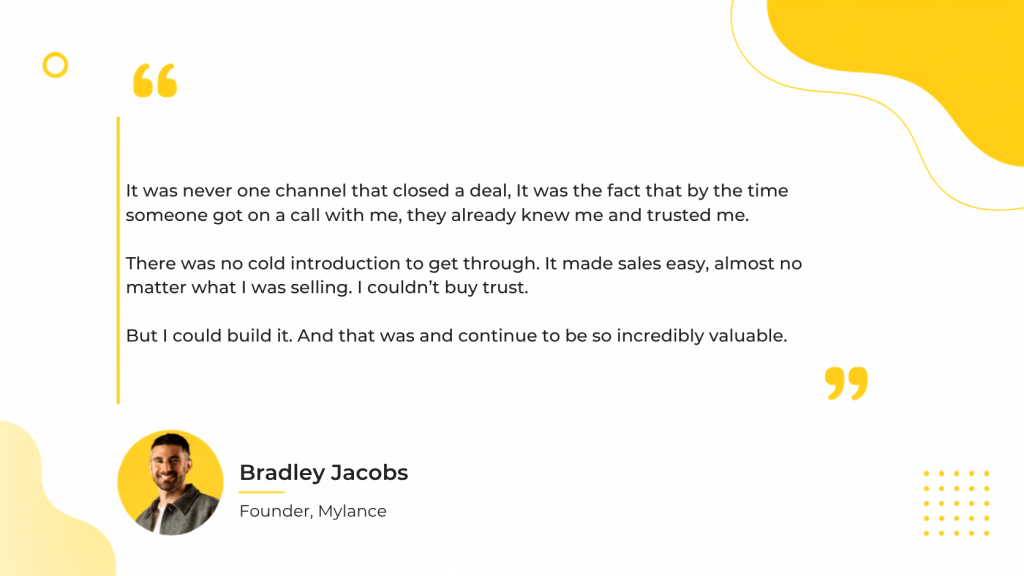
“You can’t buy trust. You build it, publicly, over time, in front of people who are watching whether you’re consistent.”
He’s still doing exactly that. One post, one client, one careful hire at a time. Betting, deliberately, that staying small is how you end up building something that actually lasts.