
Snippet
After dropping out of college in 2007, Sankhanil Basu took a different path to building India’s fintech future. Through QPi.money, he aims to empower gig workers and micro-merchants with greater pricing flexibility, a new way to build financial credibility, and access to credit, putting financial agency back in the hands of those who need it most.
Growing up in Kolkata, Sankhanil Basu observed a direct, relationship-driven economy where small business owners and customers knew each other and established mutual trust. Today, modern platforms have largely erased that dynamic, leaving gig workers and delivery riders without negotiating power or a safety net. To address this societal gap, Basu founded the fintech platform QPI Money under his company Qioseon Labs.
Basu’s approach is informed by extensive experience across the customer service, banking, and fintech sectors, having spent 19 years navigating these industries. His career is defined by continuous learning; he remains an avid reader who dedicates significant time to studying and adapting to technological shifts. His professional background spans critical roles in consumer tech, retail finance, fraud prevention and building fintech applications, with stints at organizations including JPMorgan Chase, American Express, and Tata Consultancy Services. He continues to further his education, including pursuing a diploma in Artificial Intelligence, driven by the belief that technological tools in this field evolve rapidly.
Letting the Smallest Players Set Their Own Price
Basu’s fix has two parts. The first is letting gig workers and micro-merchants price the way big platforms already do for everyone else. A delivery rider could offer a lower day rate to anyone who books him for a month instead of a single day. A home cook running a lockdown-era tiffin service could discount a full month of meals the way Amazon discounts a dry fruit subscription. A guitar teacher could price a six-month course cheaper per class than a single lesson. None of that flexibility currently exists for the smallest operators, even though ride-hailing app InDrive already proves riders will use real negotiating power the moment it’s handed to them.
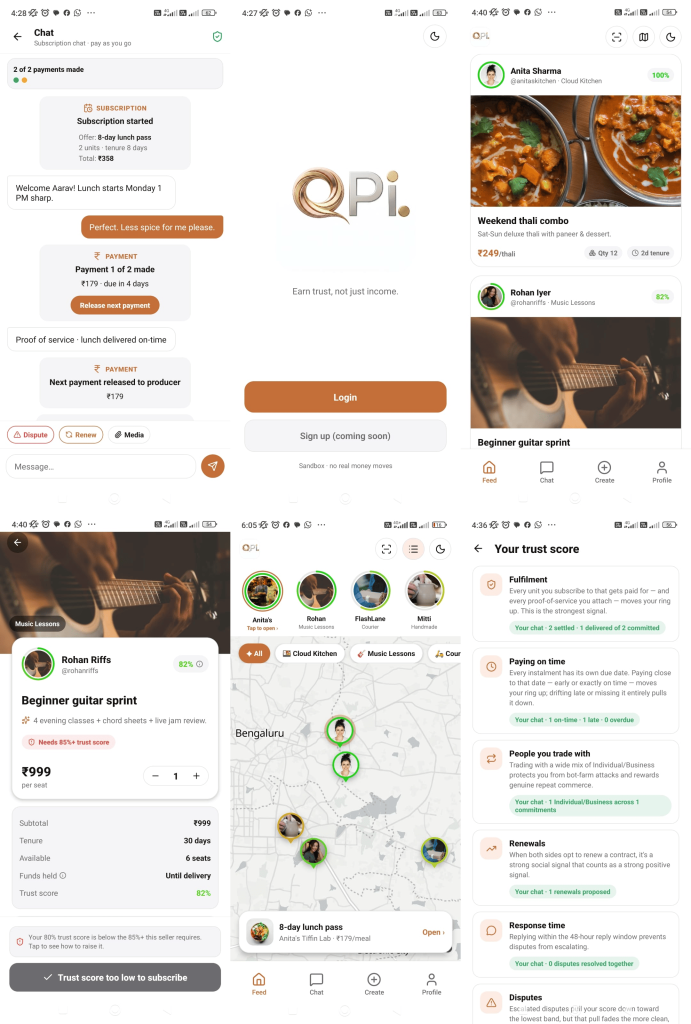
The second part is what happens when someone actually keeps that commitment. Reliably fulfilling a subscription, resolving disputes cleanly, rarely needing refunds, all of it builds what Basu calls a confidence index, an alternative credit score for people the banking system currently can’t see at all. BharatPe built credit access around a merchant’s daily transaction volume. Basu’s bet is a step further: insight into a person’s future recurring income, not just their past, which he thinks can justify a meaningfully larger loan than daily-volume data alone ever could.
Embracing Distributed Ledger Technology for Scale
Rather than utilizing public blockchains, QPI Money is built on India’s e-Rupee and UPI infrastructure. Basu recognizes the profound innovations surrounding Distributed Ledger Technology and sees immense potential when these systems are embraced by banks and governments to achieve massive scale while maintaining efficiency. By utilizing the Reserve Bank’s digital currency, loans can be programmed to pay a specific vendor directly, minimizing risk for underwriting banks. Basu anticipates that as digital economies mature, governments will increasingly leverage these secure frameworks to protect economic sovereignty and facilitate efficient, localized trade.

A Read Nobody Else Is Making Out Loud
Sankhanil has a theory about the recent backlash over UPI transaction charges for merchants that nobody else seems to be saying directly. UPI is free, massively adopted, and took roughly a decade to build that habit. A government doesn’t casually disrupt something working that well without a reason. His read: the fee pressure is a deliberate nudge toward e-Rupee, which gives the Reserve Bank far more direct visibility and control over individual accounts than UPI, which merely rides on top of commercial banks, ever could.
He connects this to something bigger than India alone. Countries are increasingly trying to trade directly in their own currencies, rupee for ruble, rupee for yuan, specifically to reduce dependence on the US dollar and the SWIFT system that currently backs nearly all global trade. He doesn’t see this as a sudden shift so much as a slow, deliberate one that’s been building for years, and he thinks e-Rupee is India’s specific tool for protecting its own economic sovereignty inside that larger realignment.
The Spiritual anchor
Beyond his relentless focus on building financial infrastructure, Basu is deeply anchored by his spiritual inclinations and a profound connection to nature. Recognizing that a high-pressure career requires balance, he has long maintained a parallel passion for creative outlets, most notably poetry and photography. This creative vision and appreciation for the natural world along with his commitment to spending quality time with family provide him with a necessary grounding away from the screen. A devoted animal lover, much of his downtime is spent in the company of his three dogs: Mishti, Yogi, and Khushi. The time spent nurturing his pets and exploring his artistic side keeps him centered and balanced as he navigates the demanding landscape of the startup ecosystem.
He often recollects the values instilled in him during his school days at Ramkrishna Mission.Sankhanil also uses the famous quote by Swami Vivekananda
—“বহুরূপে সম্মুখে তোমার, ছাড়ি কোথা খুঁজিছ ঈশ্বর? জীবে প্রেম করে যেই জন, সেই জন সেবিছে ঈশ্বর।”—
translates to “When you look around in various forms, leaving aside all else, where are you searching for God? The person who loves all living beings is the one who is truly serving God.”
The Trajectory of Micro-Lending
Currently existing as a self-funded prototype, QPI Money is deliberately laying the groundwork for a broader ecosystem of trust before a public launch. Basu is already engaging in conversations with leaders from the Industry. He foresees a clear market transition where major consumer apps will inevitably build out their own lending and storefront layers to capitalize on user spending data. By developing the underlying infrastructure to support this shift, QPI Money aims to empower the smallest players in the economy, providing them with the financial visibility and credit access necessary to thrive in a rapidly evolving landscape.