Snippet:
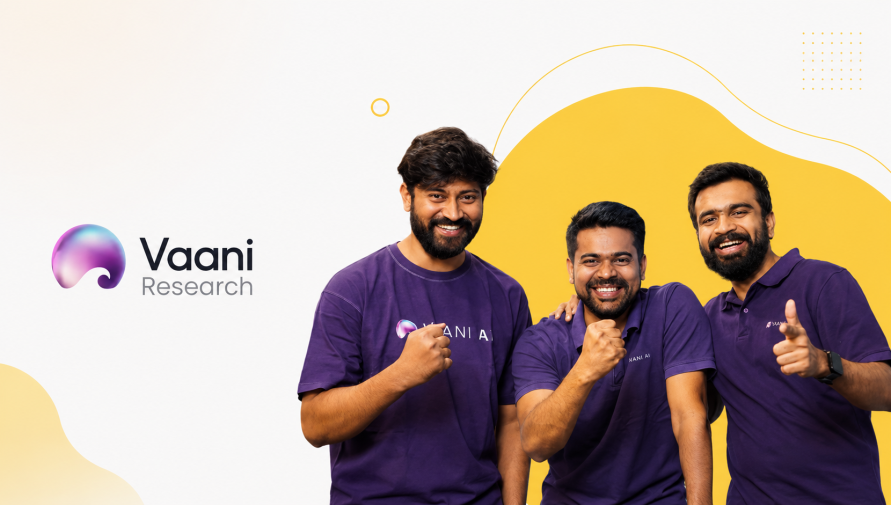
Tushar Shinde, Nitesh Tripathi, and Nitish Mishra, alumni of IISc Bangalore and IIT Madras, founded Vaani in Bengaluru in 2024 to build what India’s voice AI ecosystem does not yet have: a company that owns its own speech models, infrastructure & orchestration, and application layer, rather than stitching together western foundation models like Deepgram, ElevenLabs, and OpenAI. Vaani is building toward the same market with a different bet: that the company which builds the native full stack, designed for complex geographies like India, Middle-East and Southeast Asean languages and consultative use cases from the ground up, wins a category the others are not actually building.
In February 2026, ElevenLabs announced it was entering India. The company had closed the previous year at $330 million in annual recurring revenue, raised $500 million at an $11 billion valuation, and was used by 41 percent of Fortune 500 companies globally. Four months later, Sarvam, India’s most-funded AI startup, raised $234 million at a $1.5 billion valuation in a round led by HCLTech.
Tushar Shinde had been building toward this exact market for two years before either of those announcements. Not as a bet on timing. As a bet on a gap that neither company was filling.
The gap has a specific shape. For as long as he was a researcher at IISc Bangalore, working on reinforcement learning while his future co-founder Nitesh Tripathi worked on voice and natural language processing in the same department, every tool they reached for came from the same place. Western research. Western APIs. Infrastructure designed by people for whom an Indian accent or a Hindi-English conversation was an edge case, not the default. That did not change when they graduated. It had barely changed when they came back together and started building.
Vaani is what they built instead.
The Three Who Started It
Tushar’s path between IISc and Vaani covered more ground than most.
After his master’s in reinforcement learning, he built enterprise NLP systems at Publicis Sapient and Hypersonix. Then he managed product at OneCard, a fintech unicorn. In between, during COVID, he also opened a chai shop.
He called it Badnaam Chai. It started in a 7 by 8 foot shuttered space in his hometown, designed deliberately to be something different: targeted at a younger crowd, at a time when every other chai shop in the area served an older one. He hosted music concerts and donation camps, built a vibe that attracted media recognition, and let the coverage and the footfall feed each other. Within a year , one shop was selling 1,000 cups a day. Then there were shops in multiple cities.
He sold all of it. The business was not failing. The problem was something harder to argue with: he could see exactly how far it would go. Every venture he has run, he has taken the same measurement. Margins, hiring complexity, the shape of the ceiling. The franchise gave him a clear answer. AI infrastructure, built the right way, gives a different one.
Nitesh Tripathi, who met Tushar during their overlapping years at IISc and later built Hypersonix’s data science function from scratch before moving to ThoughtSpot, is the CTO. The third co-founder, Nitish Mishra, comes from IIT Madras, where he worked at the Sudha Gopalakrishnan Brain Research Centre on a problem that is worth pausing on. His team sliced infant brain tissue into micrometer-thin sections, extracted data from those samples, and used it to predict whether a child would develop Alzheimer’s decades later. Before that, he had co-founded a fashion brand that scaled before COVID broke its supply chain and ended it.
Three founders. Three different experiences of building something and watching it stop.
The Stack Nobody Is Building
The reasoning is not abstract. A production voice AI call today runs on four separate layers that were not designed to work together: telephony, speech-to-text, a reasoning layer, and text-to-speech. In production, Deepgram handles STT in roughly 150 milliseconds. ElevenLabs handles TTS in roughly 300 milliseconds. Stitched together across four different vendors, most production voice agents still respond in 1000 milliseconds to two seconds. Human conversation expects a response in 300 to 500 milliseconds. That gap is not a latency problem. It is what happens when the architecture was assembled rather than designed.
Building in-house is both a margin decision and a control decision. Every API call to a third-party provider is economics leaving the business. When something breaks in production on a stitched stack, you raise a support ticket. Vaani owns the entire chain. They fix it.

The use cases they are building for are the ones where stitched third-party voice AI breaks down: sales calls that run twenty minutes, financial advisory sessions with regulatory nuance, healthcare consultations that require the system to hold context across a long conversation while handling an accent the training data barely covered. Over 70 percent of financial and service sector companies in India are expected to deploy conversational AI this year. The category is not speculative.
The competition is not either. Sarvam manages over two million voice interactions daily and is now a unicorn. ElevenLabs is in India with the category’s largest revenue base. Vaani’s position against both is a specific one: Sarvam is building foundation models for sovereign AI across government, enterprise, and defence. ElevenLabs is a global platform expanding into a new geography. Neither is building the voice-agent infrastructure layer natively, from the models up, for low-resource languages and consultative use cases. Whether that gap is large enough, and how long it stays open, is the question the next two years will answer.
Vaani has one text-to-speech model built internally, in use in-house and not yet public. The self-serve platform launched in beta in July 2025. The company is backed by a pre-seed round led by Venture Catalysts, with global operators and technology leaders participating.
Who They Are Looking For
The hiring philosophy is two words: intent over skills.
Skills are table stakes. A DevOps candidate needs DevOps skills; that is assumed. What the filter is actually running on is a distinction between people who execute well within a defined scope and people who create their own scope when one does not exist. In a startup, defined scope is often a fiction. You have a goal, you have chaos, and you figure out what work needs to exist to get there. Vaani is looking for the people who find that interesting rather than uncomfortable.

The process to find them has four rounds. A vibe check first. A technical assessment. A case study, where they evaluate thought process over output, and where Vaani can tell if a candidate used AI to generate the answer. They build such models. They recognise what they made. The fourth round, the one Tushar considers most important, brings the candidate into the office for what he calls the swipe check.
The quality he is filtering against is specific: people who complete work and hand it back when it is done. That quality surfaces early. Within fifteen minutes of a conversation, he says, the signals are already there.
Vaani is currently hiring a Founding Engineers in ML Research and Founding Members in for Sales, Marketing and Customer Operations.
What They Are Building Toward
The name Vaani comes from the Sanskrit word for speech and sound. The frustration behind it goes back to IISc, to reaching for a tool and finding it was built by someone who had never considered you as the user.
ElevenLabs is now in India. Sarvam is a unicorn. The gap Vaani is building into is real, and it is closing from multiple directions at once. What they are building, the native models, the full stack, the architecture designed for complexities of voice from the beginning, is the argument that the gap does not close the same way for every company that enters.
He sold a tea franchise when the ceiling became visible. This time, he could not see the ceiling when he started. He still cannot.