These first few engineering hires are arguably the most important hires you will make in your startup. The reason is that they will set the standard, they will set the culture, and they will set the pace. Every hire after that will only inherit the values and the kind of work ethic they have created and maintained.
Before you actually make a job post, get really clear on the role you need, the kind of person you need, and from where. Also, one of the most important decisions becomes: where will you hire this person that you need at this stage?
Let’s break down:
- who you need to hire
- how to hire them
- where to find them
- how will you create this team overall
Quick note: Hire for the stage you are in
The most common mistake is hiring for where you want to be in 3 years. You do not need a specialist who has owned one narrow slice of a large system. Not yet. At the start you need people who can build across the whole thing with very little handed to them.
What roles do you need when building a founding team?
You do not need a big team to start. You need the right shape.
For a very early team, you need 3 people.
- One senior generalist who can set direction.
- 1-2 engineers who ship.
3 things to take care of –
- You do not need a hierarchy here. No handoffs. Just co-building together.
- The second thing is, if you are a non-technical founder, this senior generalist kind of becomes your technical co-founder, so make sure you get this one specifically right.
- One more filter before you open any role. Ask yourself: “What happens if we do not fill this immediately?” The answer often tells you whether you need one hire, two, or none right now. Hire slowly and wisely. Waiting for the right person costs less than the cultural debt of a rushed wrong one.
What qualities matter in a founding team? What to look for in people when building founding teams?
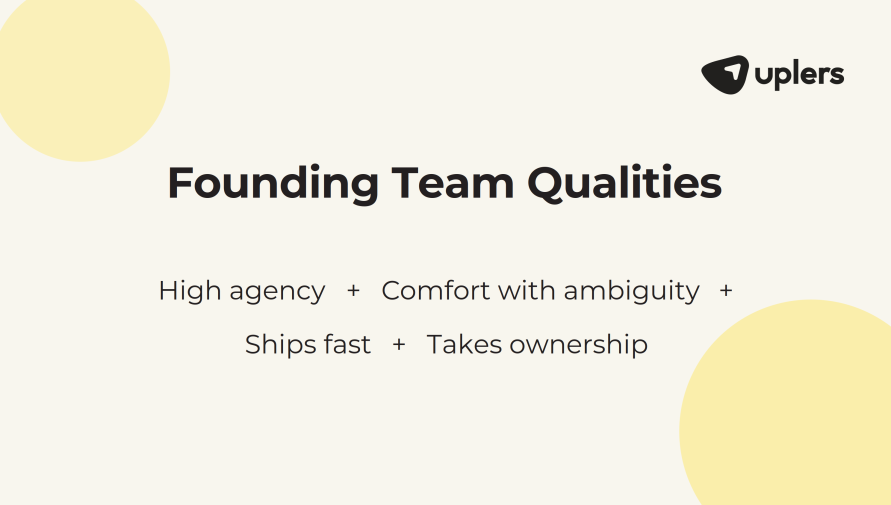
When building founding teams, more than skills, the mindset is what matters more. Be very mindful of the kind of people you bring in early on in your team. We think that you have to look for four solid things, and these will be your non-negotiables:
- High agency: They figure out a way to get the result without needing instructions. What they own is their problem to solve, and they solve it by hook or crook.
- Very comfortable with ambiguity: The thing with startups is that goals, features, products, all of that changes pretty quickly, so you need someone who can adapt when all of these things change.
- You need somebody who can work speedily: They focus less on planning, less on being organized, and more on shipping something, even though it’s imperfect, but can reach a level of perfection through iterations.
- Owning end-to-end: What happens if the product goes live and it does not work or it needs changes? How to pivot once things are already live? You need someone who cares about what happens once the product is live.
Basically, you need product-minded engineers who naturally say “I owned this,” “we discovered,” “customer feedback showed,” “we decided not to build that.”
How to read a résumé for these qualities?
Good signs:
- “Built and launched X,” not “contributed to X.” That word choice tells you a lot.
- Early-stage roles, have previously worked in a 0-to-1 setup, maybe they have a startup they founded, or also some freelance products they actually delivered or independent projects they have had live.
- The same person mentions building and deploying and fixing. That is end-to-end ownership.
- A live link you can click and open right now.
- Outcomes with numbers: “reduced checkout abandonment by 18%,” “led the launch of self-serve onboarding.” Phrases like “worked on authentication” or “developed APIs” describe a scope someone else defined.
Real red flags:
- Everything is “part of a team that.” No individual ownership anywhere.
- They have never shipped one thing a real user touched.
- They work well with SOPs, SLAs, plans, and instructions.
Bonus tip: Check their GitHub
This is your best free verification because it is real work. Don;t just be happy because they have the link. Here is what to actually check for:
- Does the thing actually work?
- Then check whether they finish what they start. A pile of half-done, abandoned projects is a warning.
- Their activity log helps too, since steady work over time beats a burst and a long silence.
- If you can read code, or you have someone who can, look at how they build. For a startup, simple and working beats clever and elaborate. Over-engineering is a real risk with early hires.
2 things not to worry about:
- GitHub stars: they mean popularity, not skill, so ignore them
- No public profile: not a dealbreaker. Plenty of strong people have all their work locked inside private company code. If that is the case, you lean harder on the interview
How to interview for a founding team role?
Get them talking about something they built themselves, and go deep there. The real builders go on and on. They remember the small stuff, what broke, what they cut. The ones who were just standing nearby when it got built will not have answers to some detailed questions.
Run it in 3 parts.
- Deep-dive on a real 0-to-1 project. Pick something they claim they built and ask:
- Tell me how this came alive. What was the first idea? What did you build first, and why that?
- What broke in production? How did you find out, what did you do?
- If you rebuilt it today, what changes? How will you now think? What knowledge you know now, would you have been happier if you knew before starting off this project?
- Give them a vague problem and watch: Something like: “We want users to be able to do X. You have two weeks and you are the only engineer. What do you build?”
A good one asks a couple of sharp questions, cuts everything non-essential, and tells you why. A weak one either waits for you to spell it all out or tries to build something huge for what is really a two-week job.
- Ask about judgment. “Tell me about shipping something you knew was not perfect. Why was that the right call?” Good builders have real scars and can walk you through the tradeoff. Anyone who claims they never ship imperfect work is a yellow flag at best.
A few more questions that reveal startup readiness are here.
Where to look for startup ready engineers?
Go with your own network here. Your first hires are people you will build with at close range, through stress and pivots and bad weeks. You want to actually know them, or know someone who does. So go there first:
- Ex-colleagues: people you have already worked with so you know their style and judgment.
- Alumni networks: you have known these people informally so you know whether they will match the culture you are trying to build.
- Founder friends and investors: they see a lot of people and know who is quietly looking.
- Warm referrals: via your own social network. Linkedin posts. Etc.
The catch with your network is that it is a smaller pool. It can run dry, especially for a specific skill. When it does, widen the net, but keep the same bar.
Beyond your circle, a few channels work like YC channels, Hacker News, Indie Hackers, founder Slack, and also Hiring partners who specialize in finding startup ready engineers (not just any random ones).
If you are hiring from India or building a distributed team
Wondering how to hire engineers from India? A lot of founders now build their first engineering team partly or fully from India, and not just to save money. The reason has shifted to quality. India’s product ecosystem has produced engineers who have built software used by millions of people worldwide.
The same rule holds here: start with people you or your network already know. Then widen out. The India-specific channels that work well:
- Founder communities: WhatsApp or Slack groups where strong engineers who are not actively job-hunting still hang out
- Product-company alumni networks: the Razorpay, Freshworks, Zoho crowds refer people with the same operating instincts
- Referrals from a product-minded engineer you have already hired: once you have one good one, their referrals become your best channel
- Stage-matched hiring platforms: they pre-screen for ownership and startup readiness so you are not sifting through hundreds of profiles yourself
Conclusion
You need a mix of generalists and specialists in the early founding teams because you want somebody who can understand a little bit of everything. You also need someone who can go deep into one product or one feature. The best way to get these people is from your own networks, and then you widen your net from there. The last thing is you need to look for people who are startup-ready, not people who work well in service environments, because they will not understand and be able to cope with the dynamic world of startups.