Snippet:
Kushagra Ahuja spent two months at his last company trying to find a tool that didn’t exist. His college senior was already building it. Neither of them knew yet.
For two months, Kushagra Ahuja tried to solve a problem at Frnd and kept failing.
He was leading the group portfolio, public live rooms where creators performed while audiences watched. The creators were surprisingly good. Tier-2, tier-3 users who had mostly consumed content had, through that consumption, built genuine instincts for what made a room hold together. The problem was what came after. Every clip needed subtitles, b-rolls, basic polish before it could go anywhere useful. Nothing he tested handled the volume at the right cost. After two months, the conclusion was four dedicated editors just to run the experiment. The pilot didn’t happen.
“And coincidentally, luckily, that is when Aditya also started with this idea of Buttercut.”
How two dancers ended up building the same thing
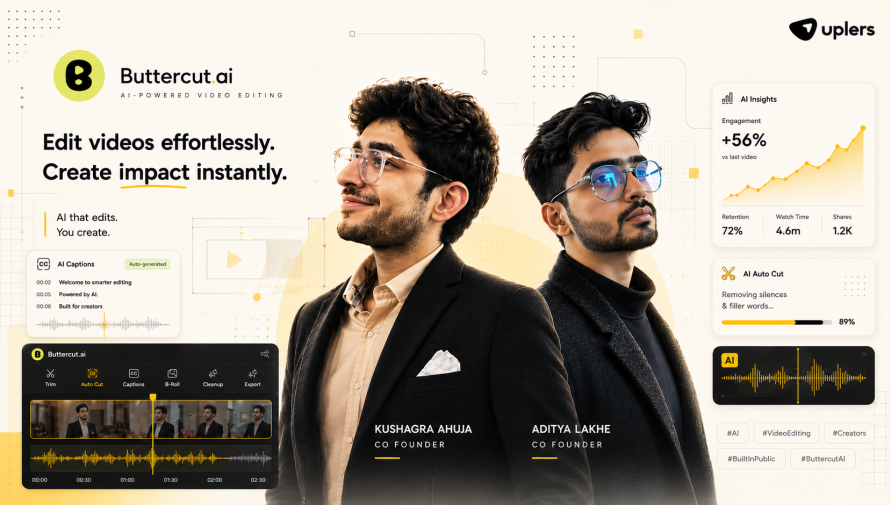
Kushagra and Aditya, Buttercut’s co-founder, met in the first month at IIT Kanpur. Aditya was a year ahead. The connection was the dance club. Three years competing, performing, building the kind of familiarity that tells you more about a person than any hiring process ever will.
Then college ended. Aditya went into product. Kushagra into business. Years of separate paths. The reconnect was a LinkedIn post. Aditya was already building Buttercut, already talking to creators. Kushagra had just spent two months being the exact customer Aditya was building for.
He joined a month later.
That origin shaped how Buttercut hires. With Aditya, there was nothing to evaluate; three years had already done that. For everyone else, they compensate differently.
They’ve hired wrong people, let people go, and learned to be slow about it.
“We went aggressive only in terms of selection.”
Four people, including 2 co-founders. Not because they can’t hire more, but because at this stage, the cost of a wrong hire isn’t just a salary.
Where the signal was strongest
They launched with subtitles in eight Indian languages. The working assumption was that Hindi and English would lead; universal languages, maximum reach.
 Hindi and English have become so universal that they’ve lost their intimacy. A creator teaching in their regional language isn’t narrowing their audience, they’re deepening the relationship with it. For anyone monetising through courses or communities, depth is where revenue actually lives.
The data confirmed it quickly. Fastest traction came from regional language users. The ones no competing tool had prioritised. A trading course creator teaching entirely in his regional language was among their first users in October. He’s still there, paying well above what any other tool charges, every month, for subtitles alone
Earlier this year, OpenAI selected Buttercut for their showcase of Indian early-stage startups, one of 30+ companies, on traction and a working product. Kushagra mentions it in a sentence. The point wasn’t the recognition. It was the same signal the trading creator gave him in October: something is working, keep going.

People are not chindi. They are choosy.
The assumption that regional creators won’t pay is something Kushagra had already watched disproved at Frnd, at Seekho, at every tier-2 and tier-3 focused product that didn’t give up on the market before finding product-market fit. The paying appetite exists. What these users don’t have is tolerance for products that aren’t worth it.
Buttercut’s pricing reflects that. ₹49 for a package. ₹9 for a three-day subscription that upgrades from there. Low enough to be a genuine trial, not a commitment. If the product delivers, they convert. If they convert, they stay.
Seventy percent of users on auto-pay don’t cancel.
“People are not chindi. They are choosy.”
Trust, once built here, is durable in a way it isn’t in markets where switching costs are purely rational.
The last mile
Buttercut’s name is a thesis. Butter smooth. Cut. Edit. The smoothest post-production you’ll ever experience.

The bet isn’t to out-build ElevenLabs on audio or Claude on language. The bet is what happens between those tools and the creator who needs to use them.
Buttercut’s first B2B deal, Seekho, didn’t close because Buttercut has better underlying technology. It closed because the product is built to adapt. Every customisation a client asks for feeds back into what the product becomes. What one client needs today is what every client benefits from next month. That’s not customer service,That’s how the stack grows.
The same logic runs through everything: regional languages nobody else wanted to serve, creators nobody thought would pay, a team small enough that every hire has to matter.
The last mile is where Buttercut lives. The question is how long before it becomes the main road.