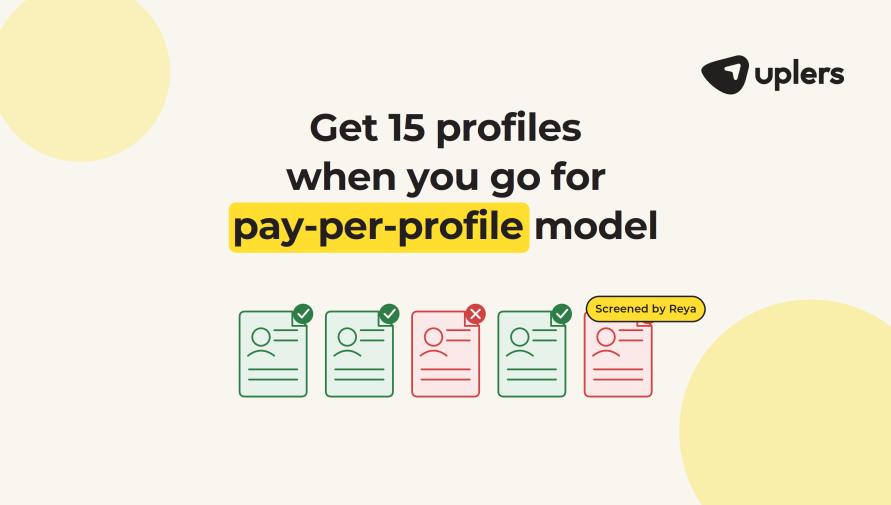
Curated sourcing is Uplers’ way of taking the sorting off your plate. It is a pay-per-profile model. You say what you are hiring for, and instead of a pile of applications you get a small batch of 15 profiles that already fit, each backed by evidence, ready for you to interview.
Sounds simple but here is what happens behind the scenes.
Step 1: You brief
There is an intake call here that happens. You share the role, the skills that actually matter, and a bit about your stage and team. You can share the Job Description if you have. Or make one with us.
Here, you have a principal recruiter who will monitor the entire process and will be your POC.
The most important thing that your POC will do here is to uncover what kind of talent would add the most value at your stage of the startup and in your environment. The objective is to create a rubric including technical skills and behaviour skills as well as to clearly identify talents who would have intent and drive to join your startup. This step defines 50% success of the entire process.
After this, Uplers builds what they call a rubric. Think of it as the scorecard for this role. The must-haves, the good-to-haves, the things that would make someone a strong fit for your team specifically. Also, takes into account the basic requirements of the role, the logistics, the resume requirements and more.
This rubric is the thing everything downstream gets measured against, so getting it right is the real work at this stage.
Step 2: Our autonomous system recruiter finds the profiles
The principal recruiter assigned to you goes and pulls candidates from our own network + consider passive candidates + active candidates not in our pipeline + uses other sourcing platforms. That judgment at the front end is what keeps the batch relevant.
They will make sure you receive the right profile as per your skill needs as well as intent to join your company. Recruiters would also jump on periodic feedback calls with you where they see more rejections of profiles or interviews to tweak our system as per your feedback.
Step 3: Our AI Agent filters the profiles + creates a report
First, once profiles are in, the AI takes over the tedious middle. It checks each candidate against the client specific rubric and drops the ones that do not match. The ones that do, it calls.

And these are real conversations, not a form. The system talks to the candidate, digs into gaps, asks why they want to move, gets a read on whether they are genuinely interested or just shopping around. Then it writes up what it found.
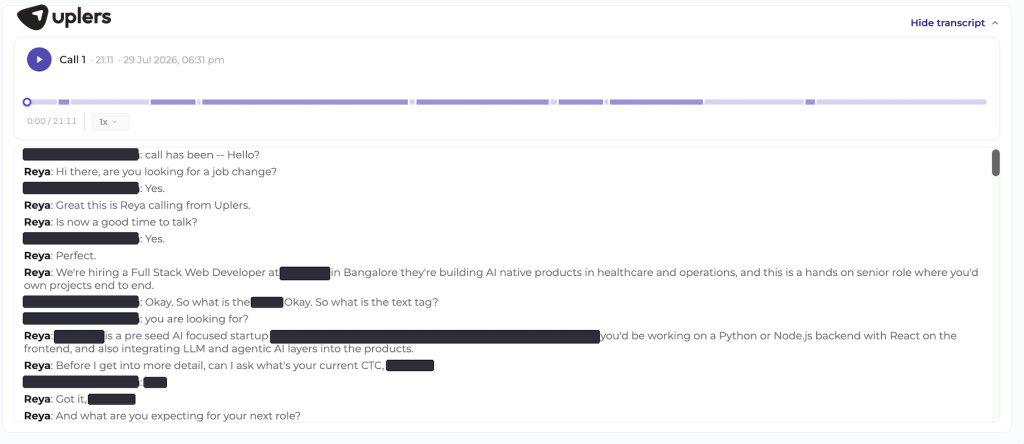
This is the part that eats a recruiter’s week, the calling, the chasing, the missed calls and callbacks, the note-taking. That is exactly why it is automated. Not to replace judgment, but to take the grind.
Second, it develops an AI Screening Report that is prepared based on the Call Transcript, and CV Screening, based on the Hiring Rubric. Here is what you get in the report:
- Gives you the whole transcripts of the calls plus the actual audio.
- Tells you if the profile matches on your must haves, good to haves, and logistics.
- Also tells you open items which are things that could not be confirmed.
You are seeing which specific requirements held up under questioning and which only partly did.
Step 4: You get a batch of 5
Not 15 at once. 5. Each one already matched to your brief and screened on a live call. With each profile you get the recording, the transcript, and a report showing what was checked and where to look closer.
Why five and not the whole list? Because a tight batch you can actually review beats a long one you will skim.
Step 5: The feedback loop
This is the part people miss, and it is where the quality really comes from.
After each batch, there is a check-in. What did you think? Were these close? Did seeing real profiles change what you actually want? Most founders realise partway through that their brief was not quite right. That is normal.
Whatever you say feeds back into the rubric. A human on the Uplers side tunes it based on your feedback. Then the next batch of five comes, sharper than the last. Batch by batch, the profiles get more like what you meant, not just what you first said.
Conclusion
These 5 steps are how our pay-per-profile works and makes your sourcing faster and more targeted. For teams that want quick closures for common roles and don’t have the bandwidth of sourcing, go for our pay-per-profile model.
*One more thing: Curated sourcing is in beta and currently open only to startups in India.