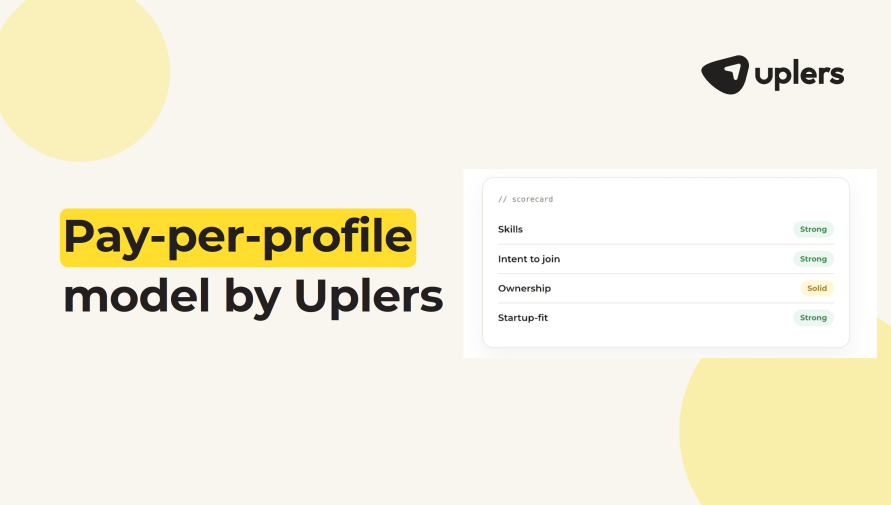
If you are an early-stage founder hiring in India, then you are familiar with the problem of the volume of applications you receive. You think it is a good problem to have, until you actually open them and see that most are irrelevant. Or they look good on paper but fail in the interview.
Then you get tired of reviewing applications and settle for someone or don’t and continue wasting time on this process.
We kept watching founders live this reality. So we built Curated Sourcing by Uplers. Let us walk you through why, and what actually happens when you use it.
The 2 choices founders were stuck with
When you need to hire, you broadly have 2 options today.
Choice 1: You do the sourcing yourself
Take a LinkedIn, Wellfound, or Naukri subscription, post the role, and start going through profiles. In India, finding profiles is easy. The hard part? Figuring out who among the thousands is actually worth your time. Someone still has to search across scattered talent pools, tell keywords apart from real capability, check who is a startup-fit, check who is actually available, and check who genuinely wants to move.
The drawback? For a founder or a one-person HR team, that is a huge amount of work. The problem was never the volume of applications. It was knowing which of these will be the actual startup match.
Choice 2: You hand the whole role to a recruitment agency
A good agency does the sourcing, screening, and stays with you till the person joins. You just interview. For senior or niche or genuinely hard roles, that model makes complete sense. But here is the mismatch.
Early-stage mandates change. You start out wanting an Engineering Manager, meet a few people, and realise you actually want a hands-on Tech Lead. Then funding shifts, or the budget moves, or the role goes remote, or you decide to wait a quarter. That is not bad planning. That is just how startups move.
The drawback? An agency will probably get very selective in terms of the roles that they pick because this model is not built for every early-stage role.
No Choice 3: The gap we saw
Sitting between those 2 options was a very specific founder need.
It sounded like this. I can interview. I can evaluate. I can convince the right person to join. What I do not have is the time to search the whole market and figure out who I should even be talking to.
That is the gap. These founders did not need another database. And they did not need someone to run their entire hiring process. They needed one strong layer. Search, filter, intelligence, shortlist. That became our pay-per-profile model.
Why is this worse in India specifically?
- There is a large talent supply: Candidates spread across startups, product companies, GCCs, IT services, and global tech. The talent is there. It is just fragmented across platforms and companies. The volume is huge!
- Mindset match: A strong engineer from a big company may or may not do well inside a 5-person startup. Early-stage companies need people who can work through ambiguity, take ownership, stay close to customers, and build rather than only manage.
- Intent is unclear: a candidate might be serving a long notice period, holding other offers, waiting on a counteroffer, or comparing you against a GCC with a bigger brand name. So you do not just need qualified candidates. You need skills, mindset, and intent together. That is a much harder thing to filter for.
What Curated Sourcing actually does
This is a pay per profile model. It gives you the sourcing help on demand. All you have to do is give us the context, the role, the skills you need, and the constraints that actually matter to you, then we search deeply and filter before any profile even reaches you.
It is not about sending you a lot of profiles. It is about sending you a selected list of 15 profiles in batches of five. The reason we send it in batches is so that, after every batch, once we receive your feedback, we can pivot according to your further selection criteria. The idea here is that you look at all your needs being met in these profiles, so you only figure out if they can be set in your environment.
Our filter is the product.
– Jaymin Bhuptani, CEO & Founder, Uplers
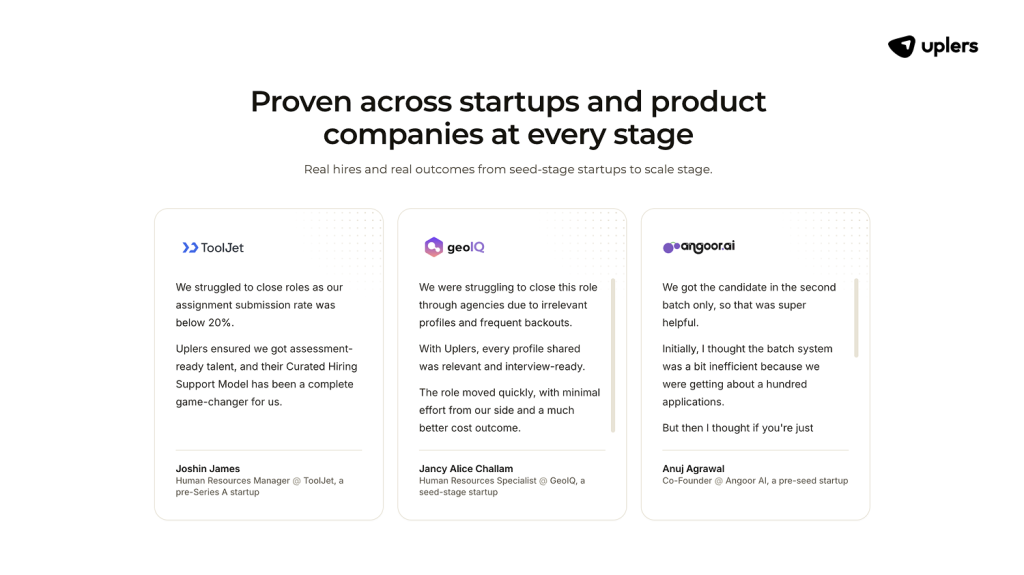
For a flat fee, currently in the range of ₹25,000 to ₹50,000 per role depending on complexity and seniority, you get a set of 15 profiles (batches in 5 so we progressively get better with each batch) that have already been screened for skill, startup-fit, and real intent to join. You handle the interviews, the evaluation, and the close. Which, if you talk to most founders, is the part they are happy to own once the right person is actually in front of them.
What we deliberately do not do
Our pay-per-profile model does not try to take you out of hiring. For an early-stage startup, you should still own the deeper evaluation, the hiring judgment, the culture and stage fit, selling the vision, and the final call. That is a real belief for us.
Outsource the work, not the judgment.
How does our pay-per-profile model hand you those 15 selected profiles?
Our pay-per-profile model is a mix of human judgement + AI intelligence.
- Step 1: Sourcing – In this step, we source candidates utilizing our own network of 3M+ talents + have access to multiple sourcing tools. Expert recruiters become your POC during the entire process to make sure you really get the kind of profiles you need.
- Step 2: Filtering – The chosen profiles go through an intense round of filtering based on what the client needs and the kind of startup readiness that the candidate demonstrates. This is where our AI agent comes into play. This agent has been developed after feeding it our 5+ years of startup hiring intelligence, so it really understands and knows how to filter and flag any details.
- Step 3: Verifying info – Our AI agent does a lot of things. First, it calls up the relevant filtered candidates and gathers information across basic tech stack, logistics, as well as if there any questions it has to clarify from the resume. Furthermore, it also gauges the candidate’s startup mindset with tailored questions, and from the client side of view, it also does a good job representing your company and job to the candidate to generate interest in your company. Employer branding that is. Plus if any further clarifications are required. They remain in touch via WhatsApp and calling so that nothing goes cold. If it spots the pattern of the candidate going cold, it will immediately alert a human recruiter to take over if the profile is genuinely good.
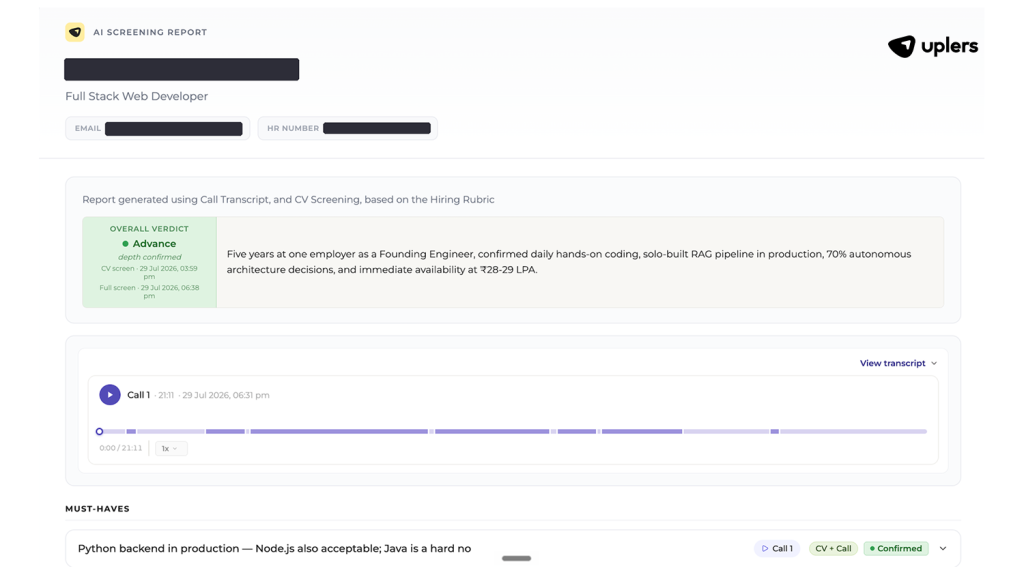
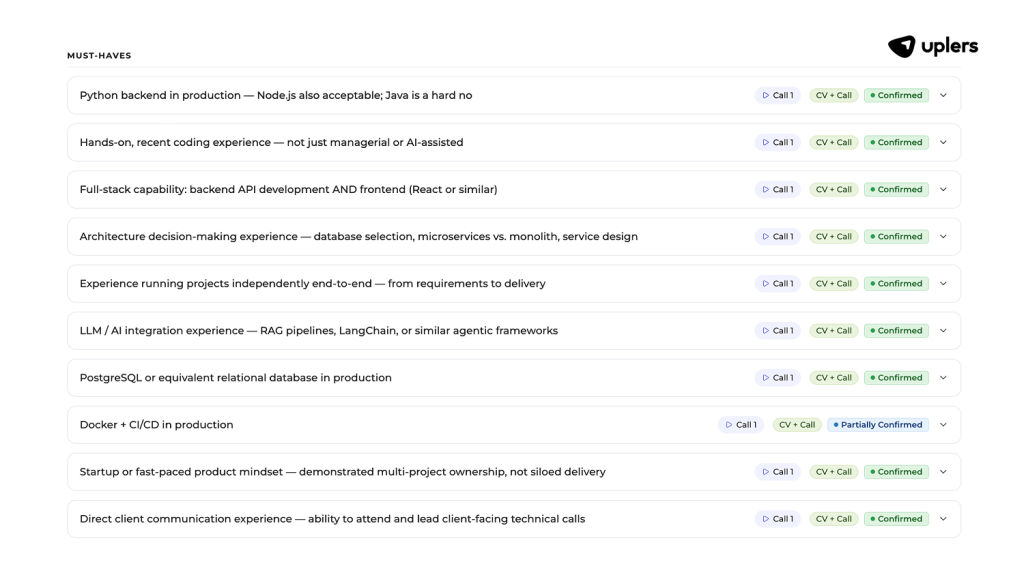
- Step 4: Developing AI Screening Report – Our AI agent puts all the information together from the call transcripts and from the resume, and matches against the client’s hiring rubric. It prepares a detailed report on whether the candidate matches the requirements like must-haves and the good-to-haves. It also flags if there are any open items that the client should probably clarify with the candidate in the interview. It gives the client the transcript, the audios, the reports, resume, everything in one place.
Candidates who clear this become part of the first batch of 5 profiles that get shipped to the client.
- Step 5: Sending other 2 batches of profiles – After getting feedback from the client on how the first 5 profiles fared, we then either make our filtering process stronger or identify the gaps and fix them so that we can send a stronger set of profiles to the client. The reason we send it in batches and not all at once is so that it gives enough time for us to change our approach if it is not hitting right in the first batch.
That’s it. That’s how our pay-per-profile model works.
So which model is right for you?
| Your situation | Go with |
| If you have capable recruiters, the role is common, and your only bottleneck is access. | Job boards and self-sourcing |
| If you can interview and close, but sourcing and filtering are the bottleneck, and you are hiring a few mid or senior IC roles. | Pay-per-profile model |
| The role is hard to define, it is a critical leadership or specialist hire | Pay-per-hire model |
The point is to match the founder’s problem to the model, not to force fit a model for each and every hiring problem, because the model you choose depends on the actual problem you want help in being solved.
*One more thing: Curated sourcing is in beta and currently open only to startups in India.