Snippet:
- An AI engineer integrates AI tools into software; an AI-native engineer designs with AI at the core and owns evaluation, deployment, and reliability.
- 6 signals of resume padding: no business impact, tutorial-clone projects, tool-listing without decisions, no evaluation methodology, no production experience, no discussion of failures.
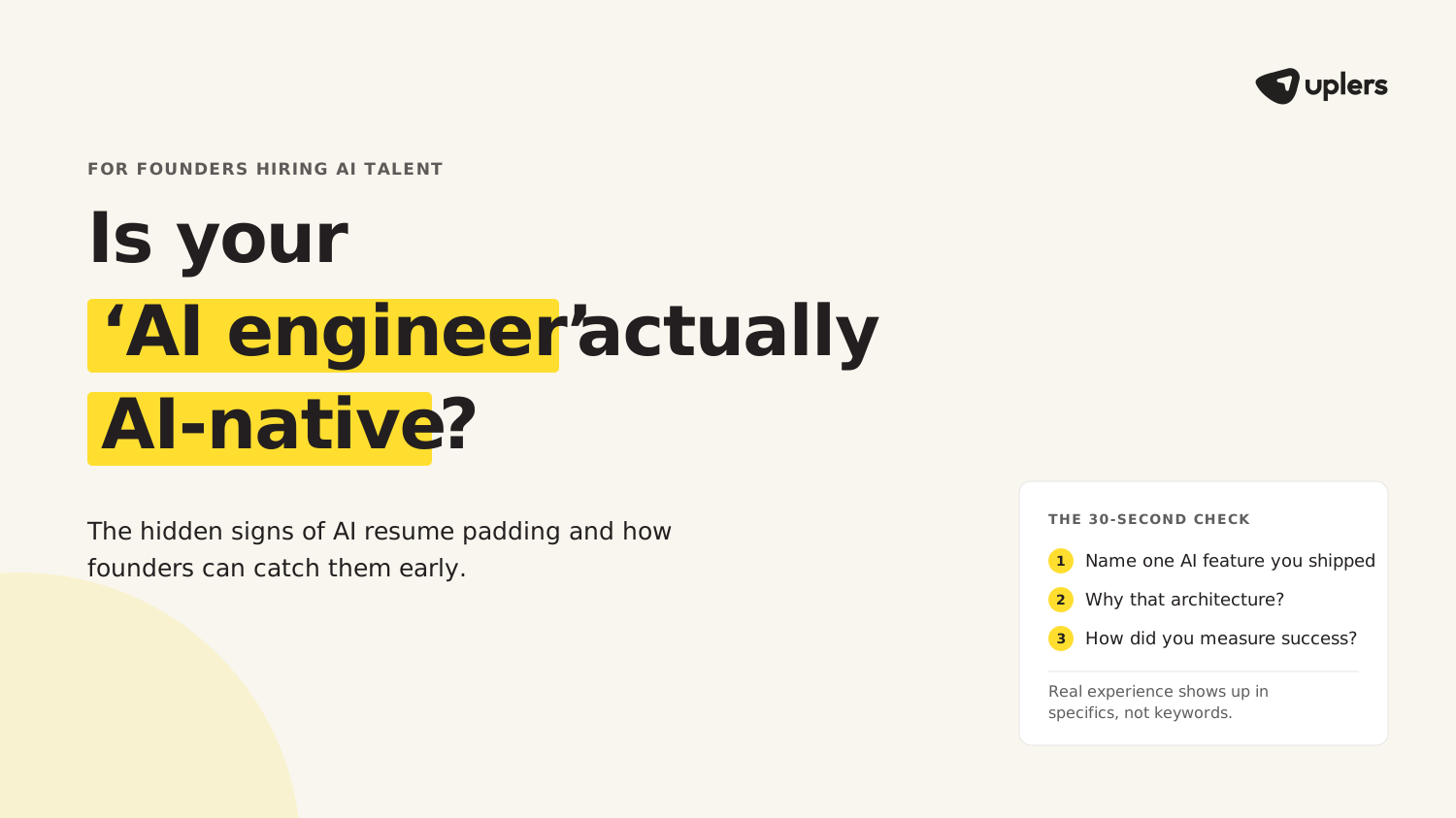
- Fastest verification method: ask about one shipped AI feature, why that architecture was chosen, and how success was measured. Genuine experience shows up in specifics, not keywords.
- Why it matters now: AI-related job postings are projected to make up ~2.5% of all US postings by the end of 2026, and demand for qualified AI talent continues to outpace supply, making padding both more common and costlier to miss.
AI appears on almost every engineering resume today. But proving genuine AI-native engineering experience is difficult.
Many candidates have adopted AI tools without developing AI-native engineering skills. Since generative AI entered the mainstream, resumes often list LLMs, RAG, LangChain, MCP, or vector databases, yet reveal little about how those technologies were applied.
That’s creating a new hiring challenge for founders.
With AI adoption increasing by leaps and bounds, AI engineer job postings grew significantly over the last few years. That growth has pulled in a wave of candidates who’ve used AI tools without ever shipping AI systems. For founders, this is a costly gap to miss.
There’s no in-house AI hiring bench to fall back on, and a mis-hire on a core AI role burns the runway you don’t have.
This guide breaks down six practical signals that an AI engineer may not be AI-native and what real AI-native experience looks like.
AI Engineer vs. AI-Native Engineer: What’s the Difference?
The two titles are often used interchangeably, but they represent different levels of AI expertise. Before you can spot padding, it helps to be clear on what you’re screening for.
What is an AI engineer?
An AI engineer builds or integrates AI features into software using models, APIs, or AI frameworks. AI is part of their work, but not necessarily the foundation of how they design products.
What is an AI-native engineer?
An AI-native engineer designs products with AI at the core. They understand how to evaluate, deploy, and improve AI systems in production. They think beyond implementation to balance reliability, user experience, and business outcomes.
| AI Engineer | AI-Native Engineer | |
| Role of AI | One part of the build | Core to the product |
| Focus | Integration | Behavior, evaluation, reliability |
| Scope of thinking | Feature-level | Product and business-level |
| Typical output | A working feature | A system that holds up in production |
Why “AI Engineer” Has Become the Most Padded Title on Resumes
AI-skill job postings jumped 109% from 2024 to 2025. By the end of 2026, around 2.5% of all US job postings will mention AI skills, which is up by 55% year-over-year and roughly 300% over the past decade.
The rapid adoption of generative AI has made AI one of the most common keywords on engineering resumes. As more developers experiment with LLMs and AI frameworks, the line between using AI and building AI products has increasingly blurred.
Today, listing technologies like OpenAI, LangChain, or RAG hardly tells you anything about a candidate’s real experience. According to a survey, 84% of developers already use or plan to use AI tools, with 51% of professional developers using them daily. AI familiarity is now common and no longer a hiring differentiator.
So, stop looking for AI keywords and screen for evidence that the candidate has built, evaluated, and improved AI products in production.
6 Signals an AI Engineer May Not Be AI-Native
AI-native experience is demonstrated through engineering decisions, production ownership, and measurable outcomes. Here are six signals that deserve a closer look.
Signal #1: The Resume Lists AI Technologies but Shows No Business Impact
A long list of AI tools means little without evidence of results.
Look for:
- Measurable results or customer outcomes- conversion, retention, cost, revenue
- The problem the AI feature solved for a specific business
- Metrics that improved after implementation
If the resume focuses on technology names but never explains the impact, the experience may be overstated.
Founder takeaway: Ask, “What changed because you built this?” Strong candidates answer with outcomes or metrics.
Signal #2: Every AI Project Looks Like a Tutorial or Chatbot Clone
Projects like PDF chatbots, RAG demos, or AI assistants are valuable for learning. But they don’t validate production experience. These are commonly the first projects anyone builds while learning the stack.
What you want to know is the problem that was solved. Ask candidates to explain:
- What constraint, user, or edge case shaped the project
- Why this problem was worth solving in the first place
- What changed after real users started using it
What to check: Ask what business problem the project was solving. A tutorial clone gets vague here; candidates default to describing the tech stack instead of the problem
Signal #3: They Describe Tools, Not Engineering Decisions
Heavy emphasis on frameworks and library names, with little to no explanation of why they used it. That’s your signal to move on to the next candidate.
A resume that repeatedly lists tools like OpenAI, Claude, LangChain, MCP, or Pinecone without explaining architectural decisions is difficult to trust. Real engineering decisions come with a reason and a rejected alternative.
Look for:
- Why a particular model or framework was chosen
- Trade-offs between speed, cost, and accuracy
- How the architecture evolved over time
Ask “why not fine-tuning instead of RAG?” or the reverse. Padding shows up as hesitation or a generic, textbook-style answer.
Signal #4: The Resume Mentions Building AI but Never Evaluating It
Building an AI feature is only half the job. Knowing whether it works is what separates AI-native engineers.
A survey found that 66% of developers are frustrated by AI responses that are “almost right, but not quite,” highlighting why evaluation is now a core engineering skill.
If a resume never mentions testing, evaluation, monitoring, or improvement, it’s missing a critical part of the AI lifecycle.
Look for:
- Evaluation methods or benchmarks
- User feedback loops
- Accuracy, quality, or reliability metrics
- Continuous improvements after launch
Founder takeaway: Ask, “How did you know the AI feature was working as expected?”
Signal #5: There’s No Evidence of Shipping AI to Production
There’s a big difference between building an AI prototype and maintaining an AI feature that customers rely on.
Production AI introduces challenges that tutorials don’t cover, such as latency, scalability, monitoring, cost, guardrails, and changing model behaviour.
You need to test:
- Production deployments
- Customer-facing AI features
- Performance or cost optimisation
- Monitoring after release
What to check: Ask about a production incident or a scaling issue they had to fix. Production experience is usually reflected in specific examples.
Signal #6: They Never Discuss AI Failures or Iteration
AI systems rarely work perfectly on the first attempt.
Engineers who have shipped AI products understand prompt refinement, retrieval improvements, evaluation cycles, and model limitations. They can explain what failed and how they improved it.
Be cautious if:
- Every project sounds flawless
- There are no trade-offs or lessons learned
- The resume focuses only on successful outcomes
Hire AI-native engineers who are comfortable discussing what didn’t work because iteration is part of building reliable AI systems.
Ask, “If you rebuilt this project today, what would you do differently?” Discomfort or a blank answer here is one of the clearest tells.
What Genuine AI-Native Engineers Demonstrate
Instead of focusing only on what should worry you, here’s what confidence looks like on the other side of the same conversation.
They connect AI work to business outcomes
They lead with what changed, such as conversion, retention, cost, speed. Strong resumes explain the problem, the AI solution, and the result.
For example:
- Reduced support ticket resolution time by 35%
- Increased search relevance through RAG implementation
- Automated manual workflows, saving 20 hours per week
They explain architectural decisions
They can tell you why they picked one approach over another, and what they gave up by doing so.
They discuss evaluation and production learning
Look for references to:
- Model evaluation
- User feedback
- Prompt optimisation
- Monitoring and iteration after deployment
They understand AI reliability, guardrails, and trade-offs
They can talk about failure modes and limitations without being pushed, which is a sign of judgment.
Resume Padding vs. AI-Native Evidence
| Resume Padding | AI-Native Evidence |
| Lists AI keywords | Explains business outcomes |
| Mentions AI tools | Explains engineering decisions |
| Tutorial or demo projects | Production AI deployments |
| Generic responsibilities | Measurable impact |
| Focuses on implementation | Discusses evaluation and iteration |
| No trade-offs mentioned | Explains reliability, cost, and performance decisions |
How to Verify AI-Native Experience Beyond the Resume
Even a well-written resume can’t replace a good technical conversation. These pointers quickly reveal whether a candidate has hands-on AI-native experience. So, let’s see how to hire the right engineer for your startup:
Ask them to explain one AI feature they shipped
Strong candidates clearly explain:
- The business problem
- Why AI was the right solution
- Their specific contribution
Ask why they chose that architecture
You’re looking for engineering judgement.
Listen for discussions around:
- Model selection
- RAG vs. fine-tuning
- Cost, latency, and scalability
- Technical trade-offs
Ask how they measured success
AI-native engineers don’t stop after deployment.
They should be able to discuss:
- Evaluation metrics
- User feedback
- Improvements made after launch
- Business impact
Conclusion
Resume padding isn’t usually about exaggerating individual tools. It is about presenting AI familiarity as AI-native expertise.
Founders who evaluate engineering decisions, production experience, and business outcomes are likely to identify candidates who can build and scale AI-first products. They can make more confident hiring decisions and avoid costly mis-hires.