Snippet
- So startup hiring changes completely by stage. Early on, it’s all about speed and referrals. Skip the job boards.
- By Series B, founders make the opposite error: extended interview processes that bleed off top candidates. Instead, compress to 2–3 weeks and run interviews in parallel.
- Here’s the real differentiator though: map every hire against your 12-month revenue target. If you can’t answer how this person moves revenue, don’t hire them yet.
The way you hire at seed stage is completely different from Series B. This guide walks through the timelines you should expect, the mistakes founders make at each stage, and how to make hiring faster and more efficient.
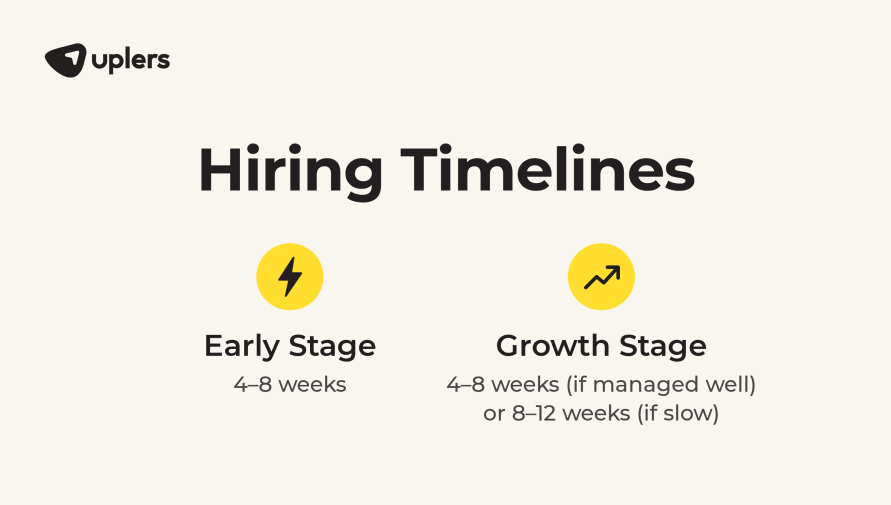
Hiring timelines to expect by stage
| Stage | Funding | Time to Fill a Role |
| Early Stage | Pre-Seed to Series A | 4–8 weeks |
| Scale Stage | Series B & C | 4–8 weeks (if managed well) or 8–12 weeks (if slow) |
Early-Stage Hiring: Pre-Seed to Series A
Team size: 2–20
Common mistakes made during early stage hiring
- You lean on job boards: Early-stage hiring doesn’t happen through Indeed or LinkedIn. Not at this stage, anyway. How are you going to find the right people vouching for your startup when they don’t know the company, its vision, or their founders well?
- Interview process is too long: A 6-round interview kills momentum. Good candidates have other options and other companies are making offers right now. Every week you delay the decision, another company closing them.
- You’re hiring from the wrong pool: This is huge in India. There’s a real gap between service-industry talent and product-industry talent. Many founders assume any engineer is any engineer. Service engineers deliver what’s asked. Product engineers build and own. You need the latter, but most founders don’t make that distinction.
How to make early-stage hiring fast?
- Hire from referrals where you can: Talk to your ex-colleagues, VCs, advisors, alumnis, and friends and family. Ask them to refer someone they know. Trusted people are imperative at this stage. And don’t stop looking once you hire, keep building pipelines as you go. Get a startup hiring partner who specializes in product talent. It will be faster, cheaper, and more efficient. But one note – hire from specialized partners not volume vendors or resume vendors.
- Use a 4-step interview process: Keeps it quick and keeps the candidate engaged.
| Step | Duration | What |
| Initial screening by founder | 20–30 mins | Assess fit for the role |
| Paid assignment/Weekend Contract Work | 2–4 Hours or a weekend | Can be take-home to savetime or a paid weekend ofwork |
| Culture round | 45–60 min | Evaluate alignment with how you work |
| Final discussion | 20–30 min | Align on expectations and offer |
For specific framework details, read our startup interview framework.
- Know what problem they will solve: Before you talk to anyone, be clear on why you are onboarding them even if you don’t have the 30/60/90 day plan ready. That is fine. When you know the problem they will be solving, evaluation and intent is clear.
- Hire startup-ready people: Don’t just hire experienced people. Hire product-minded people.Use our startup-ready candidate checklist to find people with product experience. Startups are dynamic, they need people with a different mindset than people who have worked all their lives within a defined scope.
Pro tip: How founders hire fast covers the specific tactics to compress timelines from 8 weeks to 3 weeks.
Growth Stage: Series B & Series C
Team size: 20–60 or more
Common mistakes made during growth stage hiring
- Extended interview processes are costing you top candidates: You went from 4 steps to 5 or 6 because now you need buy-in from multiple teams. Top candidates are in high demand. Every extra week is another company closing them. Your delayed feedback loops, slow decision-making, and lack of clear next steps causes candidates to accept competing offers.
- You’re promoting strong individual contributors into leadership roles they can’t handle: You hired a great engineer to build the product. Now you need a tech lead. You promote them because they are smart and capable. But they have never managed a team, never built systems for others to scale. 6 months in, they are overwhelmed, your team is frustrated, and you are stuck with someone who was a 10/10 engineer and a 4/10 leader.
- You are not mapping hiring to revenue: Founders ask “How many people can we afford?” instead of “Which 3 hires move the needle on our 12-month revenue target?” Hiring becomes budget-driven, not strategy-driven. You end up bloated or under-resourced.
- You are hiring for “now” instead of “future needs”: You fill your immediate hiring need (a second engineer, a salesperson) without considering what the company will look like in 18 months. Then you realize you hired someone great but misaligned with where you are headed.
- You are applying identical hiring logic across every role and level: Hiring a junior engineer is not the same as hiring a VP of Product. Hiring a contractor is not the same as hiring a leader. But many founders use the same process for everyone. It wastes time for junior roles (which should be 2–3 weeks) and moves too fast for senior roles (which need more vetting).
How to make growth-stage hiring fast?
- Shift from hiring generalists to hiring specialists: Create role-specific scorecards. Instead of “good engineer,” define: “engineer with 3+ years building real-time infrastructure” or “salesperson who has closed 5+ enterprise deals.” Be specific about what you need. Interview for that specific capability, not general competence.
- Compress your interview timeline to 2–3 weeks maximum: Parallel interviews. Multiple teams interview the same candidate on the same day. Set 48-hour feedback deadlines. Keep building pipelines. Keep backups, always.
- Map every hire to your 12-month revenue and product roadmap: Before you open a request, answer: How does this hire move us toward our revenue target? Is it a blocker? Can we hit our goals without them? Tie hiring to business outcomes, not open budget. This forces you to prioritize ruthlessly and say no to nice-to-have roles.
- Hire for the team you will be in 18 months, not the team you are today: If you are at 15 people and planning to be at 40, hire people who scale. Hire someone who has managed growing teams, who has worked in scaling companies. Don’t hire for today’s comfort; hire for tomorrow’s growth. This one shift changes the entire caliber of people you attract.
- Document culture and expectations in writing: By now, you can’t rely on informal communication. Write down: your company values, what ownership means at different levels, career progression paths, what “fast execution” actually looks like, compensation philosophy. New hires read it. Onboarding covers it. 30/60/90-day plans clarify it further. Create a hiring candidate checklist that new employees confirm they understand.
The bottom line?
The founder who compresses hiring timelines while clarifying expectations upfront fills roles faster and with better retention. That is your competitive advantage. Your process doesn’t need to be elaborate. It needs to be fast and honest. The stage you are in dictates the timeline and the mistakes you will make. Know which stage you are in, watch for the errors that come with it, and fix them before they cost you top talent.