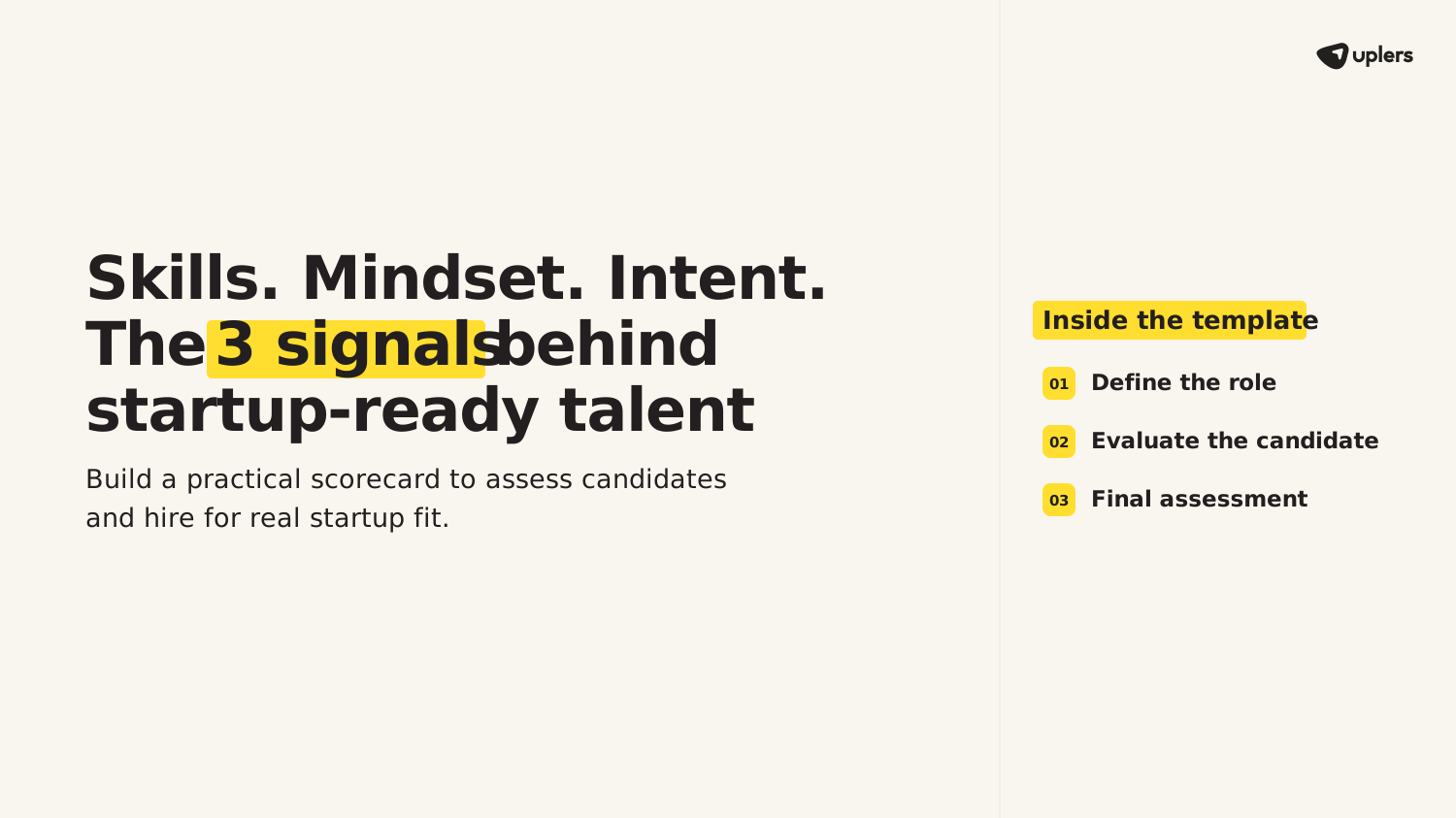
Snippet: This blog covers:
- The three dimensions that decide startup fit: Skills, Mindset, and Intent, and what each one measures.
- A step-by-step process for building a scorecard around role outcomes instead of generic qualifications.
- A scoring scale and weighting system that stops one strong answer from covering up a critical gap.
- Red flags mapped to each dimension, with guidance on when a flag needs more questions instead of an automatic rejection.
- A method for comparing candidates side by side using evidence instead of interviewer preference.
- How to read the scorecard’s findings once scoring is done.
- A free, ready-to-use scorecard template covering role definition, candidate evaluation, and final assessment.
- How Uplers applies this exact framework when sourcing and filtering startup-ready talent.
A wrong hire on a 10- or 20-person team does more damage than a bad quarter. It changes team dynamics, slows execution, and quietly loads extra work onto everyone else.
The resume can look perfect. The interview can feel great. Then priorities shift, ownership stays undefined, there is no playbook, and the same candidate who impressed you in the beginning starts to struggle.
That is why startup hiring needs more than a qualifications check. A useful scorecard evaluates three crucial aspects together: Skills, Mindset, and Intent.
It gives founders one consistent way to judge whether someone can do the work, operate through uncertainty, and is suitable for the environment they are walking into.
What Does Startup Fit Really Mean
Startup fit is the match between what a candidate can do, how they operate, and why they want the role. Tie it to the demands of your company, not a vague sense of who “seems like a startup person.”
Skills- Can They Do the Work
This dimension answers one question. Can this person solve the problems you are hiring them to solve?
Assess:
- Role-specific expertise that is important from day one.
- Problem-solving ability when the answer is not obvious.
- Ability to apply existing knowledge to unfamiliar problems.
- Outcomes they produced, not years logged in a title.
- Skills that must already exist versus skills you can reasonably teach.
A useful test asks the candidate to walk through a real problem they solved, the tradeoffs they weighed, and what happened next. A candidate who cannot narrate their own decisions probably did not make them. Hire an engineer who can adapt, ask questions, and make decisions when needed.
Mindset- How Do They Operate in Ambiguity
This dimension answers a different question. How will this person operate once the job stops matching its job description?
Look for:
- Ownership without constant supervision.
- Adaptability when priorities change mid-project.
- Resourcefulness when people, budget, or information are limited.
- Comfort making decisions with incomplete information.
- A track record of learning fast and taking feedback without getting defensive.
Skip the direct question “are you adaptable.” Ask about a project that changed direction halfway through and listen for what they did once the original plan stopped working.
Intent- Why Do They Want to Work in a Startup
This is the dimension founders check last and regret checking last. Does this person want the environment they are being hired into? This is most crucial for early-stage startup hiring.
Explore:
- Why they want to join a startup at this stage of their career, specifically your stage.
- What they expect from the role in terms of pace, scope, and structure.
- How much autonomy and ambiguity they are genuinely comfortable holding.
- Whether they want broad ownership or a tightly defined lane.
- Whether their career expectations match what your company can realistically offer over the next 18 to 24 months.
A candidate can have excellent skills and still be a poor hire if they expect a structured, well-resourced environment while your role demands constant reprioritization on their own judgment.
What Startup Fit Is and Is Not
Startup fit is not a personality type. It has nothing to do with whether someone name-drops other startups or calls themselves entrepreneurial.
Previous startup experience is useful evidence, but the stronger signal is whether the candidate has demonstrated the specific behaviors your role requires.
Someone from a large, structured company who has repeatedly built new processes or owned ambiguous projects can be more startup-ready than a five-year startup veteran who was always handed a clear brief.
How to Create a Startup-Ready Talent Scorecard
Nearly 75% of employers admit they have made a bad hire, and a senior mis-hire now costs upward of $240,000 once you count lost productivity and the search you have to run all over again. For a startup, that number can eat a full quarter of the runway. The stakes justify the extra structure.
Build the scorecard around the job you need done. Define success before interviews start, so the bar does not move from one candidate to the next.
Start With the Outcomes the Hire Must Own
Answer four questions before you write the job description.
- Why does this role exist?
- What business problem should this person solve?
- What should they have accomplished within six to twelve months?
- What evidence would tell you the hire is working out?
“Knows React and Node.js” gives you nothing to evaluate.
“Can independently take an evolving product requirement from technical discovery through production” gives you something you can track and score.
Define the Criteria You Will Evaluate
Keep every criterion this specific.
| What to Define | Founder Question |
| Criterion | What exactly am I assessing |
| Relevance | Why does it matter for this role |
| Expected Level | What does good performance look like |
| Evidence | What would convince me the candidate has it |
| Priority | Is this essential, preferred, or trainable |
Keep the list short. A scorecard with twenty criteria looks rigorous and produces worse decisions, because interviewers stop giving each one real attention.
Set a Clear Scoring Scale
Use one scale across the entire process.
| Score | Meaning |
| 1 | Clear gap, insufficient evidence |
| 2 | Some evidence, still below the required bar |
| 3 | Meets the expected bar for this role |
| 4 | Strong evidence, exceeds the bar |
| 5 | Exceptional evidence, a clear standout strength |
Define what a 3 looks like before the first interview. A 4 should mean the same thing for the first candidate and the tenth. Structured, standardized scoring is roughly twice as predictive of job performance as an unstructured, gut-feel process, which is the entire reason this is worth the extra setup time.
Weigh in the Criteria According to the Role
Not every criterion deserves equal pull on the final decision. A startup hiring its first product designer might weigh the scorecard like this.
| Dimension | Example Weight |
| Skills | 40% |
| Mindset | 35% |
| Intent | 25% |
Adjust the split for every role. A deep specialist hire usually needs heavier weight on Skills. An early generalist may need more weight on Mindset. Never let a high score in one dimension buy back a failed must-have criterion elsewhere.
Red Flags Across Skills, Mindset, and Intent
Red flags become more useful when they are tied to the specific demands of the role. Treat them as signals that require deeper questioning rather than automatic rejection.
| Dimension | Potential Red Flags |
| Skills | Claims expertise without evidence; cannot explain decisions; experience depends heavily on established processes |
| Mindset | Waits for instructions; struggles when priorities change; avoids ownership when things go wrong |
| Intent | Wants narrowly defined responsibilities; expectations don’t match startup realities; motivation is disconnected from the actual role |
One shaky answer under pressure means little. A pattern across two or three examples means a lot.
How to Use the Scorecard to Compare Candidates Objectively
The scorecard earns its value the moment you compare candidates side by side. Every candidate needs to face the same criteria and the same evidence standard.
Evaluate Every Candidate Against the Same Criteria
Use the same dimensions, the same definitions, the same scale, and the same bar for evidence across every interview.
You can ask different follow-up questions, but the underlying competency being scored has to stay fixed.
Separate Evidence From Impression
Write down what happened, not how you felt.
| Weak Note | Useful Note |
| Seems proactive. | Spotted a recurring customer issue, proposed a fix without being asked, and drove it to implementation. |
| Good communicator. | Explained a complex product decision to a non-technical stakeholder and changed the proposal after hearing pushback. |
| Handles ambiguity well. | Inherited an undefined project, clarified the goal, shipped a first version, and adjusted it after early feedback. |
The right column gives another interviewer something they can score.
Calibrate Interviewers Before They Start
Before the first interview, align a few things:
- Agree on what each criterion means.
- Agree on what a score of 3 looks like in practice.
- Flag which criteria are non-negotiable.
- Assign each interviewer a specific area to own.
- Decide what counts as sufficient evidence for each score.
This is important because most hiring noise comes from five interviewers quietly using five different standards for the same word.
Compare Strengths and Gaps
List candidates side by side and let the numbers carry the conversation.
| Criterion | Candidate A | Candidate B |
| Role expertise | 4 | 5 |
| Problem solving | 5 | 3 |
| Ownership | 5 | 3 |
| Adaptability | 4 | 5 |
| Intent alignment | 4 | 3 |
Then ask the only question that matters. Which differences move the needle for this specific role?
The highest total score is not automatically the right hire. A candidate with a lower total can still be the better choice if their strengths map directly to the risks your startup is most exposed to right now.
What Do Your Startup-Ready Talent Findings Tell You
The scorecard should not simply produce a number but explain the hiring decision. Look at the combination of Skills, Mindset, and Intent to understand where the candidate is most likely to succeed or struggle.
High Skills, Low Startup Fit
Strong specialist capability, thin evidence of independent operating or adapting to ambiguity. This can work when the startup can supply structure around them. It deserves a hard second look when the role requires them to build that structure themselves.
Strong Mindset, Some Skill Gaps
Ownership, learning speed, and adaptability show up clearly, alongside a skill gap that is realistically trainable. Separate a gap you can coach through onboarding from a capability the role needs from week one.
Strong Skills and Mindset, Misaligned Intent
The candidate can do the work and operate well, but their expectations do not match what you can offer. Surface the mismatch before the offer goes out. Misalignment on autonomy, scope, or pace turns into an avoidable resignation six months later.
Strong Alignment Across All Three
This is the pattern you are really hiring for. The candidate can contribute to the work, operate through uncertainty, and has a real reason to want this specific environment.
Want to understand how to hire in ambiguity? Here’s a guide to hire for the role that’s still evolving.
Free Startup-Ready Talent Scorecard Template
Use this as a starting point and customize the criteria around the role.
Part 1. Define the Role
| Field | What to Define |
| Role | |
| Why are we hiring | |
| Primary business outcome | |
| Key outcomes for the first 6 to 12 months | |
| Must-have requirements | |
| Trainable requirements |
Part 2. Evaluate the Candidate
| Dimension | Criterion | Priority | What Good Looks Like | Evidence | Score |
| Skills | Role-specific expertise | Must-have | /5 | ||
| Skills | Problem solving | Must-have | /5 | ||
| Skills | Relevant experience | Preferred | /5 | ||
| Mindset | Ownership | Must-have | /5 | ||
| Mindset | Adaptability | Must-have | /5 | ||
| Mindset | Resourcefulness | Preferred | /5 | ||
| Intent | Startup motivation | Preferred | /5 | ||
| Intent | Comfort with ambiguity | Must-have | /5 | ||
| Intent | Role and environment alignment | Preferred | /5 |
Part 3. Final Candidate Assessment
| Final Check | Notes |
| Strongest evidence | |
| Biggest concern | |
| Missing evidence | |
| Must-have gaps | |
| Overall score | |
| Recommendation | Strong Hire / Hire / Hold / No Hire |
| Why |
Complete the scorecard before the final hiring discussion wherever possible. That gives each interviewer an independent assessment before group dynamics influence the decision.
Here is a scorecard you can use to assess candidates on the same parameters.
How Uplers Evaluates Startup-Ready Talent
Uplers approaches startup-ready hiring by looking beyond whether a candidate matches a job description. The assessment focuses on whether the person can contribute effectively in the actual environment the startup is building.
Evaluates Beyond the Resume
Titles and years of experience only set context. The real evidence is what a candidate owned, the problems they solved, and what happened as a result.
Assesses Skills, Mindset, and Intent Together
Every candidate is checked on functional capability alongside ownership, adaptability, and motivation, so you see the full picture instead of a resume that covers one dimension and hides the other two.
Turns Candidate Signals Into Comparable Evidence
Consistent evaluation makes it easy to see where a candidate is strongest, which gaps are trainable, which gaps are disqualifying, and how every candidate stacks up against the same bar.
The Result Is a More Defensible Hiring Decision
The goal was never the most impressive resume. It is the candidate whose Skills, Mindset, and Intent give them the best real shot at succeeding in the role you are hiring for.
Conclusion
Startup-ready hiring gets easier the moment you stop treating it as a gut call. Define what success requires, score Skills, Mindset, and Intent against that definition, and capture evidence the same way for every candidate.
The scorecard does not replace founder judgment. It gives that judgment a stronger foundation and makes the decision easier to compare, discuss, and defend. Adapt the template to your next open role and make the hiring bar explicit before the first interview.