Your first few hires shape how your startup operates, ships, and grows.
At this stage, most founders set compensation without an HR team, salary bands, or a history of past hires. They rely on previous salaries, personal networks, job boards, or assumptions about the market.
That guesswork affects more than cost. A compensation range shapes the talent network you can reach, the seniority you can attract, how fast you hire, and how much runway each hire consumes.
Here’s the core idea: when your team is sm all, every salary carries more weight. Each hire takes a larger share of your people’s budget, and each offer sets the benchmark for everyone who joins next.
Why Salary Benchmarking Matters More for a First Startup Team
At a large company, one mispriced salary gets absorbed by hundreds of others. In a team of five, that same number shapes your budget, your culture, and every offer that follows.
Your First Hires Set the Compensation Baseline
Whatever you pay your first engineer becomes the reference point for your second, third, and tenth hire.
- Early salaries turn into informal pay bands: Later offers, raises, and leveling decisions get measured against them.
- An inflated first offer can cause pay inversion: A senior hire who joins later may end up earning less than an earlier, more junior teammate.
Example: Picture a five-person engineering team where an early mid-level hire earns close to what a future senior engineer would. When that senior engineer joins, you face hard conversations about role scope, experience, and pay progression. In a team this small, those gaps rarely stay private for long.
| Early compensation decision | What it shapes later |
| Salary for the first engineer | Future engineering pay bands |
| Seniority attached to the budget | Scope and expectations for later roles |
| Pay gaps between early hires | Trust and retention across the team |
A researched benchmark gives you a market-based starting point before any of these decisions reach the offer stage.
A Small Team Leaves Less Room for a Bad Compensation Decision
In a five- to ten-person team, one large salary commitment can change your entire hiring plan.
For example, a $30,000 difference in annual pay can equal a big share of the budget for another early hire. Before you commit to a number, a benchmark helps you answer three questions:
- How many hires can my current people budget support?
- How many months of runway does this team leave me?
- Which roles do I fill now, and which wait for the next round?
The goal here is smart planning. Pricing each role with confidence lets your budget stretch across the hires you need.
Your Salary Determines the Talent You Can Reach
Your compensation range quietly decides which candidates enter the conversation. Price it wrong in either direction, and the effects show up fast.
| Pricing mistake | What happens | Impact on a small team |
| Underpricing | Strong candidates skip the role or drop out after the first call | Slower hiring and a weaker early team |
| Overpricing | Candidates far above the role’s needs apply and accept | Faster burn and early churn once the work feels too small for them |
Why “Average Salary” Is a Weak Benchmark for Startup Hiring
A single average salary compresses several variables into one number. Founders need a more specific reference point, especially when the first hire carries broad ownership.
The Same Job Title Can Represent Different Work
“Software Engineer” can describe very different jobs, and the scope stretches even further inside a startup.
| Role | Likely scope |
| Product Engineer | User-facing features and product iterations |
| Backend Engineer | Backend services, APIs, and core business logic |
| Platform Engineer | Infrastructure, reliability, and developer systems |
| AI/ML Engineer | Building and deploying models or AI systems |
| Founding Engineer | Architecture, product execution, and technical decisions |
Each of these commands a different salary. Benchmark an AI/ML role against a broad software engineering average, and your hiring budget falls short before you post the role.
So match the benchmark to the work the person will own and the skills needed to deliver it.
Experience Changes the Market Value of a Hire
Three years and eight years of experience bring very different levels of technical depth, ownership, and decision-making. The difference grows when you expect the hire to work independently.
A first engineering hire may need to:
- Make architecture decisions
- Work directly with the founder
- Build the initial product
- Choose tools and technical standards
- Own production issues
- Help shape future engineering hiring
That scope can call for a different compensation range from a role with the same title inside a larger engineering organization.
Talent Level Matters as Much as Role and Experience
Two engineers with the same title and experience can sit at very different points in the market.
A flat average blends strong, proven talent with highly competitive talent, which makes it hard to connect the number to your hiring bar. This matters most in specialized roles, where only a small pool of candidates has the required depth.
A useful benchmark brings four variables together:
Role + Experience + Talent tier + Hiring market
What Founders Should Benchmark Before Making Their First Offer
Once you move past averages, benchmarks help with three early decisions: where to pay for top talent, how far equity can stretch, and when to go above market.
Which Early Roles Justify Top-Tier Pay
Every role carries a different level of business and technical leverage, so some early hires deserve a higher bar than others.
| Role | Why the hiring bar matters | Where to aim |
| Founding engineer | Sets the architecture and code standards your team builds on for years | Top-tier talent |
| AI or ML lead | Owns the capability your core product depends on | Top-tier talent |
| Feature or QA engineer | Builds on a foundation that already exists | Strong, proven talent |
Set the hiring bar for each role first, then let that bar shape the compensation range.
How Much of the Gap Equity Can Realistically Cover
A market benchmark gives you a clear reference for the cash part of your offer, which shows how much work your equity has to do.
Example: Say your target candidate sits around a $150,000 market benchmark and your planned cash compensation is $120,000. That $30,000 gap now becomes part of the equity conversation.
With the gap in view, you can weigh:
- The size of the equity grant and the ownership percentage it represents
- The vesting schedule
- How much the candidate values startup equity
- The overall appeal of the opportunity
The benchmark turns the cash-to-equity trade-off into a conversation built on clear numbers.
When Paying Above Benchmark Is the Right Call
Some hires carry unusual leverage for an early-stage company. Three situations can justify a premium:
- Rare skills that only a handful of candidates in the market have
- Founding-level scope, where the hire shapes the direction of the company
- A major execution risk removed, such as shipping the product your next funding round depends on
A benchmark helps you put an exact number on that premium.
Market range: $140K to $160K
Planned offer: $175K
Premium: $15K to $35K above the range
Reason: Specialized expertise for a core product capability
Treat the premium as a deliberate, documented decision with a clear reason and a known budget impact.
How Uplers Helps Founders Benchmark Startup Hiring Salaries
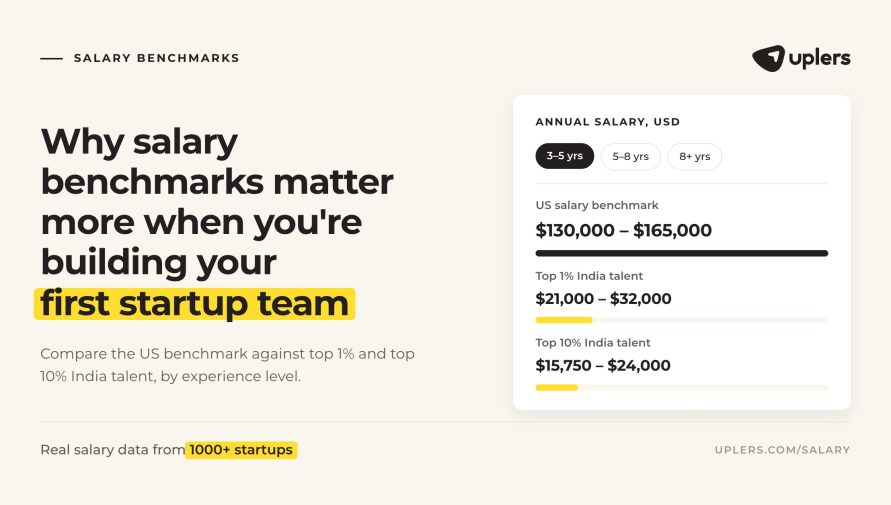
The Uplers Salary Comparison Tool gives founders a market-based reference point for engineering pay before they set a budget or open a role. It’s free to use, with no sign-up.
What the Tool Measures
- Role and skill: Specific disciplines such as Backend, Full-Stack, AI/ML, or DevOps
- Experience: Bands of 3 to 5, 5 to 8, or 8+ years
- Talent tier: Top 10% and Top 1% talent
- Location: Your current hiring market and India, side by side
| Tier | Who it covers |
| Top 10% | Strong, proven engineers who can own real scope |
| Top 1% | Engineers with strong pedigree, such as IIT-level education or MAANG-level experience |
Uplers’ data draws on hiring and salary data from 1,000+ startups, structured by role and experience band and updated in real time.
Use the Benchmark Before You Hire
- Setting the budget: Build the range around the talent tier you need.
- Writing the JD: Include a range that matches the hiring bar the JD describes.
- Choosing a market: Compare the same profile in your market and in India.
- Evaluating an offer: Check a candidate’s expectation against the role, experience, tier, and market.
Final Thoughts
Your earliest salaries become the foundation of your company’s compensation structure.
The question worth asking connects role scope, experience, talent level, hiring market, and available budget. A strong benchmark gives you that view before you open the role, speak with candidates, or make an offer.
So when you plan your first startup team, start with one specific question:
What does the talent I need cost, at the experience level and hiring bar my startup requires, across the markets open to me?
That’s the benchmark worth building your hiring plan around.