Snippet:
Paromita Bir will tell you she’s not a spotlight person. She’ll also tell you that before building TravelBuddy, she spent years watching women travel alone not because they preferred it, but because nobody around them wanted to go where they wanted to go. When TravelBuddy took shape between them, she already knew exactly what problem it was solving.
The first question most people ask when they hear about TravelBuddy’s founding team is the obvious one.
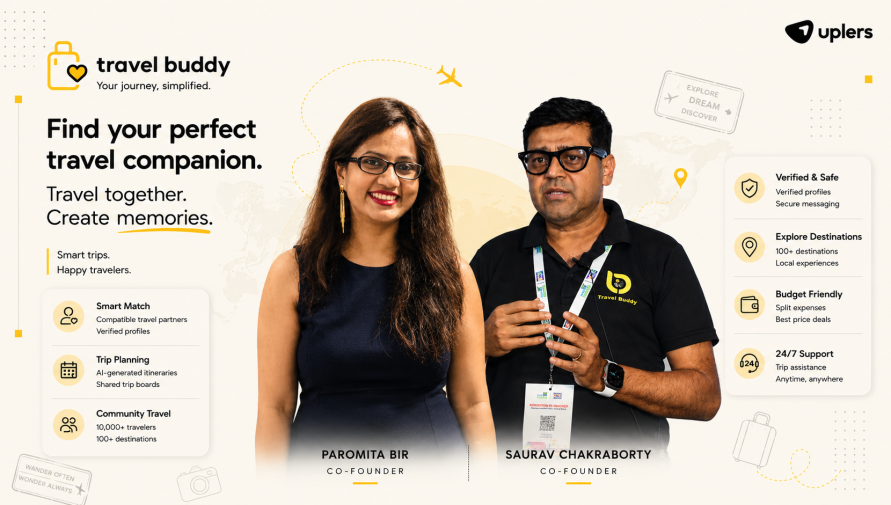
Paromita and Saurav Chakraborty are husband and wife. She’s the co-founder and Growth Head. He’s the CEO. They’ve been married for fourteen years. Before they started building TravelBuddy together, she’d worked at another startup where a husband-and-wife founding team had built something significant. She had asked the CEO the same question she now gets asked herself: how do you actually do this?
The answer she received: when you have the same goal, the small things don’t matter the way they otherwise would. Daily friction doesn’t compound. What remains is the direction, and if that’s the same for both of you, it’s enough.
Six years in, she hasn’t found a reason to disagree.
“The day-to-day things don’t really matter because our goal is on the bigger thing.”
There’s one advantage she mentions plainly. When one of them is having a hard week, the other understands it exactly, not in a general supportive way, but because they’re both carrying the same specific weight. A founder whose partner works a corporate job might find that gap hard to bridge. At TravelBuddy, there’s no translation required.
She already knew the problem
Paromita’s background is publishing and project management; content and operations, in other words. It’s exactly the combination community building requires: something worth reading, and the discipline to keep it running. That’s what she does as Growth Head. Not just acquiring users, but making sure the community they arrive into is worth staying for.
Over the years before they started building, she had met a disproportionate number of women travelling solo. Not by preference, but the people in their lives didn’t share that specific need. The wanderlust was theirs alone, and so by default was the trip.
She had heard enough of those stories to know it wasn’t incidental. It was a pattern. And the best travel experiences in her own life had always come from the opposite: the connection that made a place feel different from how it would have felt alone.
The trip that started it
Saurav had spent fifteen years at the heart of India’s travel-tech industry; MakeMyTrip, Cleartrip, and then Facebook as their Industry Head for Travel. He’d seen the entire stack from the inside. He still found this problem unsolved.
He had wanted to go to Ladakh. Friends confirmed. Then, the way friends do, they cancelled one by one. The cost of going solo more than doubled. The trip didn’t happen. But the question it left behind was specific: Why is there no way to find people who want to go to the same place, at the same time, with the same kind of intent? Someone who had built distribution strategies for the biggest names in Indian travel, and the problem of finding the right travel companion still had no answer.

The proof of what it could actually create came through Paromita’s own experience using it.
Her children were young. She and Saurav wanted to visit Hazrat Nizamuddin, the centuries-old Sufi shrine in Delhi that most visitors move through quickly, in a crowd. Through their own app she connected with a traveller from another state who had a contact near the shrine.
That contact had a son, a student who had grown up around the dargah, not as a tourist destination but as a place where he belonged. He took them in differently. The bookshelves, the quieter rooms, the way the community there actually lives. A crowded place and they didn’t feel the crowd at all.
“It was one of the very fulfilling experiences which I had in many, many years.”
That didn’t come from a search engine. It came from a connection between strangers who had no reason to know each other except that they both opened the same app.
Belonging is not a feature
Saurav runs the business. Paromita runs everything that touches the community; how users find each other, engage with each other, eventually travel together, and the services layer on top of it.
The word she keeps returning to is belonging. Not connection, not network, but belonging. The feeling that when you open TravelBuddy, you’re in a place that’s actually for you.

The early work was unglamorous: meetups, getting people who’d connected online into the same room. Some of them started planning trips together. Some of those trips happened. The community didn’t grow from a product decision, it grew from what people did after they found each other.
Now there’s Buddy Matchup: connect online, meet offline, travel together.
₹3.08 Cr in FY24 revenue.
4,500-plus trips organised.
Operating profitable.
The harder part of Paromita’s job is keeping it from becoming something else.
As TravelBuddy has grown, a portion of users have arrived looking for a social media platform rather than a travel companion; posting photos, consuming content, never actually booking a trip. That drift is the tension she manages daily. The community that made early users feel something is exactly what gets diluted when growth outpaces quality. Her growth strategy has to account for both numbers: how many people arrive, and how many of them actually travel.
The safety question runs through the same logic.
Online: selfie verification, community guidelines, fast action on reports. Offline, where control is harder, they’ve moved toward owning more of the experience, curated group trips with vetted vendors, a trip captain on every booking. Not a complete solution, she says. Something they keep improving as the feedback comes in.
The people who show up are mostly at two ends: 25 to 35, building their lives, looking for community outside their immediate circle. And 50-plus: children grown, the version of themselves that always wanted to travel now finally free to. Senior travellers often specifically seek out younger companions.
They want the energy. The younger group gets something rarer back.
We work hard and we party hard
TravelBuddy is fifteen people: tech, community, ops, sales
Almost all of them are young. Hired partly because they share what the product is built on.

What Paromita looks for is accountability over title.
No rigid hierarchy. No hire-and-fire.
They don’t raise fast, staff up fast, and cut fast when the money tightens. If something isn’t working for someone, the first conversation is about whether a different role fits. The expectation is that people take responsibility for their work and move it forward.
“We work hard and we party hard.”
For a company built on the belief that the best travel is fundamentally about who you go with, there’s probably no other way to run the inside of it.