Snippet
Vaibhav Chavan made himself a rule early on: never start anything without a cushion to fall back on. Then, cornered in 2014, he pulled the bed out of his own apartment, moved in a dining table, and bet the entire studio on a single game built in one room. It’s the bet he keeps making, and someone, he swears, is always watching him slog
By the end of 2014, underDOGS was almost out of money, and Vaibhav Chavan did something a careful man doesn’t do. He moved the bed out of his apartment.
In its place went a dining table. Four of them, Vaibhav and the three people who’d stuck around moved in around it and didn’t really leave for two and a half months. They had scoped a game with a seven-month build. They finished it in two and a half. “It was do or die for us,” he says. “We had nothing to survive on.”
The game was Skatelander, and it blew up. Number one on iPad in Russia for weeks. One of the first games out of India to sign an international publisher: Spil Games, out of the Netherlands. They were flown to Casual Connect in Singapore, then the US; none of them had stepped outside India before. “That game gave us name, money, fame. The whole story changed.”
Here’s the strange part, though. Almost nothing else about how Vaibhav built underDOGS suggests a man who likes to gamble.
The rule he made, and the one he keeps breaking
He had designed the company, from day one, to never need a miracle.
He only started UnderDOGS in 2011 because he already had three projects lined up. The instinct traces to one specific number. While working at Hungama, earning sixteen thousand rupees a month, he quietly sold a game he’d built on the side. One lakh landed in his account. “It was a game changer.” He resigned the same day, not because he was suddenly rich, but because he now had roughly five months of runway. Two days later the buyer came back asking for two more games. Now he could survive a year.
The strategy set itself: make games for other people, bank the cash, use it to fund the games he actually wanted to make.
So the bed-out-of-the-bedroom gamble wasn’t his nature. It was what happened when the cushion finally ran out. He’d stopped taking servicing work by the end of 2013, and the reserves dried up a year later. The careful man bet everything exactly once he had nothing left to be careful with.
And every breakthrough since has had the same shape.
Fourteen years of making other people’s games
What people see now is the Sony deal. What they don’t see is the fourteen years underneath it.
Vaibhav graduated as a computer engineer in 2007 and spent four years designing games for India Games, Disney, Games2win, Hungama.
As a producer, part of his job was finding small studios to outsource games to and he kept failing to find any worth hiring. So he became one. From 2011, underDOGS made browser Flash games, then mobile games, then gamified training simulations for brands. More than two hundred, two hundred and fifty titles across a decade, all for other companies. “Servicing,” he calls it, the bread and butter that paid for everything else.
But the DNA was never servicing. It was a story. Vaibhav spent ten, twelve years in Marathi theatre in Mumbai, acting and directing. “That’s where the knack for storytelling comes from.”
It surfaces in the strangest places.
Before Mukti, underDOGS made a small game called Till the Dawn Waiting, about a dog left tied to a bench by an owner fleeing a Florida hurricane, something Vaibhav had actually read about in the news. The dog could chew through the leash and run. He stays, because he doesn’t want to disappoint the owner who might still come back. The game ran for an hour. They cut it to twenty-five minutes. “We saw people crying while playing it. Even I would have cried.”
A founder who cuts his own game in half because it’s too sad to finish is not optimizing for engagement metrics. He’s directing.
Someone is always watching you slog
Then there’s luck, except Vaibhav doesn’t think it’s luck, and the distinction is the entire point.
When they built a ten-minute demo of Mukti in Unity back in 2018, Unreal, Epic’s engine team, somehow took notice of it. Vaibhav thinks it’s because he’d spent years putting his work, finished and unfinished, on YouTube and LinkedIn.

Unreal asked if he’d switch engines; there was a grant in it, a MegaGrant. He switched, applied, and got around $25,000 in 2020. He used it to build a far better vertical slice and a cinematic teaser. That teaser is what he eventually pitched to Sony.
Out of 400 applications to PlayStation’s India Hero Project, the program Sony brought to India after running its China Hero Project since 2016, underDOGS was selected. Sony funded the game outright. It ships on PS5 and PC, day one.
“If you look at the trajectory,” he says, “there’s always someone watching us slog.” He says it the way people say things they half-believe are magic. But strip the mysticism and it’s a method: he had been visible for years, leaving unfinished work where the right people could trip over it, so that when he finally needed a door, the door already knew his name.
Why he’d pick the decent guy over the genius
Of the people Vaibhav first hired, five are still with him fourteen years later. He thinks that’s the single reason the studio is alive. Which tells you what he actually screens for, and it isn’t talent.
He found Sankesh, now his co-founder, by walking into a small local training institute and asking for their best student. He left a card with an address. The address was a four-by-four-foot cabin wedged inside his father’s metal workshop, in the middle of an industrial estate.
Sankesh hunted for two hours for something that looked like a games company before someone pointed him up a staircase into the factory. He found Vaibhav sitting there in his shorts. “I don’t know, it just matched.” Sankesh stayed for fourteen years.
The clearest version of the philosophy is a story about two interns hired on the same day in 2017. One was, by Vaibhav’s account, a genius, so sharp it was unsettling; he’d sometimes talk to himself. The other was merely decent. But the genius ate lunch alone, carried what Vaibhav calls “product ego”, and didn’t listen. The decent one ate with everyone, took every note, and kept getting better.
On their last day, Vaibhav told the genius to his face: if I could work with one of you again, I’d pick him. He says he meant it as a push to improve. He also meant it.
“Skills, everyone can learn. That’s not the challenge.” What he hires for is the DNA, good listeners, humble, long-term, able to lead things later.

It’s worth seeing the place this produces.
No strict timings, no rigid leave policy, PS5s running in the office, the whole team eating out of lunchboxes together like schoolkids. Vaibhav still sits on the floor with them at lunch, fourteen years in, when plenty of founders at his stage have long since retreated to a cabin. The culture is the retention strategy.
The kid who cries gets the milk
This is also, it turns out, his answer to everyone trying to break in.
Vaibhav has been making content for eight years, since 2018, for one reason: when he started, there was no institute, no information, no support, and he didn’t want anyone else starting from that same nothing. He now gets hundreds of messages from people wanting into games, and he thinks most of them fixate on exactly the wrong thing. Which course. Which engine. How to make their own game first. “All of that is useless.”
 He has a line for it. “Out of a hundred kids, the one who gets the milk is the one who cries the most.” People imagine they’ll study for two years and then be ready.
Wrong, he says.
Be ready from day one. Post what you’re learning each week. “Two hundred people will see it, two like it, that’s fine. By the time you’re ready to be ready, the world will be ready to take you.”
It is, of course, exactly what he did. The slog was always visible.
What he’s actually chasing
Vaibhav won’t call himself successful yet. “We’ll only call ourselves successful when the game is out, when we’ve made a name for the studio, and the money too.”
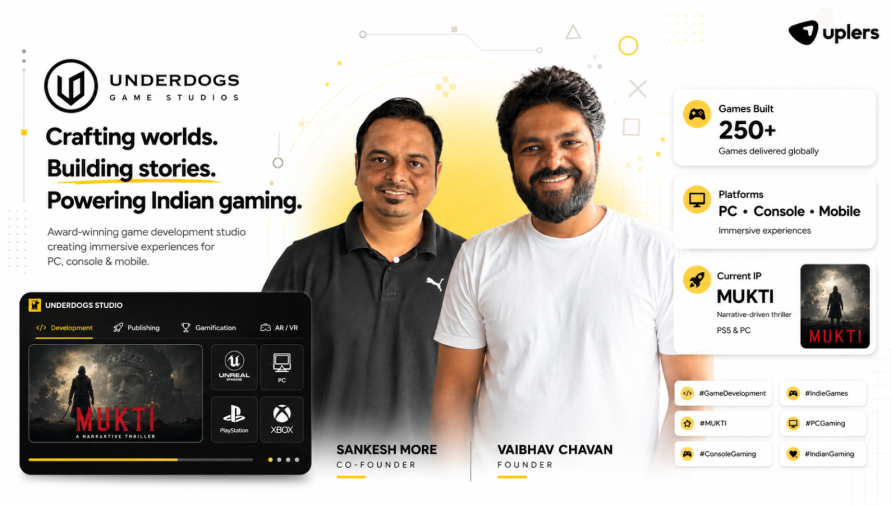
He’s spent fourteen years making other people’s games to earn the right to make one of his own. And the one he chose is about something as unglamorous and unmarketable as human trafficking, shot with real actors in real locations like a film, dropped into a game, on a console almost no one in India owns.
By every investor’s math, it’s the wrong bet. There are no case studies for it here; the money goes to mobile, where you can test an idea in three months.
He’s making it anyway, the same way he stripped his own bedroom in 2014.
Because the careful version of his life, it turns out, was only ever the thing that funded the reckless one.