Snippet:
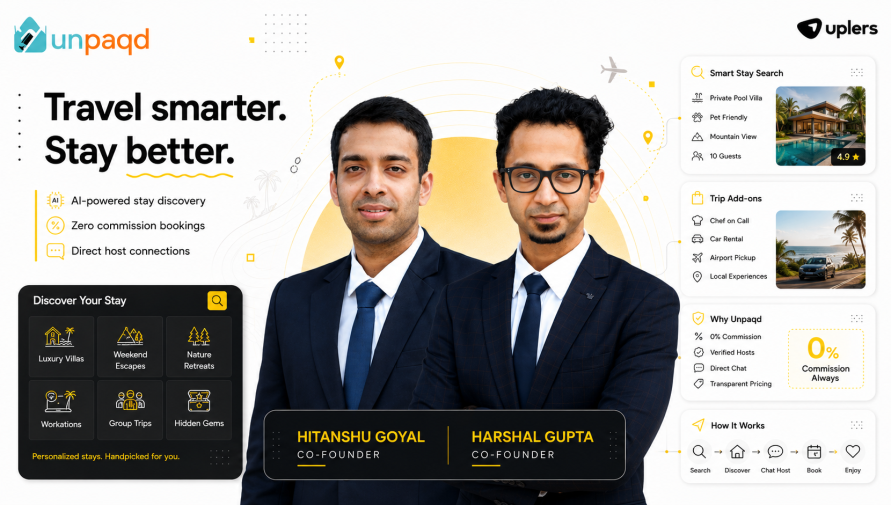
When Hitanshu Goyal and Harshal Gupta listed their first Goa villa on Airbnb, seven or eight out of ten guests would call before booking, to negotiate on price, to get a live walkthrough, to be sure. They weren’t looking at a problem. They were looking at a market. About 70% of India’s premium vacation rental bookings happen off any platform. Unpaqd was built for that 70%.
Hitanshu Goyal and Harshal Gupta were roommates at IIM Lucknow. They’d been circling business ideas throughout their MBA- pitched an edtech startup to the college incubator, and graduated into high-intensity jobs without one that had worked. One short trip to Goa changed that.
It was the first time they’d stayed in an Airbnb together. They came back, took a four-bedroom Portuguese villa on lease, and listed it while holding their jobs. The model looked right on paper. What they found when the guests started calling was more useful than anything they’d researched.
Seven or eight out of ten guests wanted to communicate off the platform before they’d book.
The call that didn’t happen on Airbnb
The reasons were always the same two. The first was price: Airbnb takes around 18% per transaction, and when you can see that and reach the host directly, you ask. The second was trust: a premium vacation rental costs upwards of ₹20,000 a night for a trip most people in that bracket take once every year and a half. Eight or nine reviews per property isn’t enough to commit that kind of money. They wanted to see the property live before they booked.
Airbnb doesn’t allow direct contact before booking, for exactly this reason. But the contact was happening anyway. Hitanshu and Harshal were the hosts fielding those calls, and what they found on the other end wasn’t a problem. It was the real market.

The walkthrough
What Unpaqd built isn’t a better Airbnb. It’s a different premise entirely: if a guest has seen the property before they book, expectation mismatch almost disappears.
The data layer reflects this. Unpaqd captures roughly two and a half times the property information that Airbnb would, not just amenities, but specifics. Exact pool size, which floor the bedrooms are on, the actual distance from the beach in kilometres. The natural language search built on top of it doesn’t return a hundred options, type your requirement and it returns five that match. Once you’ve found the property, you get a live walkthrough before you commit.
For hosts, the pitch is straightforward: pay ₹12,000 a year for a 1BHK listing instead of 18% per transaction. Goa is the pilot, with 10,000+ properties listed across North Goa, South Goa, Candolim, the densest Airbnb geography in India and the right place to prove the model before expanding.

The CSAT is 4.79. Hitanshu is direct about why: “The expectation mismatch is very rare when someone has actually live-seen the property.” It’s not support quality. It’s that there’s very little left to be disappointed about. The repeat rate is 25 to 27 percent, unusually high for a category where most people travel once every eighteen months.
The second distribution channel is less visible to most travelers. BidYourStay: the same company, different face, serves travel agents: the B2B layer that still handles the majority of leisure travel booking in Tier-2 and Tier-3 India. The same inventory powering Unpaqd’s consumer platform reaches agents at net rates, who resell at a markup. B2C for the traveler who books online. B2B for the agent who still books on the phone. One supply base, two channels. It’s not a pivot, it’s the same thesis applied to the entire distribution stack.

The bid they toned down
The bidding feature came from watching what the offline negotiations actually looked like, guests naming a price, hosts countering, back and forth until they found a number. The question was: why does this only happen on the phone?
Priceline tried to answer that question for US hotel bookings for twenty years and quietly killed it. “Name Your Own Price” worked on distressed hotel inventory, last-minute rooms that would otherwise go empty, but failed as a primary booking mechanic. Consumers in the US wanted certainty more than they wanted the discount.
India runs differently. Negotiation in India isn’t a workaround; it’s the default, built into how any purchase over a certain threshold gets made. The mechanics of the bid transfer.
What they didn’t anticipate was price anchoring. Once a guest places a bid, that number becomes their floor, not an opening, the price they expect to pay. By the time the host responds, the ceiling is already set. The feature that was pulling people into the funnel was compressing the revenue at both ends.
So they toned it down. The bids still come in every day, it’s still there, still working, but it no longer headlines the product. What leads is the walkthrough, the trust, the direct relationship. Because that’s what the 70% were actually calling about.
The people who take it personally
Hitanshu was early at UpGrad; thirty, thirty-five people on the team. When a customer said something bad about the company, he’d defend it. Not because anyone asked him to. Because when you’re that early and that invested, the product’s reputation feels like yours.
That’s the only filter he hires on. Seventy percent intent, thirty percent skill. Not IIM pedigree. Not a particular background. The skill gap, he thinks, AI closes fast enough. What it doesn’t close is whether someone cares. His read on it: “If you talk to anyone in the company right now and you say something bad about Unpaqd, they will be offended.”
The first hires came from references, people who’d worked with either of them before and took pay cuts to join. The team is nineteen people, and the culture hasn’t been designed so much as it’s accumulated. Light. No micromanagement. And built, Hitanshu says, from the everyday conversations, not from anything explicit. The kind of ownership he’s describing doesn’t come from a culture doc. It comes from finding people who already feel that way before they start.