Snippet
- First thing: don’t copy-paste a JD from another company.
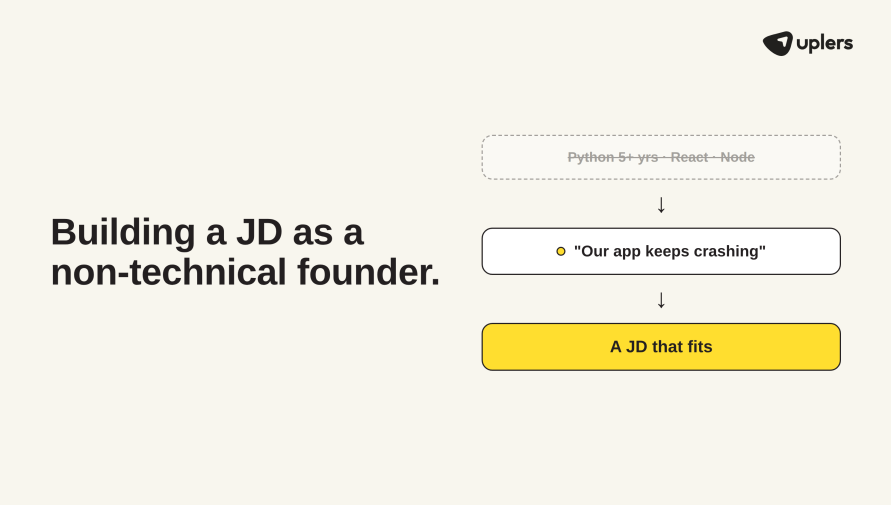
- Start with the problem, not the tech. “Our app is slow and crashes” tells a good engineer more than a list of 10 technologies.
- Say your stage out loud. Pre-seed with 3 people is a completely different job than Series A with 15.
- Describe what they’ll own, not a task list. The best early engineers want ownership, not a to-do list.
- Don’t skip soft skills or the salary range. Can they decide without being told? Do they treat the product like it’s theirs? And a missing range wastes everyone’s time.
- If nothing works, try our AI Job Description Builder. Check it out below.
If you are a non-technical founder who has to hire an engineer then you must be dreading writing a job description because how do you know who you even need?
At this stage, It is very important to remember that you don’t just copy-paste a JD from another company. It attracts people who match keywords, not people who fit your company. And the good ones, the ones who could actually build your thing, just skim it and move on.
Here’s the shift, in short:
| What founders usually write | What to write instead |
| A list of 10 technologies | The problem you need solved, in plain words |
| “5+ years of React” | “Comfortable owning our product end to end” |
| A daily task list | What the person will own |
| Nothing about working style | The soft skills your stage actually needs |
| No salary range | A real range, benchmarked before you post |
| A generic “requirements” block | A short “this is for you if” filter |
Here’s how to do it better, even if you can’t tell Python from JavaScript.
- Start with the problem, not the tech: You don’t need to know the stack, you just need to know what’s broken or missing. “Our app is slow and crashes.” “We have no way to turn our data into features.” “Customers want X and we can’t build it.” Write that down in plain words. A good engineer reads the problem and infers the tech. A simple google search or talking to an engineer friend will help you polish this.
- Say what stage you’re at: Pre-seed with 3 people is a completely different job than Series A with 15. If you hide this, you attract people who might not fit. It’s a filter that pulls in the people who like that and repels the people who’d quit in a month.
- Describe what they’ll own, not a task list. Non-technical founders often list tasks because tasks feel safe. But the best early engineers want ownership, not a to-do list. “You’ll own how we build and ship features, working directly with us” beats a bullet list of daily chores.
- Don’t skip the soft skills: This is the part founders miss most, and it’s the part that matters most at a startup. Can this person work when the path is unclear? Do they make decisions without waiting to be told? Do they treat the product like it’s theirs? A brilliant engineer who needs a manager and a spec will sink at a 3-person company. Name the working style you need.
- Put in a salary range: Skipping it wastes everyone’s time. You’ll get applicants who are way out of your budget and lose ones who’d have been perfect. If you don’t know the market rate, look it up before you post.
- Add a “who this is for” line: A short, honest filter. “This is for you if you’ve built something from scratch and want the architecture decisions to be yours.”
Now, the honest truth: doing all of this well, as a non-technical founder, is hard. You’re guessing the experience levels, market salary, and which soft skills matter at your stage. That guessing is exactly why we built the AI Job Description Builder.
You tell it the problem, in your own words. It maps that to the right role, even if you don’t know the title. It infers the stack, the experience range, and the seniority from your stage and what you describe, so you’re not guessing. It writes the ownership language, the soft skills, and the fit filter for your exact stage. It benchmarks the salary to the Indian product market for you.
You answer 2 or 3 questions. It handles the parts you’d have had to fake.
You don’t need to become technical to write a JD that a strong engineer respects. You just need to say the real thing clearly, and get help with the parts that need market knowledge you don’t have yet. It’s built for hiring India-based engineering talent, so the role mapping and salary come from the Indian product market.