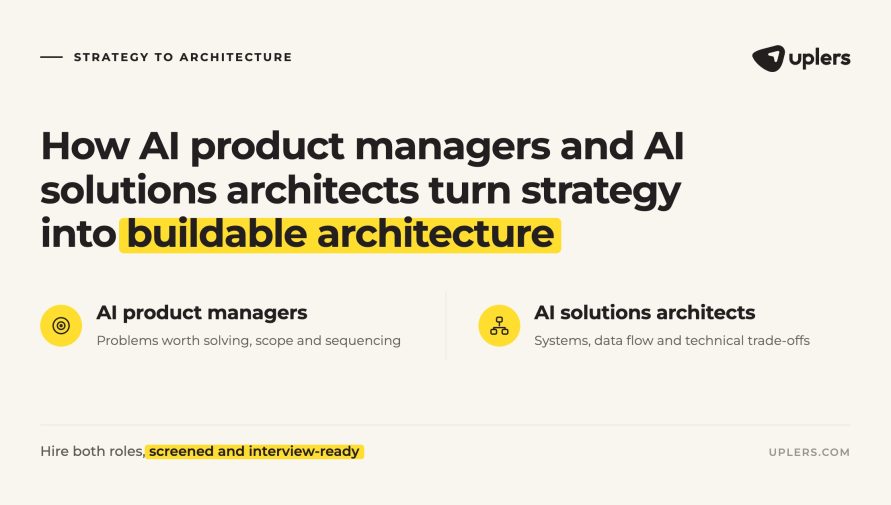
An AI strategy becomes buildable when your startup can turn an AI opportunity into product decisions and a technical plan your team can execute. That’s where two roles become crucial early.
An AI Product Manager turns your business goal into a customer problem, MVP scope, product requirements, and success metrics. An AI Solutions Architect turns those decisions into a blueprint covering models, data, RAG, agents, integrations, security, and cost.
Think of it this way: the Product Manager decides what deserves to be built and why. The Solutions Architect decides how to build it without creating unnecessary complexity. Together, they help founders move from AI ambition to a product that customers can use.
What Does an AI Product Manager Define Before Architecture Begins?
Founders usually start with an AI idea. The AI Product Manager turns that idea into something engineering can build and customers will find useful.
Define the Business Outcome
The first job isn’t choosing a model, but it is choosing the outcome.
| Founder goal | Product outcome |
| Reduce support costs | Automate Tier-1 support |
| Increase sales | AI-assisted account research |
| Save team time | Workflow automation |
| Launch an AI product | Defined MVP |
Example: “Build an AI support agent.“
Becomes: “Resolve eligible Tier-1 support requests using approved company knowledge.”
That single rewrite gives the architect direction.
Turn User Needs Into AI-Specific Product Requirements
The AI Product Manager converts customer workflows into buildable requirements.
Instead of broad user stories, they define:
- What information the AI receives
- What it returns
- What actions it can take
- When humans step in
- How fast it should respond
This also protects the MVP from growing into an oversized first release.
Define What “Good” Looks Like
AI products need measurable success before development starts.
| Measure | Why founders care |
| Task completion | Product works |
| Accuracy | Customer trust |
| Human escalation | Operational effort |
| Latency | User experience |
| Cost per task | Unit economics |
For agent-based products, evaluation also includes how the AI reached its answer. Anthropic recommends evaluating agent workflows, tool usage, and execution paths alongside outcomes.
If success isn’t measurable, engineering ends up guessing what “good enough” means.
How Does an AI Solutions Architect Turn Requirements Into Architecture?
Once the product direction is clear, the next question becomes: what’s the simplest system that delivers it?
That’s exactly AI Solutions Architects do.
Map the Product Workflow to AI System Components
Every product requirement becomes a technical decision.
| Product need | Architecture decision |
| Private company knowledge | RAG |
| Customer records | API/database |
| Business action | Tool call |
| Multi-step workflow | Agent |
| High-risk action | Human approval |
For example: For a customer-support product, the AI can retrieve relevant company knowledge, check the customer’s account, recommend a resolution, and complete an approved action.
Each step becomes its own component instead of one oversized AI call.
Choose the Right Architecture Pattern
Architecture follows workflow complexity.
| Product need | Best fit |
| Content generation | LLM |
| Internal knowledge | RAG |
| Multi-step execution | Agent |
| Fixed business rules | Software |
| Mixed workflows | Hybrid |
A founder’s question should always be: “What’s the minimum architecture needed to validate this product?”
Select and Route Models Based on Requirements
Model choice affects both experience and margins.
The architect balances:
- Reasoning quality
- Response speed
- Context size
- Multimodal needs
- Inference cost
- Vendor flexibility
Many startups route simple tasks to cheaper models while reserving premium models for complex work.
Stanford’s 2026 AI Index shows top model performance converging, with competitive pressure increasingly shifting toward cost, reliability, and domain-specific performance. That makes model selection an ongoing business decision for startups.
Good architecture protects both your roadmap and your runway.
Designing the Data, Retrieval, and Agent Layer Together
What your AI knows and what it can do should be designed together. Separating those decisions usually creates unnecessary complexity later.
Decide What Data the Product Needs
Start with the customer journey, not your database.
A sales AI product may need:
- CRM records
- Contracts
- Product documentation
- Support history
- Live account data
The architect decides where each source comes from, how fresh it needs to be, and how the AI accesses it.
Design RAG for Freshness, Relevance, and Permissions
Production RAG is a retrieval system, not just a vector database.
It typically includes:
- Document ingestion
- Chunking
- Hybrid retrieval
- Reranking
- Permission filtering
- Source attribution
For founders, the question is simple: “Can the AI retrieve the right answer without exposing the wrong data?”
Decide Where Agents Add Value and Set Their Boundaries
Agents make sense when workflows require planning and execution across multiple steps.
The architect defines clear boundaries.
| Boundary | Decision |
| Tool access | What AI can use |
| Data access | What AI can read |
| Approval gates | What humans approve |
| Step limits | How far AI can act |
| Handoff | When humans take over |
This prevents autonomous workflows from becoming unpredictable.
Know When RAG, Fine-Tuning, or Plain Software Fits
Not every problem needs the same solution.
| Startup need | Best approach |
| Current private knowledge | RAG |
| Behavior adaptation | Fine-tuning |
| Multi-step execution | Agents |
| Fixed rules | Software |
Choosing the right approach early saves months of rebuilding later.
The goal isn’t using more AI. It’s using the right amount of AI.
From Requirements to Architecture: The Shared Handoff
This is where strategy becomes something engineering can build. The handoff works best when both roles shape it together.
Turning a PRD Into a Technical Design Doc
The Product Manager brings business clarity.
The architect adds implementation clarity.
| Product Manager | Solutions Architect |
| Customer workflow | System design |
| Requirements | Components |
| Success metrics | Data flow |
| Constraints | Security & cost |
Example:
Product requirement: The AI should resolve eligible refund requests.
Technical design: The system verifies the order, checks the refund policy, requests approval when needed, and then processes the refund through the company’s payment or order system.
Using Shared Standards Like MCP as a Common Technical Language
Standards like MCP (Model Context Protocol) make product discussions more concrete.
Instead of saying: “Connect AI to our CRM.”
The conversation becomes: “Give the agent read access to customer records and permission to perform approved actions.”
That level of clarity reduces translation loss between product and engineering.
Making Joint Architecture Reviews a Recurring Ritual
AI products evolve faster than traditional software.
Regular reviews help teams revisit:
- Customer feedback
- Model performance
- Costs
- Retrieval quality
- Agent behavior
- New integrations
The roadmap and the architecture should evolve together.
AI Product Managers and Solutions Architects shouldn’t work in sequence but as a feedback loop.
Making the Architecture Production-Ready
Shipping an AI MVP is one milestone. Running it reliably is another. This is where architecture starts affecting customer trust and business margins.
Build Evaluation Into the Product Lifecycle
Evaluate real product scenarios.
Include:
- Common customer requests
- Edge cases
- Tool-use tests
- Permission-sensitive tasks
- Failure scenarios
For agents, measure both the outcome and the execution path. NIST recommends structured evaluation throughout the AI lifecycle.
Instrument for Observability and Cost Control
Founders need operational visibility.
| Metric | Business signal |
| Latency | User experience |
| Cost per task | Profitability |
| Retrieval quality | Answer quality |
| Tool failures | Workflow health |
| Escalation rate | Human effort |
These metrics show whether the product scales economically.
Design for Security, Governance, and Model Portability
Security should exist inside the architecture.
That includes:
- Access controls
- Tool permissions
- Prompt-injection defenses
- Audit logs
- Vendor abstraction
A modular design also makes future model changes much easier.
Production-ready architecture protects customer trust before it protects infrastructure.
From Strategy to Buildable Architecture: The Practical Framework
Founders can simplify the entire process into seven decisions.
- Define the business outcome.
- Set product requirements and success metrics.
- Map the customer workflow.
- Choose the right architecture pattern.
- Design data, RAG, and agent capabilities together.
- Set security, governance, and cost guardrails.
- Launch an MVP and improve it with real usage.
Every step represents a shared decision between product strategy and technical architecture.
Conclusion
AI Product Managers help founders decide what deserves to be built. AI Solutions Architects help founders build it without creating unnecessary technical debt.
The strongest AI startups connect these roles early, turning customer problems into product requirements, architecture decisions, and MVPs that can grow with the business instead of forcing expensive rebuilds later.