Your first two engineering hires can determine how quickly your startup turns product decisions into working software. The question is whether you need a backend-focused engineer, a frontend-focused engineer, two full-stack engineers, or a combination of these profiles.
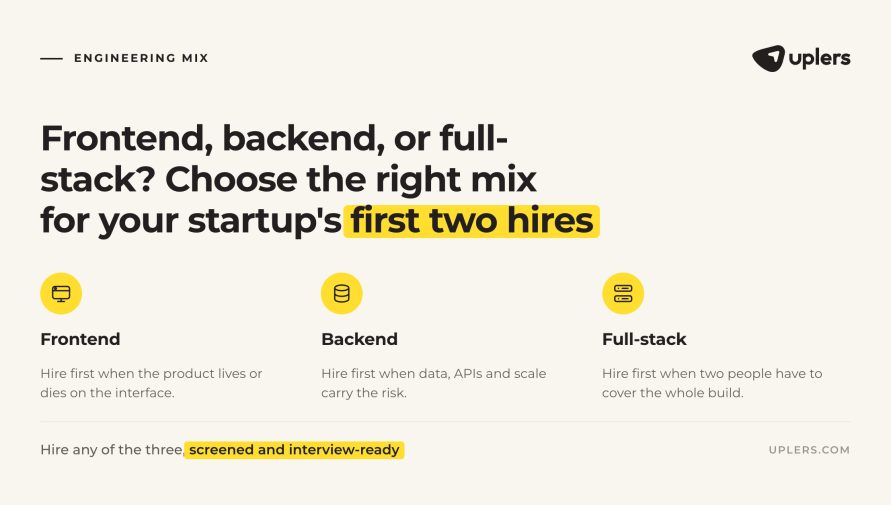
There is no fixed 50/50 formula. Start with the part of the product that carries the most engineering risk. If that risk sits in data, APIs, integrations, or infrastructure, start with backend expertise. If the product depends on a complex user experience, start with frontend expertise. If you need one person to move across the entire product, start with a full-stack engineer.
The second hire should close the most important capability gap left by the first.
What Should Your First Two Engineering Hires Cover?
Two engineers can cover a broad technical surface without creating unnecessary specialization. Define what each engineer needs to own before deciding which job title to use.
Hire #1 Should Cover the Biggest Technical Constraint
Start by identifying what could prevent the product from shipping or being validated.
That constraint usually falls into one of three areas.
- Product interface and user experience: The product needs complex interactions, workflows, dashboards, or rapid UI experimentation.
- APIs, data, business logic, or infrastructure: The product depends on complex processing, integrations, permissions, transactions, or data architecture.
- End-to-end product delivery: The startup needs one engineer who can take a feature from requirements through production.
The question is not simply whether to hire frontend or backend. The question is which engineering capability the product needs first.
Hire #2 Should Fill the Gap
The second engineer should add capability that the first engineer cannot cover deeply enough.
| Hire #1 | Hire #2 |
| Backend-focused | Frontend-focused |
| Frontend-focused | Backend-focused |
| Full-stack | Specialist in the area where complexity is increasing |
This gives founders a practical basis for deciding whether to hire backend developer talent first or build frontend capability first.
When Should Your First Hire Be a Backend Developer?
A backend-first hire makes sense when the product’s core functionality depends on systems that users do not see. The engineer needs to make those systems reliable enough for the rest of the product to build on.
The Product’s Complexity Lives in Data and Business Logic
Backend expertise should come first when the product requires substantial work in areas such as:
- APIs and third-party integrations
- Data models and business workflows
- Authentication and permissions
- Payments and transaction processing
- Background jobs and asynchronous processing
- Data pipelines and AI workloads
- System reliability and infrastructure
Consider a fintech product that handles transactions and multiple account permissions. Its early engineering risk sits in data integrity, business rules, security, and integrations. A polished interface cannot compensate for gaps in those foundations.
The Product Can Start With a Simple Interface
A backend-first approach can also fit products where the initial interface is straightforward.
Examples include:
- Internal business tools
- API-led products
- Data-heavy platforms
- Developer-facing products
- Products where core functionality needs validation before interface refinement
When should you hire a backend developer first?
Hire backend-first when data, APIs, integrations, infrastructure, or business logic represent the main technical risk. Your first backend developer should be able to make architecture decisions independently because there may be no second engineer to provide specialized backend input.
When Should Your First Hire Be a Frontend Developer?
A frontend-first hire works when the product’s value depends heavily on how users interact with it. The engineer needs to turn product requirements into a usable experience while the backend remains manageable.
The User Experience Drives Product Adoption
Frontend expertise should come first when the product requires:
- Complex user workflows
- Highly interactive interfaces
- Consumer-facing experiences
- Sophisticated dashboards
- Rich visualizations
- Frequent interface experimentation
- Strong emphasis on usability and accessibility
Consider a collaboration product where users need to create, edit, organize, and share information quickly. The interface becomes a major part of product validation because users need to experience the workflow before the startup can learn what works.
The Backend Can Remain Manageable
A frontend-first hire can work when the backend requirements are covered through:
- Existing APIs
- Third-party services
- Managed infrastructure
- Simple initial data models
- A technical founder who can handle backend development
When should you hire frontend developers first?
Hire frontend-first when product validation depends on the user experience and the initial backend can support that experience without significant architectural work. If you hire frontend developers at this stage, look for engineers who can integrate APIs and work comfortably across the boundary between the interface and backend services.
How Should Startups Split the First Two Hires?
Three hiring patterns cover the main scenarios for an early-stage startup product. Choose between them based on where the product has the greatest technical risk and how independently the work can progress.
Backend-First + Frontend Second
Choose this sequence when backend development is the initial constraint.
The first engineer can establish the data model, APIs, business logic, and core infrastructure. The second engineer can then build the interface around those foundations and take ownership of the growing product experience.
Example: A B2B platform depends on several external systems, complex permissions, and data processing. The backend needs to be established before the customer dashboard becomes the main engineering focus.
Frontend-First + Backend Second
Go for this when the product needs substantial interface work before the backend becomes complex.
The first engineer can build the core workflows and make them usable for early customers. The second engineer can strengthen the backend as product requirements, data needs, and integrations expand.
Example: A consumer application needs users to test several workflows during the MVP stage. The backend can rely on established services while the startup experiments with the product experience.
Full-Stack First + Specialist Second
This works when the startup needs rapid iteration across the entire product.
The first engineer can own complete feature slices from requirements through deployment. The second engineer should add depth where the product is beginning to encounter more complex technical requirements.
That specialist could focus on:
- Backend architecture and infrastructure
- Frontend architecture and performance
- AI and machine learning
- Data engineering
- Security
- Reliability
If You Started Full-Stack, How Do You Know When to Specialize?
A full-stack approach can work while the product is small. As the product grows, one engineer may spend too much time switching between frontend and backend problems. That is when ownership starts becoming useful.
Frontend Work Becomes an Engineering Problem
Look for several of these signals.
- The number of screens and workflows keeps increasing.
- Client-side state becomes difficult to manage.
- Frontend performance requires sustained engineering work.
- Accessibility becomes an important product requirement.
- A design system needs consistent ownership.
- Product teams are running frequent UI experiments.
Backend Work Requires Deeper Ownership
Backend specialization becomes more relevant when:
- Data volume increases significantly.
- Third-party integrations become numerous or complex.
- Reliability becomes a major product requirement.
- Security or compliance requirements increase.
- Background processing becomes resource-intensive.
- AI inference or data workloads require engineering attention.
Both Sides Can Move in Parallel
Specialization becomes easier to justify when frontend and backend work can progress independently.
Look for three conditions.
- API contracts are stable enough for engineers to work in parallel.
- Each side has enough meaningful work to occupy an engineer.
- Ownership is clear without creating constant coordination overhead.
The signal is complexity combined with independent work. Team size or a fixed hiring timeline should not determine when specialization happens.
What Should the Two Engineers Own Together and Separately?
Separate ownership makes decisions faster, but the two engineers should still understand the complete product. A frontend issue can affect backend behavior, and a backend change can alter the user experience.
Shared Ownership
Both engineers should participate in:
- Product architecture
- Feature planning
- API contracts
- Testing strategy
- Deployment
- Production debugging
- Technical decisions that affect complete user workflows
Separate Ownership
| Frontend ownership | Backend ownership |
| UI architecture | Data architecture |
| State management | APIs |
| Frontend performance | Third-party integrations |
| Accessibility | Security |
| Design-system consistency | Infrastructure and reliability |
These boundaries should guide ownership rather than restrict collaboration.
A frontend engineer may trace an API problem affecting a user workflow. A backend engineer may investigate a production issue through the interface. The team should organize collaboration around features and user outcomes rather than rigid frontend and backend lanes.
A Simple Framework for Choosing Your First Two Engineering Hires
Use the product’s current engineering constraints to decide which capability comes first.
| Product situation | Hire #1 | Hire #2 |
| Backend or data is the main risk | Backend | Frontend |
| UX is the main product differentiator | Frontend | Backend |
| The team needs rapid end-to-end iteration | Full-stack | Specialist |
| Backend and UI are complex from day one | Backend or frontend based on the primary risk | Complementary specialist |
| AI or data processing is central to the product | Backend or full-stack with relevant expertise | Frontend or domain specialist |
| The product has one simple workflow | Full-stack | Specialist based on the emerging constraint |
Before you hire a backend developer or a frontend developer, answer these three questions.
1. What part of the product could stop us from shipping?
That capability should influence the first hire.
2. Which engineering work requires depth right now?
Separate work that needs specialist expertise from work a strong generalist can handle.
3. Can our first engineer own a complete feature from requirement to production?
If the answer is yes, broader full-stack ownership may fit the current stage. If the answer is no, identify the missing capability before defining the second role.
The Goal Isn’t a 50/50 Engineering Split
Your first two engineers should give the startup complementary technical coverage. That could mean backend + frontend, frontend + backend, or full-stack + specialist.
Revisit the split as the product, customer workflows, and technical complexity change. If you are deciding when to hire frontend developers, look at the frontend workload your product has today and the capability your current engineer cannot cover deeply enough. The right hiring sequence follows that gap.