The demo works. A GenAI engineer has built a chatbot that retrieves company data, answers questions, and generates useful responses.
Then the product team asks for something different: “Can the AI check the CRM, decide what to do next, call the right APIs, and finish the task on its own?”
That is where a GenAI engineer and an Agentic AI engineer stop being interchangeable and where hiring the wrong one starts costing you.
Hiring the first for the second problem or over-hiring the second for a simple GenAI workflow can mean wasted salary, unnecessary AI spend, and months of rework. The key is knowing which engineering problem your product has before you hire.
What Is a GenAI Engineer?
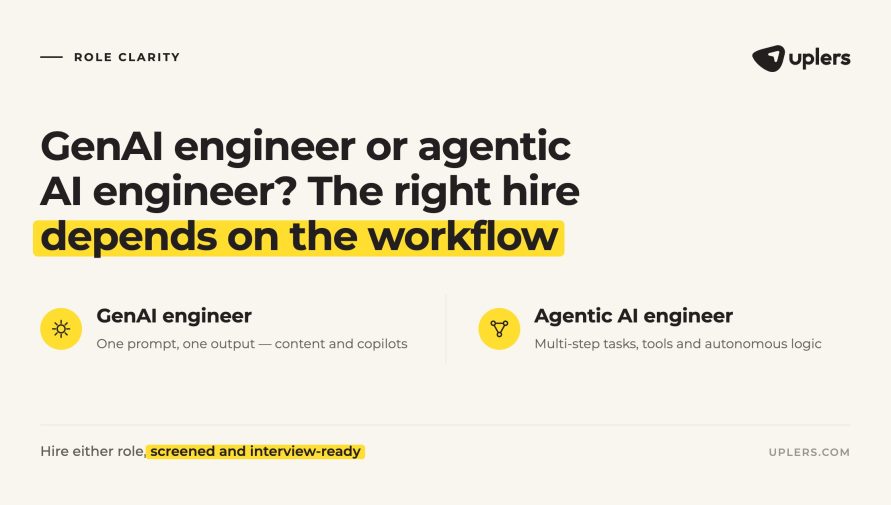
A GenAI engineer builds systems that generate, retrieve, or transform content using LLMs, without independently deciding what to do next.
What they typically build:
Hire a GenAI engineer if you need:
- LLM-powered applications: chatbots, copilots, writing/coding assistants
- RAG systems and knowledge assistants: retrieval over proprietary docs and data
- Content transformation: summarization, classification, extraction, translation
- Prompt and model optimization: prompting, few-shot design, cost-vs-quality tuning
- Model/API integration and evaluation: wiring LLMs into products, testing output quality
Example: A customer-support copilot that retrieves an answer from your knowledge base and drafts a reply is a GenAI problem. The model produces the answer. It doesn’t decide to check an order system, issue a refund, and email the customer.
What Is an Agentic AI Engineer?
An Agentic AI engineer builds systems that plan, decide, act, and adapt across multiple steps with limited human input.
What they add:
Hire an Agentic AI engineer for:
- Multi-step task execution: chains of actions toward a goal
- Planning and task decomposition: deciding what happens next, and when the task is done
- Tool and API calling: selecting and invoking the right system at the right time
- Memory and state management: tracking progress across steps or sessions
- Workflow orchestration: coordinating multiple agents, tools, and processes
- Guardrails and failure recovery: permissions, retries, escalation when an action is risky
Example: An AI ops agent that checks inventory, flags a shortage, creates a purchase request, gets approval, and updates the ERP. That’s a fundamentally different engineering problem than generating an email.
The Skill Difference That Matters When You’re Hiring
Both roles touch the same underlying models, so resumes tend to look similar at a glance. What separates the two is who has depth where it counts.
| Capability | GenAI Engineer | Agentic AI Engineer |
| LLM/API integration | Core | Core |
| Prompt engineering | Core | Supporting |
| RAG | Core | Common |
| Tool calling | Supporting | Core |
| Planning & orchestration | Limited | Core |
| Memory & state | Supporting | Core |
| Evaluation | Output quality | Output + task completion |
| Guardrails | Important | Critical |
| Failure recovery | Supporting | Core |
| Observability | Application-level | Workflow-level |
Both need solid LLM fundamentals. The split is orchestration, memory, tool use, and failure recovery. These are the parts that are crucial once a system starts acting, not just answering.
What It Costs to Hire a GenAI Engineer for an Agentic Role
This is usually the costlier mistake, because the candidate looks capable at first. The gap only shows up once the job shifts from “AI can answer this” to “AI needs to complete this.”
Demo works, production breaks
A convincing chatbot or RAG demo mainly proves the model can produce a good single answer. It doesn’t prove the system can decide what to do after that answer, such as retry a failed API call, check whether a previous step succeeded, or pick up where it left off.
Those are separate engineering problems, and a demo has no reason to surface them. By the time the gap surfaces, stakeholders have already seen it working.
Your team becomes the missing agent layer
Orchestration, tool integration, and monitoring don’t disappear just because the developer couldn’t cover them. They land on backend engineers who weren’t hired for that work, and ownership gets blurry enough that nobody’s clearly accountable once something breaks.
Spend rises without better outcomes
A single GenAI feature might make one model call per request. An agentic task can trigger several model calls, tool executions, and validation checks in sequence. If the orchestration is weak, the system can loop back through the same steps repeatedly without ever finishing the task, burning tokens each time.
Reliability and security get bigger
An agent that sends emails, calls APIs, or edits records has a far larger blast radius than one that only writes text. Nearly two-thirds of respondents in McKinsey’s 2026 State of AI Trust survey cite security and risk concerns as the top barrier to fully scaling agentic AI, ahead of regulatory uncertainty or technical limitations.
What It Costs to Hire an Agentic Engineer for a GenAI-Only Role
This mistake is quieter because nothing visibly breaks. You just end up paying for, and building, more than the product needs.
Paying for complexity you don’t need
If the product only needs RAG, extraction, or generation, you’re paying agentic-level rates for skills the roadmap never calls on.
Building an agent where a pipeline would do
If your workflow always runs the same way- retrieve the document, extract the data, validate it, then generate a response- a deterministic pipeline is easier to test, debug, and explain than an autonomous agent. Autonomy earns its keep only when the sequence itself needs to change.
Solving the wrong problem
Agentic sounds more advanced, but that doesn’t make it the right engineer. If the requirement is “understand this and generate an accurate response,” autonomous execution doesn’t fill a gap that isn’t there.
Which Engineer Should You Hire?
Everything above points to one practical question: given what you’re building, which of these two do you need first? Match the engineer to the workflow below, not to whichever title sounds more current.
Hire GenAI if your product needs to
Generate or transform content, answer questions over proprietary data, build RAG assistants, extract or classify information, add LLM features to an existing product.
Example: An assistant that searches internal policies and drafts an answer for an employee.
Hire Agentic AI if your product needs to
Complete multi-step tasks, decide which tools/APIs to use, coordinate multiple systems, maintain state, adapt based on intermediate results, act with limited human intervention.
Example: An AI sales agent that researches a prospect, checks the CRM, drafts a personalized email, schedules a follow-up, and updates the record.
Need both?
Agentic systems still need solid GenAI foundations. But if autonomous execution is your core differentiator, prioritize someone who’s operated multi-step workflows in production; not someone whose experience stops at prompting and RAG.
Match the Engineer to the Problem, Not the Hype
GenAI and Agentic AI engineers aren’t interchangeable just because both work with LLMs. One generates, retrieves, and transforms. The other plans, acts, and recovers.
Get that wrong, and the bill comes due as engineering rework, an AI budget that quietly outgrows its plan, or a system so over-built for a simple task that no one wants to maintain it.
Before you write the job post, map the workflow: what does the AI need to produce, decide, and do on its own? That answer picks the hire, not the title.