Picture your new AI research scientist’s first Monday. They open their laptop and ask, “What am I working on?”
If you can answer in one sentence, with the problem, the gap, and the target, you may be closer to this hire than you think. If the answer sounds like “help us figure out our AI strategy,” the role needs more shape first.
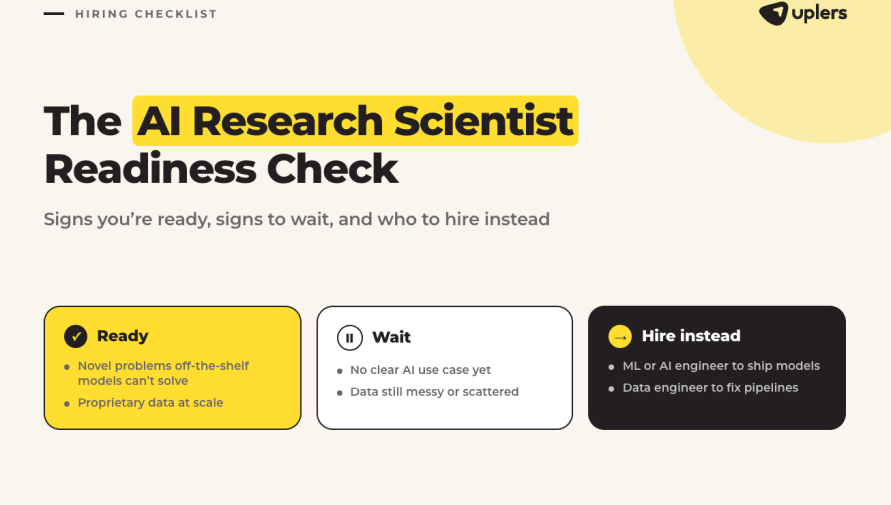
That Monday-morning test gets to the heart of the decision. A research scientist earns their seat when your product needs an AI capability today’s models can’t deliver, and your team can give them the problem, data, and engineering support to build it. This guide helps you check each of those and shows you what to do if the timing isn’t right yet.
What Does an AI Research Scientist Do?
An AI research scientist creates new models and methods for problems existing AI can’t solve well. Their work gives your team new capabilities to build into the product.
What an AI Research Scientist Works On
- New approaches: Designing algorithms, model architectures, training methods, or evaluation techniques.
- Hard problems: Running experiments on challenges that established methods fail to handle.
- Usable results: Turning research findings into capabilities your product can ship.
For example, a legal-tech startup finds that general-purpose LLMs misread clauses in region-specific contracts. A research scientist might design a new training approach on annotated contracts to close that accuracy gap.
AI Research Scientist vs. AI Engineer vs. ML Engineer
| Role | Question they answer | Main output | Time horizon |
| AI Research Scientist | How can AI do something it can’t do yet? | New models, methods, and experimental results | Months to years |
| ML Engineer | How do we train and run this model well? | Training pipelines, tuned models, optimized inference | Weeks to months |
| AI Engineer | How do we put AI into our product? | AI features, integrations, and deployed systems | Days to weeks |
In early-stage startups, these roles overlap, and one person may cover two of them. What separates them is the main output each one owns.
Why Would a Startup Need an AI Research Scientist?
Startups bring in research talent when AI performance becomes either the limit on the product or its main edge. These two situations make the business case.
Product Needs Capabilities Existing Models Can’t Deliver
You’ve tried leading models, prompt engineering, and fine-tuning, and results still fall short of what customers need. The gaps show up in four places:
- Accuracy in specialized domains such as medical imaging or legal text.
- Reliability on edge cases where a single error is costly.
- Latency or cost at a scale general models can’t support.
- Data types current models handle poorly, such as sensor signals or proprietary formats.
Once you hit these limits, progress depends on a new model, training method, or architecture. More integration work won’t close the gap.
AI Research Is Your Competitive Advantage
When every team can call the same API, the AI layer alone gives you little protection. Proprietary models and novel methods give you a capability competitors can’t buy or copy quickly.
Buying is now the default. Menlo Ventures’ 2025 State of Generative AI in the Enterprise report found that 76% of enterprise AI use cases were purchased in 2025, up from 53% in 2024. When most competitors run on bought tools, a capability built through research stands out.
Research depth also builds credibility with investors evaluating AI-first startups and with technical partners deciding whether to build on your work.
Signs Your Startup Is Ready to Hire an AI Research Scientist
Needing research and being able to support it are two separate questions. Check your startup against these four conditions before you open the role.
You Can Clearly Define the Research Problem
An AI research scientist does their best work with a sharp problem statement. You should be able to explain what you’ve tried, where it failed, and what success looks like.
- Vague: “We want better AI for our forms product.”
- Clear: “Our extraction model reaches 82% field accuracy on handwritten forms, and our enterprise customers need 95%.”
You Have the Data, Compute, and Runway to Support Research
| Resource | What to check |
| Data | Enough clean, relevant data, with the access and permissions to train and evaluate models |
| Compute | Budget for GPUs or cloud credits to cover training and inference across repeated experiments |
| Runway | Funding for research cycles that can take several months to show results |
You Have the Engineering Capacity to Turn Research Into Product
Research results need engineers to test, integrate, and keep them running in production. Without that support, promising experiments stay stuck in notebooks.
If your engineers are already stretched across core product work, plan for that capacity before the research hire starts.
You Can Measure Research Progress Against Business Outcomes
Set benchmarks, review milestones, and criteria for when an experiment moves toward production, and then link each metric to a product result. For example:
- Higher model accuracy leads to fewer manual reviews for customers.
- Faster inference enables real-time features.
- A new capability gives you a feature competitors find hard to replicate.
Signs Your Startup Isn’t Ready Yet
Many startups feel the pull toward AI research before their product needs it. If any of these three signs fits your situation, it’s worth waiting.
Your Bottleneck Is Building and Shipping AI Features
APIs, open-source models, retrieval-augmented generation (RAG), or fine-tuning may already meet your requirements. In that case, the hard work is product engineering, including building features, connecting systems, and keeping AI reliable in production.
Most teams get there with simple techniques. The Menlo Ventures report found that prompt design and RAG are the most common ways companies customize AI, while fine-tuning and reinforcement learning are still niche and used mainly by frontier teams.
For example, a customer support startup running an LLM with RAG over help docs needs stronger retrieval pipelines and monitoring. An engineer can deliver that within weeks.
You Haven’t Validated the Product or Its AI Requirements
Research is a long bet on one technical direction. If customer needs, product scope, or the limits of current models are still unclear, you risk funding research on a problem your customers may not have.
Validate the use case with existing tools and early customer feedback first. That evidence shows which capabilities customers value and which technical gaps deserve research investment.
You Need Fast, Predictable Shipping Timelines
Research moves through hypotheses, failed experiments, and iteration, so results arrive on an uncertain schedule. When customers or investors expect new features every few weeks, a research hire will feel out of sync with the rest of the team.
If research sits on your roadmap anyway, keep exploratory milestones separate from committed release dates so delivery stays on track.
Who to Hire Instead of an AI Research Scientist
If research can wait, the right engineering hire keeps your AI roadmap moving. It also prepares the ground for a research hire later.
Hire an AI Engineer to Build on Existing Models
An AI engineer is the right fit when your product runs on existing models, and you need features in customers’ hands. They handle:
- LLM-powered features and AI agents
- RAG pipelines and third-party integrations
- Production reliability, monitoring, and cost control
Hire an ML Engineer to Train and Optimize Models
An ML engineer is the right fit when you need to train, fine-tune, or optimize models on your own data. They handle:
- Training and evaluation pipelines
- Fine-tuning on proprietary data
- Inference optimization and MLOps
This hire also builds the infrastructure a future research scientist will rely on.
How to Hire an AI Research Scientist for Your Startup
Once you’re ready, a focused process helps you find someone who fits both your research problem and your startup’s pace.
Turn Your Research Problem Into a Clear Role Scope
Build the job description around the problem you defined earlier. Add the outputs you expect, the seniority the work calls for, and the data and compute the hire will have access to.
Evaluate Research Depth and Practical Problem-Solving
- Research contributions relevant to your problem
- Rigor in designing experiments and reproducing results
- Experience turning research into working systems
- A PhD where your problem needs frontier research, or strong applied experience where it needs results on a known path
Choose Between Full-Time and Contract Hiring
| Model | Best when |
| Full-time | Research is a long-term core capability for your product |
| Contract | You have a bounded problem with a clear endpoint |
Before you set a budget for either model, benchmark the role’s salary across markets. Hiring remotely widens your talent network beyond your local market and gives you more room on cost.
Get Startup-Ready AI Research Scientist Profiles in 48 Hours With Uplers
Uplers is an AI hiring platform that helps startups and product companies hire talent from India. Its AI screens and filters candidates against your role requirements, and human evaluation confirms the shortlist is the right fit. You receive 3 to 5 matched profiles within 48 hours, for full-time or contract roles. For specialized research searches, Uplers’ Full Service Hiring adds recruiter-led support.
Conclusion: Let the Problem Decide the Hire
An AI research scientist makes sense when three things line up existing models can’t deliver what your product needs, AI research is your competitive edge, and you have the problem definition, resources, and engineers to support the work.
If those pieces are still coming together, build your engineering team first and revisit the decision as your product matures.
When you’re ready to hire, share your role with Uplers and get 3 to 5 screened, matched profiles within 48 hours.