Picture a robot arm on your line that spots a misaligned part, corrects its grip, and keeps working. That is intelligent automation in 2026, and it is moving quickly from pilot projects into daily operations.
Here is what most founders learn early. AI models give machines the ability to perceive and decide. Robotics engineers turn that ability into reliable physical action on factory floors, in warehouses, in hospitals, and across farmland.
In this guide, we will walk through who robotics engineers are, the technical layers they build, the industries they are reshaping, the challenges that decide success, and where the field is heading. Use it to decide what to automate, which capabilities to build in-house, and when to hire robotics engineers.
Who Is a Robotics Engineer?
A robotics engineer makes a robot work reliably outside the lab. Knowing what they own helps you scope the role clearly before you hire.
The role is growing with the market. IFR reports that a record 5 million industrial robots were operating worldwide in 2025, after more than 600,000 new installations that year. Every one of those systems needed engineers to scope, integrate, and maintain them, which is why demand to hire robotics engineers keeps rising.
What a Robotics Engineer Does
A robotics engineer designs, builds, programs, and maintains robotic systems. The work combines mechanical, electrical, software, and AI engineering into one functioning machine.
Think of robotics as a systems discipline. The defining skill is making motors, sensors, code, and models work together under real-time constraints on a live production floor.
Most engineers specialize in one or two areas:
- Perception: vision, sensor processing, and scene understanding
- Controls: motion, stability, and precise actuation
- Manipulation: grasping and handling objects with arms and grippers
- Mobile robotics: navigation, mapping, and localization
- Systems integration: connecting robots to the wider operation
When you hire robotics developer, look for depth in one specialization and enough breadth to work across the others.
Key Responsibilities Across the Robot Lifecycle
- Defining the problem: They identify which tasks are worth automating, set performance and safety targets, and check whether the project makes technical and financial sense.
- Designing and prototyping: They select sensors, actuators, grippers, and compute hardware, then model the system before anything is built.
- Programming and integrating: They write the robot’s behavior and fit the system into your existing equipment and workflows.
- Testing and validating: They measure accuracy, cycle time, repeatability, and safety against defined targets before the system goes live.
- Deploying and improving: They commission the system on site, monitor it, fix issues, and update logic or models as conditions change.
How the Role Changes in Intelligent Automation
Traditional robotics work meant programming fixed motions. Intelligent automation asks engineers to design systems that handle uncertainty, so they now work with training data, model behavior, and confidence scores alongside code and kinematics.
| Dimension | Traditional automation | Intelligent robotic automation |
| Operating logic | Predefined rules and sequences | Rules combined with AI-driven decisions |
| Environmental response | Reprogramming needed for most changes | Adapts to changes it was designed for |
| Perception | Limited, task-specific sensing | Integrated sensing with contextual interpretation |
| Task flexibility | Best for stable, repetitive tasks | Handles more variable tasks |
| Human interaction | Separated by fences or fixed workflows | Supports dynamic collaboration when designed for it |
One point is worth remembering here. Every bit of a robot’s intelligence is engineered, and it adapts only within the limits set by its sensors, models, training data, and safety rules.
Founder takeaway: Write the job description around the lifecycle stage you need most right now. An early-stage startup needs someone strong at prototyping and integration, while a scaling company needs deployment and reliability experience.
How Robotics Engineers Make Automation Intelligent
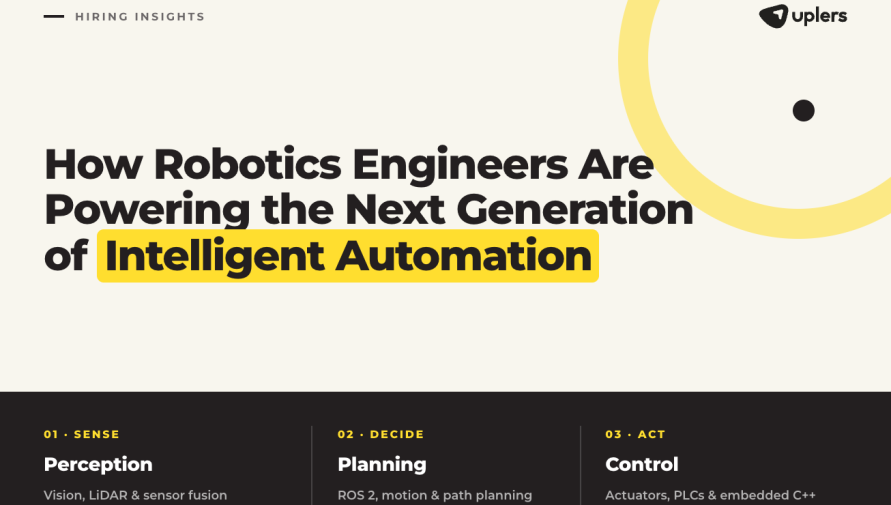
Robotics engineers build intelligence as a four-layer pipeline: sense, decide, act, and connect. Each layer solves a different problem, and the robot performs only as well as its weakest layer.
Sensing: Building Real-Time Perception Through Sensor Fusion
Every sensor has blind spots:
- Cameras struggle with glare, shadows, and low light.
- LiDAR struggles with glass, mirrors, and shiny metal.
- Force and torque sensors register information only on contact.
Robotics engineers solve this with sensor fusion. They combine several inputs so the robot keeps an accurate picture of its surroundings when one source degrades.
Example: A mobile robot near a glass loading-bay door relies on camera and wheel-odometry data when its LiDAR reads the glass poorly. The result is dependable object detection, localization, and obstacle awareness in real time.
Deciding: Embedding AI and Machine Learning into Robot Behavior
Machine learning adds the most value where variation is high, and rules are hard to write. Common uses include:
- Object recognition across changing parts and packaging
- Grasp prediction for items the robot has never seen
- Defect and anomaly detection during inspection
Good engineers also choose which decisions stay rule-based. Emergency stops, force limits, and safety zones run on deterministic logic because they must behave the same way every time. Drawing that line well is one of the most valuable judgment calls in the role.
Example: In bin picking, an ML model chooses where to grasp a jumbled part, while a fixed safety rule caps gripper force on every attempt.
Acting: Translating Decisions into Precise, Adaptive Motion
A decision is useful only when the robot can execute it precisely. Engineers turn decisions into movement through three tools:
- Motion planning to find a collision-free path
- Trajectory optimization to make that path fast and smooth
- Feedback control to correct errors as the robot moves
The real test is adapting mid-task. A well-engineered robot compensates for a shifted part, a heavier load, or a blocked path and keeps the operation running.
Example: A welding robot with seam tracking adjusts its torch path on the fly when a metal panel sits a few millimeters off its expected position.
Connecting: Integrating Robots into Industrial Systems and Data Flows
A robot delivers business value once it shares data with the rest of your operation. Engineers connect robots to:
- PLCs that control production equipment
- MES and WMS platforms that manage production and inventory
- IoT devices and data platforms that support monitoring and analytics
Much of this work involves legacy equipment built long before intelligent robots existed. Engineers bridge older protocols with modern interfaces so robots become coordinated, monitorable parts of a larger system.
Example: A picking robot receives orders from the warehouse management system, reports each completed pick, and flags errors to a live dashboard.
Founder takeaway: Map your product against these four layers and find the weakest one. That layer is where your first robotics hire should focus.
Where Robotics Engineers Are Transforming Intelligent Automation
Each industry hands robotics engineers one defining problem to solve. Here is that problem, and what engineers build around it, in four sectors leading adoption.
Manufacturing: Making Robots Flexible Enough for High-Mix Production
The problem: Many factories now run short batches of many product variants. A robot that takes weeks to reprogram for each changeover slows the whole line.
What engineers build:
- Adaptive assembly cells that recognize the incoming part and load the right routine
- Vision-guided welding that follows each seam as it appears
- AI-based quality inspection that learns new defect types from a small set of examples
Why it matters: Flexible cells let mid-sized manufacturers automate product lines that once seemed too varied for robots.
The opportunity: The US overtook Japan in 2025 to become the world’s second-largest market for industrial robots, with installations up 12% to almost 38,500 units (IFR). Adoption is spreading beyond automotive, with US food and beverage installations up 30% (IFR US report). These newer adopters need robots that are easier to set up and redeploy, which is the gap product startups building vision systems, inspection software, and reconfigurable cells can fill.
Warehousing and Logistics: Coordinating Fleets of Robots
The problem: Warehouses run dozens or hundreds of autonomous mobile robots in shared aisles. Each robot needs to know where the others are heading and which task to take next.
What engineers build:
- Fleet orchestration software that assigns tasks and manages traffic in real time
- Robotic picking systems that handle thousands of SKUs of different shapes and sizes
- Dynamic sorting that reroutes items as order priorities change
Why it matters: Fleet-level coordination raises throughput across the whole facility, which drives the return on the entire robot fleet.
Healthcare: Engineering for Precision Under Human Oversight
The problem: Medical robots work at millimeter or sub-millimeter precision, where errors carry serious consequences. Clinicians must remain in control throughout.
What engineers build:
- Robotic-assisted surgery systems that scale and stabilize a surgeon’s hand movements
- Laboratory automation for sample handling and testing
- Rehabilitation robots that adjust support to each patient’s progress
Why it matters: Precision and reliability come first here, so engineers design every system around clinician oversight, redundancy, and strict regulatory approval.
Agriculture: Handling Organic, Irregular, Unpredictable Objects
The problem: Every fruit, plant, and field is different. Lighting, weather, and terrain change throughout the day.
What engineers build:
- Selective harvesting robots that judge ripeness and pick gently
- Precision sprayers that target individual weeds or plants
- Autonomous field equipment that navigates uneven ground
Why it matters: Agricultural robots help growers manage labor shortages and cut chemical use by treating each plant individually.
Founder takeaway: Name the one industry problem your product solves, then hire engineers who have shipped systems against that exact problem.
The Engineering Challenges That Decide Whether Intelligent Automation Works
A robot that performs well in a demo still has a long road to dependable daily operation. These three challenges are where experienced robotics engineers earn their value.
Closing the Simulation-to-Reality Gap
Engineers train and test many robots in simulation or digital twins first. Real-world friction, lighting, sensor noise, and material behavior always differ slightly from the virtual model, so performance can drop on deployment.
Engineers close this gap with three techniques:
- Domain randomization: varying lighting, textures, and physics in simulation so the robot learns to handle a wide range of conditions
- Real-world data collection: gathering on-site data to retrain and correct the model
- On-site fine-tuning: adjusting models and parameters during commissioning
Designing for Edge Cases and Graceful Failure
Rare, unexpected situations are a common source of failure in intelligent systems. Think of a torn package, a reflective spill on the floor, or a part placed upside down.
Experienced engineers plan for these moments with:
- Confidence thresholds that trigger caution when the model is unsure
- Fallback behaviors such as slowing down, retrying, or asking a human for help
- Safe recovery routines that return the robot to a known state
Proving Safety and Reliability Before Scaling
Before deploying robots across multiple sites or production lines, engineers must verify that systems operate safely and deliver consistent results under real working conditions.
- Safety validation: Conduct risk assessments, test failure scenarios, and verify compliance with applicable standards, including the ISO 10218 series for industrial robots.
- Reliability testing: Measure task success rates, downtime, recovery time, and performance across repeated runs and changing conditions.
For a robot handling 1,000 picks per hour, even a small error rate can create significant operational disruption.
| Success rate | Failed picks per hour |
| 95% | 50 |
| 99% | 10 |
| 99.9% | 1 |
Engineers use these results to identify failure patterns, refine the system, and confirm that it meets deployment targets before scaling.
How Robotics Engineers Will Shape the Future of Intelligent Automation
Three shifts are moving from research labs toward early deployment. Each one changes what robotics engineers will build over the next few years.
Foundation Models and General-Purpose Robots
Vision-language-action (VLA) models such as Google DeepMind’s Gemini Robotics and NVIDIA’s Isaac GR00T let robots take camera input and plain-language instructions, then output motor actions. The goal is a robot that learns a new task from demonstrations or a spoken instruction.
For engineers, the work moves toward collecting robot data, fine-tuning models, and evaluating behavior at scale. Before any production rollout, they test task reliability, latency, hardware compatibility, and safety.
Humanoids and Mobile Manipulators for Human-Built Spaces
Factories, hospitals, and stores are designed around human bodies. Humanoids and mobile manipulators aim to work in those spaces as they are, which saves the cost of rebuilding facilities around fixed robots.
Momentum is building fast. Counterpoint Research counted more than 22,000 humanoids shipped in H1 2026, up nearly 300% year on year, and expects over 50,000 for the full year. More than 60% of those units went to entertainment, research, and data collection, so commercial use cases are still taking shape.
That gap is the opening for product startups that can prove a commercial use case. Before committing to one, check payload, battery life, dexterity, maintenance needs, safety certification path, and performance over a full shift before committing to a use case.
From Shared Workspaces to Shared Tasks
Collaborative robots today share space safely with people. The next step is shared work, where humans and robots divide a task dynamically based on who suits each step best.
Example: A robot handles heavy lifting and repetitive fastening, while a technician takes over fine adjustments and final checks.
The pace of all three shifts depends on engineering. AI capability is advancing fast, and the real bottleneck is making these systems reliable, maintainable, and economical to deploy.
Conclusion: Robotics Engineers Are Turning Automation into Intelligent Action
Intelligent automation succeeds when perception, decisions, and motion work together reliably in real operations. Robotics engineers are the people who make that connection hold up shift after shift.
For founders, engineering capability is a competitive edge. Companies that hire robotics engineers early build reliability into the product from day one, so they deploy faster and scale with fewer surprises.