Building an LLM-powered product takes more than connecting an application to a model and writing a few effective prompts. Production systems need reliable data pipelines, retrieval, evaluation, model integration, and consistent output behavior.
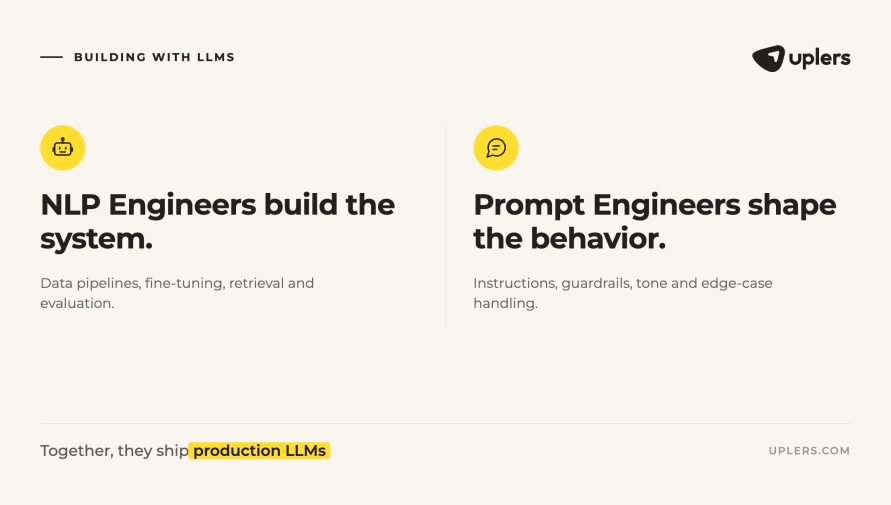
NLP Engineers typically build the technical foundations that make language-model applications function reliably. Prompt Engineers focus on shaping model behavior for specific tasks and workflows. The two roles are different, but their work forms a continuous feedback loop.
NLP engineering expands what the system can reliably do. Prompt engineering helps the model use those capabilities effectively in context.
What NLP Engineers Bring to Production LLM Systems
NLP Engineers bring the language-processing and machine learning expertise needed to build the systems around an LLM. Depending on the product and team, their work can include:
- NLP and LLM integration– applying language-processing and ML concepts to application requirements
- RAG and retrieval– document ingestion, chunking, embeddings, indexing, and context pipelines
- Data processing– preparing and structuring language data for retrieval, evaluation, or generation
- Model evaluation– designing test datasets, analyzing failure modes, measuring performance
- System optimization– improving quality, latency, throughput, and inference cost
- Production infrastructure– integrating models with APIs, databases, and monitoring
In a production system, an NLP Engineer’s work extends well beyond the model itself. They build the technical environment the model needs to perform consistently.
Teams whose products depend heavily on retrieval, language processing, or custom NLP workflows often need to hire NLP engineers specifically for this layer. It’s rarely something a prompt-focused hire can absorb on top of their own scope.
What Prompt Engineers Bring to Production LLM Systems
Prompt Engineers focus on how an LLM is instructed and how its behavior shifts across tasks, contexts, and constraints. In production, that’s far more than writing a good prompt once.
- Task-specific prompt design– system instructions and reusable patterns for defined workflows
- Few-shot examples and structured outputs– using examples and constraints to make responses more usable downstream
- Prompt and context optimization– refining instructions based on observed behavior
- Prompt evaluation– testing versions against representative cases, catching regressions
- Reliability improvements– constraints that support grounded, policy-compliant outputs
- Continuous iteration– updating prompts as models, context, and usage patterns change
Prompt engineering in production is increasingly treated as an iterative discipline, which includes testing, evaluation, versioning, rather than trial-and-error prompt writing. For teams running complex workflows, structured outputs, or agentic behavior, it’s worth deciding early whether to hire Prompt Engineers as a dedicated role rather than spreading that work thin across the team.
How NLP Engineers and Prompt Engineers Reinforce Each Other
The strongest collaboration happens when system-level and prompt-level improvements inform each other.
Retrieval + Prompt Design
NLP Engineers build the pipeline that retrieves and ranks context. Prompt Engineers decide how that context gets presented, what to prioritize, how to handle conflicting sources, what format to follow. If retrieval returns weak results, no prompt fixes that. If the prompt is ambiguous, even strong retrieval gets wasted.
Model Performance + Prompt Optimization
A quality problem doesn’t always call for a bigger model. NLP Engineers can look at model selection, context handling, and retrieval quality. Prompt Engineers can test different instructions and examples. Together, they can pinpoint whether the issue sits in the model, the system, or the prompt, avoiding an unnecessary jump to a larger, costlier model.
Evaluation + Iteration
NLP Engineers build the datasets and evaluation pipelines. Prompt Engineers use them to catch instruction-following failures, formatting errors, and inconsistent outputs. A prompt change then gets tested against the same evaluation set, not judged from a handful of examples, which matters, since production changes routinely introduce regressions.
Reliability + Guardrails
Neither role solves reliability alone. NLP Engineers address pipeline failures, latency, and fallback behavior. Prompt Engineers add instruction-level constraints and output requirements. Production systems generally need both, plus monitoring and application-level safeguards on top.
Continuous Optimization
LLM systems aren’t static. A model update can shift output behavior. A reindexing change can affect retrieved context. A new prompt can alter downstream formatting. That means this isn’t a one-time handoff but an ongoing, cross-layer testing process.
Where the Two Roles Overlap and Where They Don’t
The exact split varies by company, and some engineers cover both areas. Still, the distinction is useful for defining ownership:
| NLP Engineer | Prompt Engineer |
| Builds language-model infrastructure and pipelines | Designs task-specific model behavior |
| Works with retrieval, embeddings, data, and models | Works with instructions, examples, context, and outputs |
| Focuses primarily on system-level performance | Focuses primarily on prompt- and task-level behavior |
| Evaluates technical and system behavior | Evaluates prompt behavior and task outcomes |
The overlap is strongest around evaluation, debugging, and optimization. The difference is mostly of emphasis. NLP Engineers work deeper into the underlying system, whereas Prompt Engineers focus more directly on how the model behaves within a given workflow.
What This Collaboration Looks Like in a Real Production Workflow
Take a customer-support LLM that answers questions using internal documentation.
The NLP Engineer builds the RAG pipeline- ingesting documents, creating embeddings, retrieving relevant passages. The Prompt Engineer structures that retrieved information and sets the rules for how the model should answer: use only the supplied documentation, follow a set format, flag when the context doesn’t support an answer.
The team evaluates the system against representative customer questions. If the right information is consistently missing, the NLP Engineer investigates retrieval, chunking, or ranking. If the information is there but poorly used, the Prompt Engineer investigates instructions or context structure.
They keep iterating until quality, reliability, latency, and cost all clear the bar. That’s the mechanism behind “reinforcing each other”; a failure in one layer routinely points to the fix in the other.
Why Hiring Both Skills Matters for LLM Teams
Having both system-level and behavior-level expertise makes troubleshooting more systematic. Instead of guessing whether a bad output is a model problem, a retrieval problem, or a prompt problem, a team with both skill sets can isolate it quickly.
The important part isn’t just having two job titles on the org chart. Teams should define which layer each person owns and, just as importantly, how they’ll work together when a problem crosses that boundary because in production, most problems eventually do.
Building LLM Systems That Work Beyond the Prototype
A strong prompt can’t compensate for poor retrieval, weak evaluation, or unreliable architecture. A technically solid NLP pipeline doesn’t automatically produce useful model behavior either.
NLP Engineers build and optimize the technical capabilities around the model. Prompt Engineers shape how those capabilities get applied to real tasks. Their shared evaluation and iteration loop is what turns an LLM prototype into a system users can actually rely on.