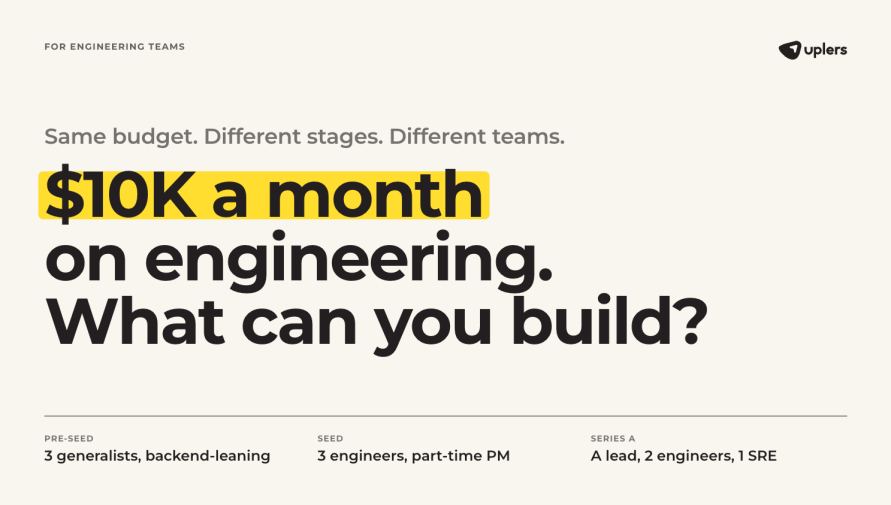
Snippet:
In this guide, you’ll learn:
- How the same $10K/month engineering budget should be allocated differently at pre-seed, seed, and Series A.
- The ideal team structure for each startup stage.
- What each team can realistically build.
- Where founders can hire engineers without stretching their budget or slowing product development.
One of the common questions founders ask is:
“I have a $10K/month engineering budget. How many engineers can I hire?”
It’s a reasonable question, but it’s the wrong one.
A fixed engineering budget doesn’t automatically translate into a fixed team size.
The better question: “What team gives me the biggest unlock for my stage, on this budget?”
The team that gives a pre-seed startup the best chance of finding product-market fit is very different from the team a Series A company needs to support thousands of users.
Think about it this way: a startup validating its first MVP and another preparing for Series B could both spend the same $10,000 each month, yet build completely different engineering teams. Both would be making the right decision.
Your team mix shifts based on product complexity, how much of your stack needs AI/ML work, your runway, and what you’re optimizing for next.
Why Stage Matters More Than Budget
The budget stays the same. Your business goals are not.
A pre-seed startup is trying to answer one question:
“Will customers use this product?” So, every dollar should buy speed and range.
A seed-stage company has a different challenge:
“Can we build enough traction to justify the next funding round?” The job is to show growth and product depth.
By Series A, the focus shifts again:
“Can this product scale without breaking?”
The budget shifts toward ownership and reliability.
The takeaway is simple:
A $10K/month engineering budget doesn’t buy a fixed number of engineers; it buys progress toward your next milestone. For better understanding, check out our detailed analysis of engineers’ salaries in India.
Pre-Seed: Build an MVP as Fast as Possible
You’re not optimizing for scale. You’re optimizing for finding out if this works at all. That means senior generalists who don’t need a spec handed to them, are comfortable with ambiguity, and are backend-heavy. This is the stage where senior generalists outperform narrow specialists.
Sample $10K/month team:
| Role | Experience | Approx. Monthly Cost |
| Senior Full-Stack / Generalist Engineer | 8+ years | ~$4,000 |
| Mid-Level Backend Engineer | 3–5 years | ~$2,750 |
| Mid-Level Frontend Engineer | 3–5 years | ~$2,750 |
Why this works: Three people, one setting direction, two shipping. No layers, no handoffs, no waiting on a spec that doesn’t exist yet. If you’re a non-technical founder, this shape matters even more as your senior generalist is effectively your technical co-founder for hire.
What you get: A real MVP in front of real users, fast enough to still be relevant to the problem you started solving.
Seed: Build Features That Help You Raise the Next Round
By the seed stage, the question changes from “Can we build it?” to “Can we show enough traction to raise again?” You still need versatile engineers, but now product prioritization and customer data should influence what gets built next.
Sample $10K/Month Team
| Role | Experience | Approx. Monthly Cost |
| Senior Full-Stack Engineer | 5–8 years | ~$3,500 |
| Mid-Level Backend Engineer | 3–5 years | ~$2,500 |
| Mid-Level Data Engineer | 3–5 years | ~$2,500 |
| Part-Time Product Manager | — | ~$1,500 |
Why this team works
- Generalist engineers continue shipping core product features.
- A data engineer helps turn customer behavior into product decisions.
- A part-time Product Manager keeps the roadmap focused on business outcomes.
- Balances fast execution with better prioritization.
What you get: A team that ships consistently, learns from users, and builds the traction investors expect.
Series A: Build for Scale, Reliability, and Ownership
By Series A, you’ve found product-market fit. Now the priority is scaling without slowing down. This is where technical leadership, ownership, and platform reliability become just as important as shipping new features.
Sample $10K/Month Team
| Role | Experience | Approx. Monthly Cost |
| Engineering Lead / Staff Engineer | 8+ years | ~$4,500 |
| Senior Product Engineer | 5–8 years | ~$3,000 |
| Senior Product Engineer | 5–8 years | ~$3,000 |
| SRE or DevOps Engineer* | 3–5 years | ~$2,500 |
Depending on your infrastructure needs, this role can be full-time, shared, or contract-based to stay within budget. Also, there can be added costs, depending on the benefits you offer and more, so make sure to find the real cost of hiring an engineer in India.
Why this team works
- An engineering lead sets technical standards and mentors the team.
- Senior product engineers own major parts of the application end-to-end.
- DevOps or SRE improves deployments, monitoring, and platform reliability.
- Creates a stronger foundation for scaling the product and future hiring.
What you get: A team with the technical leadership and operational maturity to support long-term product growth.
Quick Comparison: All Three Stages Side by Side
| Stage | Team Composition | What It Solves |
| Pre-seed | 1 senior generalist + 1 backend + 1 frontend | Fast MVP, product-market fit |
| Seed | 1 senior full-stack + 1 backend + 1 data engineer + part-time PM | Weekly shipping, data-informed roadmap for next raise |
| Series A | 1 staff engineer + 2 senior product engineers + 1 SRE/DevOps | Ownership, architecture, reliability at scale |
To get a clearer idea of engineers’ salaries in India, visit Uplers’ Salary Guide 2026.
Where to Hire This Team From- Find Engineers within a $10k/month Budget
Knowing the team shape is half the problem. Finding these exact people, at these exact price points, fast enough that your runway doesn’t leak away in the search is the other half.
- Job boards / LinkedIn– Cheapest per hire on paper, but slow. You end up screening resumes instead of building, and at founder-time-value, that’s rarely cheap.
- Freelance platforms– Fine for a one-off contract or a short sprint, but weaker fit when you need someone embedded in the product long-term.
- Referrals– You find the best hires, but unreliable as a primary channel. You can’t schedule when a good referral shows up.
- Hiring partners/platforms– A screened talent network built for exactly this problem: matching seniority mix to a fixed monthly number instead of you hiring one role at a time and hoping the math works out at the end. To understand how hiring platforms work and their fee structure, check out Uplers’ pricing page.
| Hiring Source | Speed | Best For | Trade-off |
| Job boards & LinkedIn | Slow | Companies with internal recruiting bandwidth | High screening effort and longer time-to-hire |
| Referrals | Unpredictable | Trusted early hires | Not scalable on demand |
| Freelance platforms | Fast | Short-term projects or specialist work | Less suited for long-term product ownership |
| Hiring partner/ platform | Fast | Building a stage-appropriate engineering team | Higher upfront coordination than posting a job, but significantly less sourcing and evaluation effort |
Conclusion
A $10K/month engineering budget in India can go much further than most founders expect, but only when it’s aligned with your current stage.
At pre-seed, it buys speed. At seed, it buys product execution. At Series A, it buys technical leadership and reliability. Focus less on maximizing headcount and more on building the team that gets you to your next milestone.