Snippet:
- Here’s the honest range: a software engineer in India in 2026 runs roughly $2,000 to $6,000 a month.
- Expect to spend about 40% more than the base salary once every layer stacks up.
- What are those layers? Recruiter or platform fees (one-time, 8–25% of annual comp), EOR markups if you’re hiring from outside India (~8–20% recurring), plus statutory costs like PF and gratuity that apply to everyone.
- One thing most people miss before they benchmark: India has two kinds of engineers—service and product and they don’t cost the same.
All in, hiring an engineer in India runs roughly $2,000 to $6,000 a month. That depends on 3 things: how you find them, how much experience they bring, and what kind of engineer they are, and where you are based out of. Add it all up and you’re usually looking at about 40% on top of the base salary you started with.
So here’s the full picture, layer by layer. Starting with the salary, because that’s what you came here for.
What engineers in India earn in 2026?
Strong engineers here have options now. You’re not the only one bidding. You’re up against remote-first startups, GCCs, and well-funded AI companies. So pay has gone up with the quality.
One thing to know before you benchmark. India has 2 kinds of engineers.
In the service world, engineers deliver a fixed spec. Task-based work. In the product world, they figure out what to build and own the outcome. Product engineers cost more and expect more, because they’ve worked closer to what a startup actually needs.
So benchmark against the kind of engineer you actually want, not against a market average.
How much do engineers in India cost in 2026?
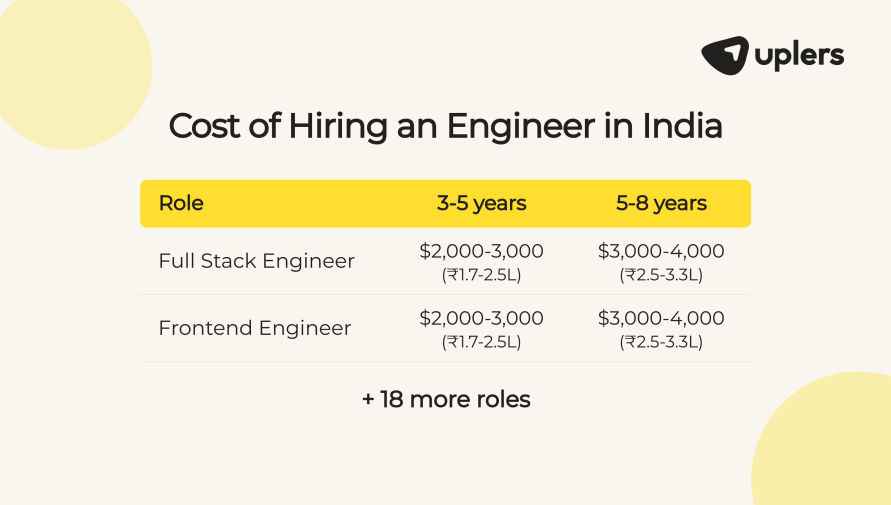
Here are the 2026 monthly ranges, straight from the Uplers India Salary Guide.
Core engineering roles, per month
| Role | 3-5 years | 5-8 years | 8+ years |
| Full Stack Engineer | $2,000-3,000 (₹1.7-2.5L) | $3,000-4,000 (₹2.5-3.3L) | $4,000+ (₹3.3L+) |
| Frontend Engineer | $2,000-3,000 (₹1.7-2.5L) | $3,000-4,000 (₹2.5-3.3L) | $4,000+ (₹3.3L+) |
| Backend Engineer | $2,000-3,000 (₹1.7-2.5L) | $3,000-4,000 (₹2.5-3.3L) | $4,000+ (₹3.3L+) |
| Data Engineer | $2,000-3,000 (₹1.7-2.5L) | $3,000-3,500 (₹2.5-2.9L) | $3,500+ (₹2.9L+) |
| Cloud / DevOps Engineer | $2,000-2,500 (₹1.7-2.1L) | $2,500-3,500 (₹2.1-2.9L) | $3,500+ (₹2.9L+) |
| Mobile Engineer (Flutter / React Native) | $2,000-3,000 (₹1.7-2.5L) | $3,000-4,000 (₹2.5-3.3L) | $4,000+ (₹3.3L+) |
| Product Engineer | $2,000-2,500 (₹1.7-2.1L) | $2,500-3,500 (₹2.1-2.9L) | $3,500+ (₹2.9L+) |
| Python Engineer | $2,000-3,000 (₹1.7-2.5L) | $3,000-4,000 (₹2.5-3.3L) | $4,000+ (₹3.3L+) |
| Data Scientist | $2,000-3,000 (₹1.7-2.5L) | $3,000-4,500 (₹2.5-3.8L) | $4,500+ (₹3.8L+) |
Specialist and platform roles, per month
| Role | 3-5 years | 5-8 years | 8+ years |
| Cybersecurity Engineer | $2,000-2,500 (₹1.7-2.1L) | $2,500-3,500 (₹2.1-2.9L) | $3,500+ (₹2.9L+) |
| Platform Engineer | $2,500-3,000 (₹2.1-2.5L) | $3,000-3,500 (₹2.5-2.9L) | $3,500+ (₹2.9L+) |
| ML Ops Engineer | $2,500-3,500 (₹2.1-2.9L) | $3,500-4,500 (₹2.9-3.8L) | $4,500+ (₹3.8L+) |
| Solutions Architect | NA | $3,500-4,500 (₹2.9-3.8L) | $4,500+ (₹3.8L+) |
| QA Automation Engineer | $1,500-2,500 (₹1.3-2.1L) | $2,500-3,500 (₹2.1-2.9L) | $3,500+ (₹2.9L+) |
| Site Reliability Engineer (SRE) | $2,000-2,500 (₹1.7-2.1L) | $2,500-3,500 (₹2.1-2.9L) | $3,500+ (₹2.9L+) |
| .NET Engineer | $2,000-3,000 (₹1.7-2.5L) | $3,000-4,000 (₹2.5-3.3L) | $4,000+ (₹3.3L+) |
Product and GTM roles, per month
| Role | 3-5 years | 5-8 years | 8+ years |
| Product Manager | $2,000-2,500 (₹1.7-2.1L) | $2,500-3,500 (₹2.1-2.9L) | $3,500+ (₹2.9L+) |
| Product / UX Designer | $2,000-2,500 (₹1.7-2.1L) | $2,500-3,500 (₹2.1-2.9L) | $3,500+ (₹2.9L+) |
| Growth Marketer | $2,000-2,500 (₹1.7-2.1L) | $2,500-3,500 (₹2.1-2.9L) | $3,500+ (₹2.9L+) |
| Customer Success | $2,000-2,500 (₹1.7-2.1L) | $2,500-3,500 (₹2.1-2.9L) | $3,500+ (₹2.9L+) |
AI/ML engineers
Calling these out separately because they are premium roles. And if you pull them from top institutes, they cost even more.
| Role | 3-5 years | 5-7 years | 7+ years |
| AI/ML Engineer | $2,500-3,500 (₹2.1-2.9L) | $3,500-4,500 (₹2.9-3.8L) | $4,500+ (₹3.8L+) |
| AI/ML Engineer (top institutes: IITs, BITS, IIMs) | $3,000-3,500 (₹2.5-2.9L) | $3,500-6,000 (₹2.9-5L) | $6,000+ (₹5L+) |
Additional cost 1: the hiring fee
This one only hits if you go through a recruiter or a hiring platform. Source it on your own network and you skip it entirely. Use a platform and it’s often your biggest one-time cost.
Platforms in India usually charge one of 2 ways.
Most common is a percentage of annual comp. Somewhere between 8% and 25%, depending on seniority. Paid once, usually with a 30 to 90 day replacement window if the hire doesn’t work out.
Some charge a flat fee instead. Easier to predict when salaries climb. Either way, budget for it up front, not after the offer.
Additional cost 2: payroll and EOR
This one depends entirely on where you’re based.
If you’re a company in India, you can mostly skip it. You already have an entity and run payroll directly, so there’s no markup here. The one exception: if you’d rather outsource payroll and compliance even with an entity, that’s a service cost you’re choosing to take on.
If you’re based outside India with no Indian entity, this applies to you. An Employer of Record becomes the legal employer in India while the engineer works for you. They handle payroll, contracts, taxes, and local compliance. You manage the work. They manage the employment.
So what does an EOR cost? Usually a recurring markup of around 8% to 20% on top of salary. Sometimes a flat monthly fee per head, sometimes a percentage, sometimes a blend. Multi-state compliance and extra benefits push it up. Standardizing across several hires brings it down.
For 1 to 10 engineers, an EOR is simpler and faster. Once you’re past 10, the monthly markup usually costs more than running your own entity. So that’s the point to start thinking about setting one up.
Additional cost 3: the statutory layer
These apply to everyone, India-based or not. Statutory costs sit on top of salary no matter how you employ someone.
Provident Fund (PF): India’s retirement contribution. Employers put in 12%, but on the basic salary component, not total comp.
Gratuity: a benefit that vests after 1 year of service. Companies typically accrue about 4.81% of basic salary a year for it.
Professional tax: a small state-level deduction that varies by state.
Then there’s onboarding, which everyone pays too. The first month is more than payroll. Laptop, dev environment, cloud access, and the usual SaaS stack: GitHub, Slack, Notion, Jira, Figma, whatever your team runs on. Distributed teams lean harder on tooling, so this runs higher than people expect.
The total cost of hiring an engineer in India
| Cost layer | Typical range | Applies to |
| Base salary | See salary tables above | Everyone |
| Recruiter or platform fee | One-time, often 8 to 25% of annual comp | Only if you use a recruiter/platform |
| EOR or payroll service | Recurring, ~8 to 20% markup | Foreign hirers with no Indian entity (or India-based firms outsourcing payroll by choice) |
| Employer PF | 12% of basic | Everyone |
| Gratuity accrual | ~4.81% of basic per year | Everyone |
| Onboarding and tooling | One-time setup | Everyone |
So before you send the first offer, ask the honest question. Does your budget have 1 layer in it, or all of them? And do you actually know which layers apply to you?