
Snippet:
- You don’t need to set up an Indian entity to legally hire engineers in India.
- Employee vs. contractor is the first decision. It determines every structure and compliance question that follows.
- Three real hiring models exist: your own entity, a hiring platform (EOR-backed), or independent contractors.
- Three ways to pay: direct payments, payroll support, or a full EOR; each fits a different team size and stage.
- EOR and PEO aren’t interchangeable. No entity means EOR; an existing entity means PEO.
- The most common founder mistake: setting up an entity too early or misclassifying a contractor as an employee.
- Get the structure right first; payroll, taxes, and compliance follow logically from it.
US startups are no longer testing the waters with India. They’re building core engineering teams in the country.
Hiring an engineer in India is an employment-structure decision. Founders need to decide on worker classification, employment contracts, payroll, taxes, statutory benefits, and ongoing compliance.
Should I hire an engineer as an employee or contractor? Do I need an Indian entity? Who runs payroll, handles statutory benefits, and manages ongoing compliance?
For seed to Series B startups, the goal is not to master Indian employment law. It is to choose the right hiring model before making the hire.
This guide explains the different ways US startups can legally hire and pay engineers in India, including direct employment, Employer of Record (EOR) arrangements, independent contracting, and integrated hiring and employment platforms.
Can a US Company Legally Hire Engineers in India?
Yes, a US company can legally hire engineers in India. But the legal and compliance requirements depend entirely on the engagement model you choose.
The common models are:
- Direct employment through your own Indian entity
- Independent contractor engagement
- A hiring platform that also supports employment, payroll, or compliance
Each model changes who employs the engineer, who runs payroll, and who handles local compliance.
Employee vs. Independent Contractor
This is the fork in the road that determines everything downstream.
Employee relationship: You control how, when, and where the work happens. The engineer is integrated into your team, uses your tools, follows your schedule, and works exclusively (or near-exclusively) for you.
Contractor relationship: The engineer provides services under a commercial agreement, has greater autonomy over work methods, can serve multiple clients, and is engaged for a defined scope or project.
The contract label alone is not enough. The actual working relationship matters. Call someone a “contractor” while treating them like a full-time employee (fixed hours, exclusivity, performance reviews, company email), and you’re exposed to misclassification risk on both sides of the border.
Do You Need a Legal Entity in India to Hire Engineers?
Not always. Here’s the honest breakdown:
| You need an entity when… | You can skip it when… |
| You’re hiring 15+ engineers long-term | You’re hiring 1–10 engineers to start |
| You want full control over IP, benefits, and culture | You want to test the market before committing |
| You have 12+ months of runway for setup + compliance overhead | You need to hire within weeks, not months |
Opening an Indian entity purely to hire your first two or three engineers doesn’t make sense. Entity setup, registrations, and ongoing statutory filings carry real fixed costs. An EOR or hiring partner can remove that requirement entirely while you validate the team and the market.
What to Decide Before Choosing a Hiring Model
Before you pick a hiring model, get honest answers to:
- How many engineers do you expect to hire?
- Is the work ongoing or project-based?
- How much control will you have over how the engineer works?
- How quickly do you need the person onboarded?
- Are you building a long-term operation in India?
Your answers narrow the options.
How Can US Startups Hire Engineers in India? 3 Legal Structures
There is no single best model. The right structure depends on your stage, timeline, and appetite for administrative overhead.
Option 1: Hire Through Your Own Indian Legal Entity
Your Indian entity directly employs the engineer and manages the local employment relationship.
Best for: Startups building a substantial, long-term presence in India.
You register a subsidiary or branch office in India, become the direct employer of record, and manage payroll, tax filings, and statutory compliance yourself (or through a local accountant/payroll provider).
Pros: Full control over employment terms, culture, IP assignment, and benefits design.
Cons: Entity registration, ongoing statutory filings (PF, ESI, professional tax, GST if applicable), and a local finance/HR function to manage it all. Setup typically takes 6-12 weeks minimum before your first hire can start.
Option 2: Hire Through a Hiring Platform
An integrated hiring platform can connect an entire process, from talent discovery and hiring to onboarding and payroll & compliance support. But you need to hire someone full-time. A third party becomes the legal employer; your startup manages the day-to-day work.
Best for: Startups that want fewer handoffs between finding talent and managing the engagement.
Depending on the engagement model, a platform may support:
- Talent sourcing and matching
- Candidate assessment
- Contracts and onboarding
- EOR or employment support
- Payroll coordination
- Ongoing engagement administration
A hiring partner like Uplers helps startups hire professionals from India through full-time and contract engagement models, with support extending beyond talent matching into post-hire operations. You get access to a huge talent network, consisting of top 1% professionals, so you get screened and interview-ready candidates.
Important: Always confirm who is the legal employer or contracting party and which compliance responsibilities the platform manages.
Option 3: Engage Engineers as Independent Contractors
A contractor provides services under a commercial agreement rather than an employment relationship. The engineer invoices you directly; you pay against those invoices via international wire or a payments platform.
Best for: Genuinely independent, project-based, or short-term work.
This model can fit:
- Defined projects
- Specialist consulting
- Short-term requirements
- Work performed with genuine independence
Works well when: The engagement is scoped, time-bound, and the engineer retains control over how the work gets done, and likely serves other clients too.
Doesn’t work when: You need someone full-time, exclusive, and directed like an employee. Treating a contractor like an employee- fixed hours, sole client, ongoing indefinite work- is exactly the misclassification pattern regulators look for.
Quick Comparison: What Each Model Is
| Model | What It Is | Entity Needed? | Typical Use Case |
| Own entity | You register a subsidiary or branch office in India and employ engineers directly. | Yes | Large, long-term India teams (15+ engineers, multi-year horizon) |
| Hiring platform/EOR | A third party helps source candidates and becomes the legal employer on your behalf. | No | First 1-10 full-time hires, no entity in place |
| Independent contractor | The engineer works under a commercial services agreement. | No | Scoped, project-based, or short-term work |
How Can US Startups Pay Engineers in India?
Hiring engineers is only one part of the process. Once you’ve decided how you’ll engage talent, you also need a payment model that fits your business. If you’re hiring engineers in India without setting up an entity, there are three real options to manage payments.
The right approach to pay employees in India depends on your hiring model, team size, and how much payroll and compliance work you want to manage internally.
Option 1: Pay Employees Directly
Best for: Early-stage founders paying their first one or two hires.
Direct international wire transfer is the simplest way to pay. We always recommend this method as it keeps the process hassle-free. You can pay via Deel or similar platforms in no time.
Keep in mind: Every wire carries a different exchange rate, and it gets harder to manage as your team grows, which is where Options 2 and 3 come in.
Option 2: Payroll Support
Best for: Startups expanding their engineering teams and want to simplify payroll operations while retaining direct management of employees.
When your India team starts growing, payroll becomes more than just sending monthly payments.
This sits between paying directly and a full EOR. If you’ve hired engineers through Uplers, payroll support is a value-added service: you send one consolidated invoice, and Uplers disburses salary, handles PF/ESI/TDS compliance, and manages payslips and documentation while you continue directing the engineer’s work day-to-day.
Option 3: Employer of Record (EOR)
Best for: Startups hiring full-time engineers in India that need a compliant employment structure without opening an Indian subsidiary.
An EOR is a third party that becomes the legal employer of the engineer in India while your startup manages the day-to-day work. The EOR handles the employment contract, payroll, tax withholding, benefits, and statutory compliance.
This provides a fully managed employment solution without the time and cost of establishing your own legal entity.
This is currently the fastest-growing structure for cross-border tech hiring. The global EOR market is valued at roughly $5.97 billion in 2026, and Asia-Pacific is its fastest-expanding region.
EOR vs. PEO: What’s the Difference?
Although they’re often mentioned together, an EOR and a PEO are designed for different situations.
EOR (Employer of Record): The EOR is the legal employer of your employee. No Indian entity needed on your side. It handles payroll, tax withholding, and statutory compliance while you manage the day-to-day work. This is the model most seed-to-Series-B founders use.
PEO (Professional Employer Organization): A PEO works through co-employment and only makes sense if you already have your own Indian entity. You remain the legal employer; the PEO takes on agreed HR and payroll admin on top.
Quick check: No entity yet? You want an EOR. Already have one? A PEO may help you manage it.
How Hiring Platforms Simplify Payroll and Compliance for Founders
Hiring across borders can become fragmented quickly.
A hiring partner can take care of most of it. But founders should look beyond the promise of “end-to-end hiring” and ask what the provider actually owns.
What a Hiring/EOR Platform Manages for You
Strip away the marketing language, and a good platform is handling:
- Compliant offer letters and employment contracts
- End-to-end payroll runs (gross-to-net, every cycle)
- Statutory filings: PF, ESI, TDS, professional tax
- Ongoing compliance monitoring as regulations shift
- Benefits administration and leave tracking
What to Look for When Evaluating a Hiring/Payroll Partner
Before signing with any provider, check:
- Do they have a registered legal presence in India (not just a reseller of someone else’s infrastructure)?
- Can they show you a sample compliant offer letter and payslip?
- Do they proactively track regulatory changes (like the 2025-26 Labour Codes rollout)?
- What’s their time-to-hire: from signed offer to engineer starting work?
- Is pricing transparent (flat fee vs. % of payroll), with no hidden statutory pass-through costs?
- Do they carry liability for compliance errors, or does that risk sit with you?
How Uplers Helps US Startups Hire and Pay Engineers in India Compliantly
Uplers combines talent sourcing and employment infrastructure into a single workflow: screened engineering talent, compliant contracting, payroll processing, and statutory compliance, without requiring you to set up an Indian entity first.
For a founder hiring their first or fifth engineer in India, that means one relationship to manage instead of a recruiter, a payroll vendor, and a compliance consultant stitched together separately.
Common Mistakes US Startups Make When Hiring in India
Even experienced founders can run into compliance issues when hiring across borders. Avoid these common mistakes:
| Mistake | Better Approach |
| Setting up an entity too early for 2–3 hires | Start with an EOR or payroll support; wait until you hire 15+ engineers. |
| Calling someone a “contractor” but treating them like an employee | Match the contract to the actual working relationship. |
| Assuming a cheap wire transfer means a compliant hire | Treat payment method and compliance as two separate questions. |
| Not knowing who the legal employer actually is | Confirm this upfront with any EOR, PEO, or hiring platform. |
| Treating payroll compliance as a one-time setup | Revisit it periodically. |
| Choosing a model that doesn’t match future hiring plans | Pick a structure that supports both your current needs and expected team growth. |
Pre-Hire Checklist for Founders
- Before you make your first hire:
- Decide whether the role is an employee or independent contractor.
- Choose the hiring model that fits your current stage.
- Prepare compliant employment or contractor agreements.
- Finalize how you’ll handle payroll, taxes, and statutory compliance.
- Confirm who is responsible for ongoing HR and employment administration.
- Plan onboarding, IP protection, and confidentiality from day one.
How to Choose the Right Hiring and Payroll Model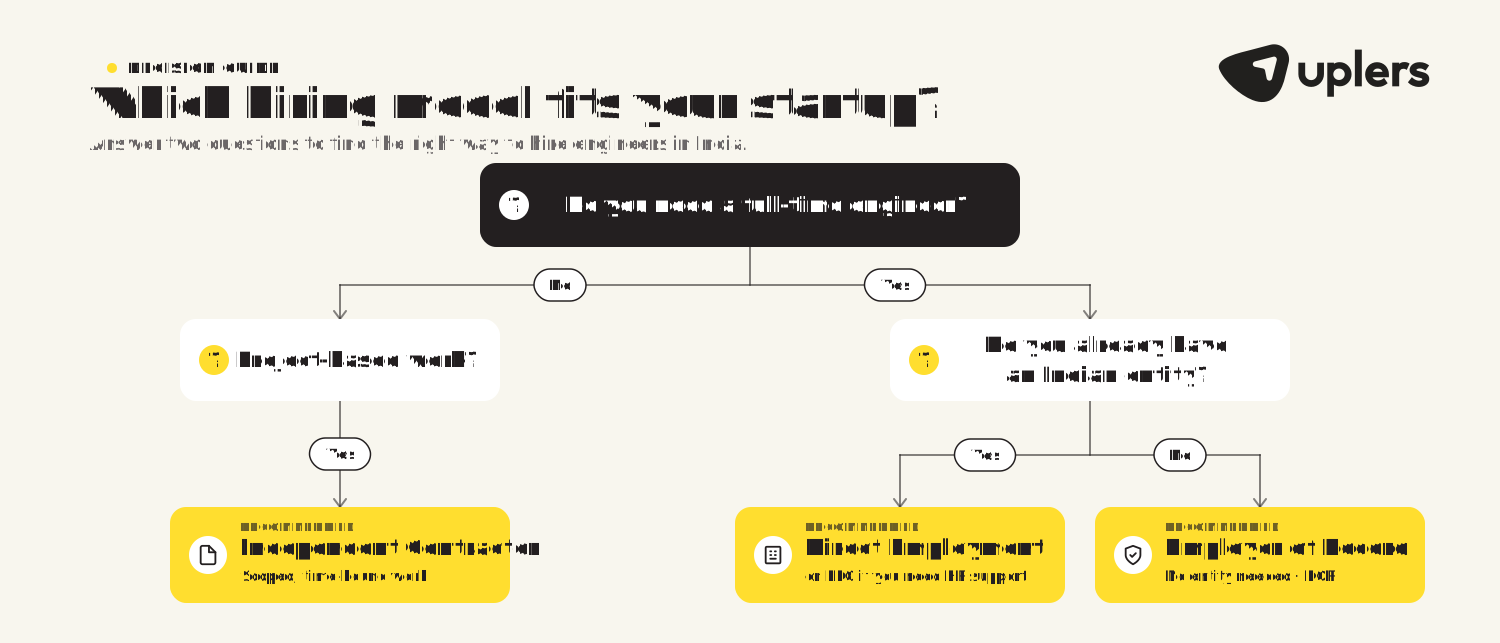
Choose Your Own Indian Entity If: You’re building a substantial, permanent operation in India, 15+ engineers, multi-year horizon, dedicated local leadership.
One note: Entity setup and ongoing administration can create more infrastructure than an early-stage startup needs for its first few hires.
Choose a Hiring Platform If: You want to hire full-time employees from a large talent network in India without establishing your own entity. Best for seed-to-Series-B startups making their first 1-10 hires.
Watch for: Understand the platform’s scope, pricing, legal-employer structure, and offboarding process before signing.
Choose an Independent Contractor Model If: The work is genuinely independent and project-based with a defined scope.
Conclusion
Hiring engineers in India doesn’t have to start with setting up a local company or navigating complex employment laws on your own.
The key is choosing the right hiring and payment model based on your team size, growth plans, and the type of working relationship you’re creating.
Early-stage startups often begin with independent contractors or a hiring partner, while growing companies may eventually transition to an Employer of Record (EOR) or establish their own Indian entity.
Get the structure right early, and payroll, taxes, and statutory compliance follow logically.