Snippet
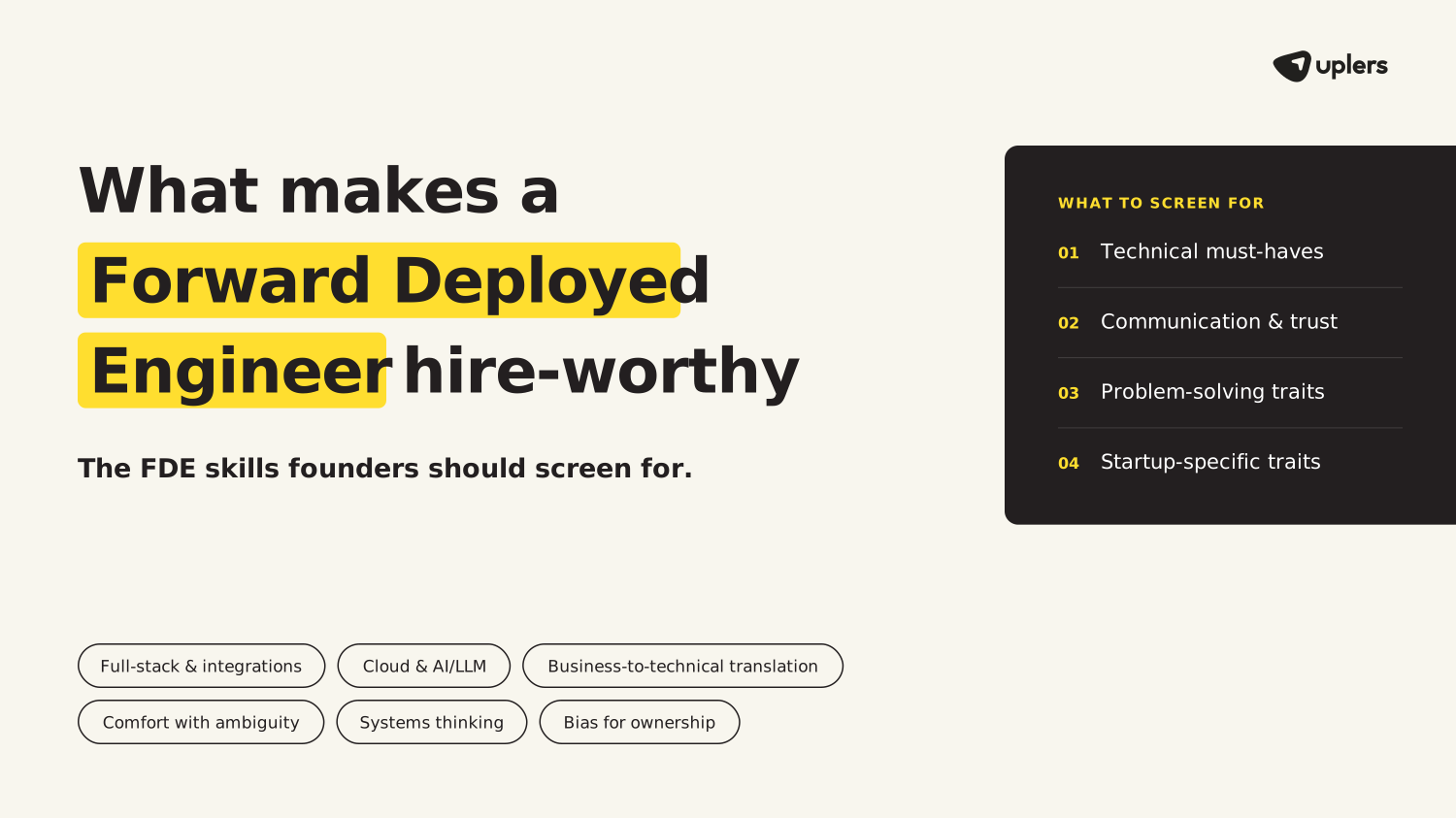
This blog covers:
- What a Forward Deployed Engineer does, and why hiring for one needs a broader screen than a standard engineering hire.
- Technical must-haves: Full-stack engineering, API/legacy-system integrations, cloud deployment, and AI/LLM skills, and which ones are role-dependent.
- Communication skills: Translating business problems into technical solutions, and building trust across engineers, security teams, and executives.
- The three problem-solving traits that separate a strong FDE from a technically strong engineer: comfort with ambiguity, systems thinking, and bias for ownership.
- Startup-specific traits: Resourcefulness, customer empathy, and a feedback-loop mindset.
- Two interview methods to screen for these traits: an ambiguous deployment scenario and evidence-based follow-up questions.
- A 10-point skills checklist for quick reference during hiring.
Your first FDE (Forward-deployed Engineer) hire either becomes the person who unblocks your biggest deals, or the one your team quietly routes around because they can’t ship without hand-holding. You usually don’t find out which one you got until they’re three weeks into a customer deployment.
A normal engineering interview won’t catch this. Someone can ace a coding round and still sit on a stalled integration for two days because no one spelled out what to do. Here’s what separates a strong FDE from a resume that just looks strong.
Who Is a Forward Deployed Engineer?
An FDE is the engineer you send into a customer’s environment to make your product work there, writing real code against real, often broken, systems until the deployment is live. Think of them as a founding engineer on loan to your toughest account.
For the full breakdown of the role, its origins, and when to hire one, see our complete FDE guide.
Core Technical Skills to Look For
Skip the tool checklist. Screen for whether someone can diagnose a mess, build a fix, and ship it without a safety net.
Full-Stack & Backend Engineering
When you hire a forward-deployed engineer, the bar isn’t “can they code”; it’s “can they own something end to end without waiting on another team.” Look for:
- Production-ready code
- Comfort moving across the stack when a fix needs it
- Speed turning a rough prototype into something reliable enough to hand to a customer
- Debugging code someone else wrote, under a deadline
Ask about a project that touched the frontend, backend, and a third-party system in the same week. If every project they describe had a clean handoff point, treat that as a signal, not a green flag.
One analysis of 1,000 FDE job postings found Python in 66% of listings and TypeScript in around 35%, but the language matters far less than proof they can build and ship independently.
APIs, Integrations & Legacy Systems
This is the actual job, most days. You’re handing them a 2019 CRM, an undocumented payments system, and an IT team that takes a week to approve access, not a clean API and a modern data warehouse. Look for:
- REST APIs, webhooks, and third-party integrations
- Authentication and access control, including OAuth and SSO
- Comfort reverse-engineering an undocumented or half-broken API
- Experience tracing how data actually moves between systems
Ask candidates to describe the worst-documented system they’ve ever integrated with. If they can’t name one, they haven’t done this work yet.
Cloud, Data & Deployment
Look for someone who’s debugged something already live in production, under a deadline, with a customer watching. Specifically:
- Practical experience on AWS, Azure, or GCP
- Databases, SQL, and basic data pipeline work
- Comfort with Docker and standard CI/CD workflows
- The instinct to check logs and monitoring first when something breaks, instead of guessing
A candidate who’s only shipped to their own staging environment hasn’t been tested the way this role tests people.
AI, LLM & Agentic Workflow Experience
By 2026, this is close to table stakes for AI-native FDE roles. The same 1,000-posting analysis found AI agents mentioned in about 35% of listings and LLMs in roughly 31%. Look for:
- Hands-on work with LLM APIs
- RAG pipeline experience, if your product touches retrieval
- Agent workflow design, where relevant to your product
- The judgment to know when a simple deterministic script beats an AI call
Treat this as role-dependent. An FDE deploying a conventional enterprise SaaS product doesn’t need deep LLM expertise. Don’t let this become the whole interview either. A candidate fluent in five AI frameworks who can’t get a working solution into a customer’s messy environment still isn’t the hire.
Founder shortcut: Ask them to name a project where the “textbook right” technical solution wasn’t an option, and what they built instead. That answer tells you more than their GitHub.
Communication and Customer-Facing Skills
This is the half most technical interviews miss entirely, and it’s usually the reason a strong-on-paper hire doesn’t work out.
Translating Business Problems Into Technical Solutions
A customer says, “We need this to work with our system.” That’s rarely the real ask. A strong FDE starts asking things like:
- What workflow is broken right now?
- Which systems hold the data that matters here?
- Who uses this day-to-day, and what do they need it to do?
- What security or compliance constraints apply?
- How will we know this worked?
Look for candidates who ask three or four sharp follow-up questions before writing a line of code.
Stakeholder Communication & Trust-Building
Your FDE will explain the same trade-off to an engineer, a security lead, and a VP in one afternoon, and each version needs to land. Look for someone who can:
- Explain a technical trade-off in plain language, fast
- Set expectations a customer will remember
- Push back on a request that’s the wrong fix, without burning the relationship
- Stay steady when a deployment gets contentious
In the interview, have them explain a technical decision live, as if you’re a non-technical customer stakeholder. Watch for jargon creeping back in under pressure.
Problem-Solving Mindset: The Real Differentiator
This is where you separate a good FDE from a great one.
Comfort With Ambiguity
FDEs walk into situations with incomplete requirements, often before the customer fully understands their own problem. Ask for a specific example, not a hypothetical.
If they can’t name a real project where they had to define the problem themselves, be skeptical.
Systems Thinking
A strong FDE sees how a fix in one corner of a customer’s stack ripples elsewhere, weighing the security team’s constraints, the data flow, and the launch timeline together instead of in isolation.
Give them a scenario with multiple moving pieces and listen for whether they map dependencies before proposing a fix, or jump straight to code.
Bias for Action & Ownership
FDE job postings have grown well over 700% in the last year, and the candidates getting hired aren’t the most credentialed on paper. They’re the ones with a track record of staying on a problem until it’s resolved.
Ask what they did the last time a fix they shipped broke something else. Their answer tells you whether they own outcomes or just tasks.
Startup-Readiness Traits
Some traits matter more at a 20-person startup than at a 5,000-person company, because there’s no second FDE to catch what the first one misses. Here are a few essentials to hire for an early-stage startup:
Resourcefulness Over Perfection
Your FDE needs to ship the practical fix that gets a customer live this week, then improve it later.
Ask about a time they deliberately chose the “good enough” solution over the elegant one, and why.
Customer Empathy
FDEs who listen before proposing a fix build trust faster and avoid rebuilding things twice. That matters more when you’ve got one shot at an early enterprise logo.
Feedback-Loop Mindset
Every integration quirk your FDE hits in the field is free product intelligence, if they bother to write it down.
Ask how they’ve previously turned a one-off customer fix into something reusable. Candidates who can’t answer this will keep solving the same problem from scratch every time.
How to Screen FDE Candidates for These Skills in Interviews
Your interview should recreate some of the ambiguity the candidate will encounter on the job.
Give an Ambiguous Deployment Scenario
Try this: “A customer wants to deploy your product, but their data is fragmented, their security team is strict, and their systems barely have APIs. Walk me through your first week.”
Don’t grade the answer. Grade the questions they ask before they answer, and the order in which they ask them. That sequence is the real signal.
Ask for Evidence, Not Claims
Push for specifics:
- A time they shipped without a complete spec
- A production issue they owned start to finish
- A stakeholder disagreement they navigated
- The most complex integration they’ve built
- Something they built once and later made reusable
If an answer stays general after two follow-up questions, that’s usually a rehearsed answer. To seek help hiring the right FDE, here are top hiring platforms to consider.
Forward Deployed Engineer Skills Checklist
| Skill/Trait | What to Look For |
| Full-stack engineering | Owns work end-to-end without waiting on handoffs |
| APIs & integrations | Comfortable with undocumented, legacy systems |
| Cloud & deployment | Has debugged live production under real pressure |
| AI/LLM experience | Relevant for AI-native products |
| Communication | Can explain trade-offs to a non-technical stakeholder, live |
| Customer empathy | Asks before proposing, not the reverse |
| Problem-solving | Sequences questions before jumping to a fix |
| Systems thinking | Maps dependencies before proposing solutions |
| Ownership | Has a real story of staying on a problem until it closed |
| Startup readiness | Chooses “good enough, shipped” over “perfect, delayed” |
Conclusion
Skip the checklist mentality on languages and frameworks; they’re the easiest thing to screen for and the least predictive of success here.
What matters is whether someone can go from “what is broken?” to a working solution in production, on someone else’s infrastructure, without a script and without you having to check in every day.
You are looking for someone who combines engineering depth with customer communication, systems thinking, and ownership under ambiguity.
Hire for that, and the frameworks take care of themselves.