Snippet:
Forward Deployed Engineers (FDEs) are the fastest-growing tech role. They are customer-embedded engineers who own AI deployments from pilot to production, writing production code inside real customer environments.
- The role was coined by Palantir in 2011 to solve complex deployment challenges in defense and government environments.
- It has now been adopted by OpenAI, Google, Salesforce, and 100+ companies.
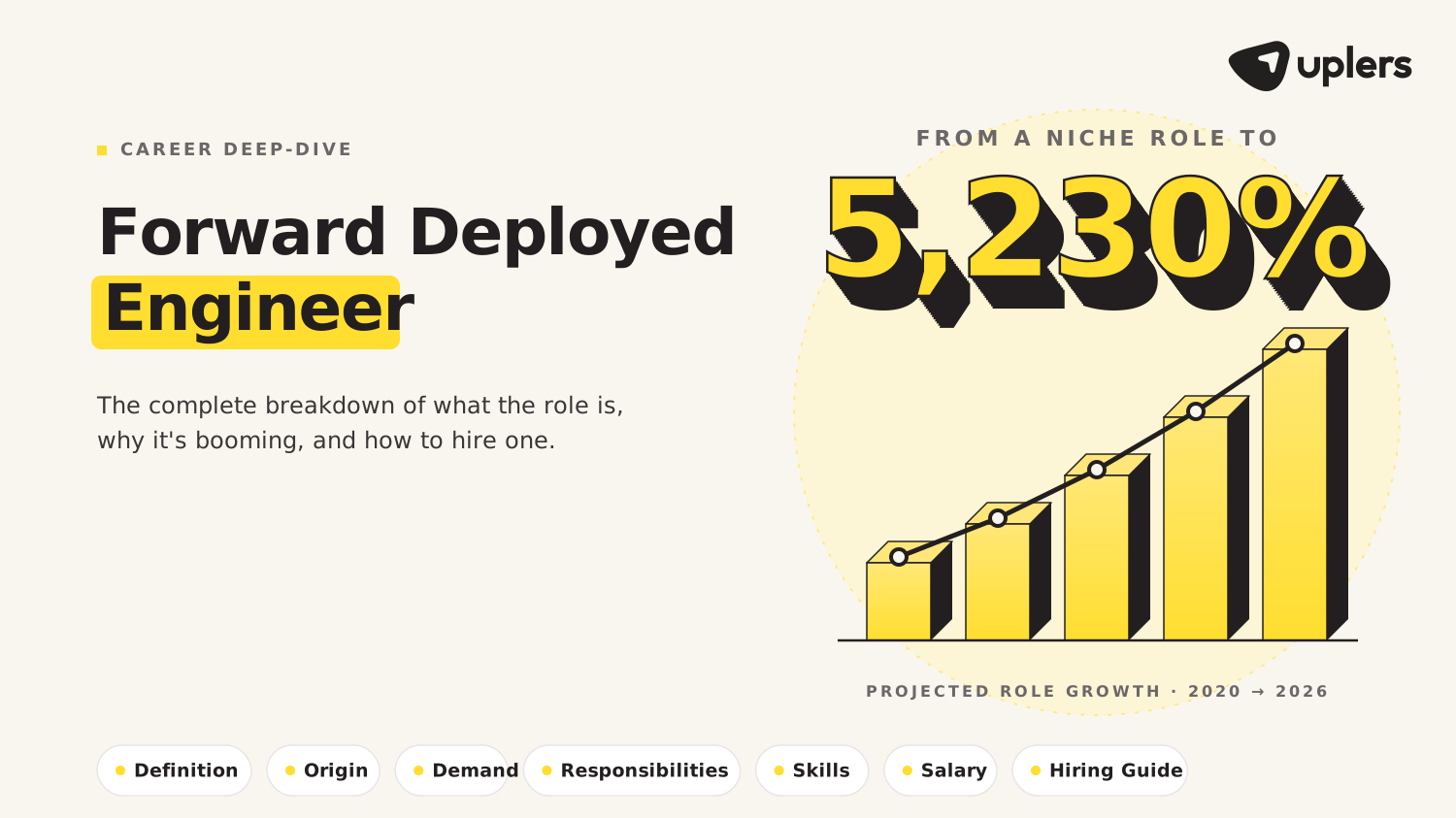
- FDE job postings grew 729% year-over-year by April 2026.
- The role is most valuable in industries with complex systems, strict compliance requirements, and high deployment risk.
- For example, fintech, defense, healthcare, and enterprise SaaS.
- FDEs combine technical depth, customer communication, systems thinking, and domain expertise.
- Best candidates for the role are early startup engineers, backend engineers from AI labs, and solutions architects who miss writing code.
- Hire one when deployment friction is costing you revenue; don’t hire if your product self-serves.
Your AI pilot worked. The demo impressed the customer. The budget got approved. Everyone expected a quick rollout.
Then deployment started. Six months later, it’s in production at exactly zero customers.
Security reviews, legacy systems, fragmented data, compliance requirements, and internal workflows suddenly became bigger obstacles than the AI itself.
If you’re building AI products today, you’ve probably seen this happen.
The gap between what AI can do in a sandbox and what it actually does inside a real company’s messy infrastructure has a job title now. And it’s the fastest-growing role in tech- Forward Deployed Engineers (FDEs).
Their job isn’t just to build software. It’s to make software work inside real customer environments.
This guide covers what a Forward Deployed Engineer is, where the role came from, who’s hiring, what it pays, how to hire one well, and when you absolutely should not.

Why is everyone talking about Forward Deployed Engineers
A year ago, most founders had never heard of Forward Deployed Engineers (FDEs).
Now, they’re everywhere.
Job postings for FDEs have surged, frontier AI labs are hiring aggressively, and companies from startups to enterprises are quietly building teams around the role.
So what changed?
AI moved from demos to deployment.
For years, AI lived in demos. Now it’s inside businesses. The challenge is no longer “Can the model work?” It is “Can the model work inside this company?”
The new system introduces new challenges:
- integrations
- permissions
- compliance
- legacy systems
- workflow customization
- internal stakeholders
Founders call it the integration wall. And this is where FDEs become valuable.
They bridge the gap between a successful AI pilot and a successful production deployment by owning customer implementations, solving integration challenges, and making complex systems work in the real world.
Google Cloud CEO Thomas Kurian said that growing client and partner demand for AI products is why Google is ramping up FDE hiring. Box CEO Aaron Levie put it even more directly, saying, “Forward-deployed engineers are about to become one of the most in-demand jobs in tech and one of the most important functions for AI rollouts.”
By the Numbers
The rise of FDEs is not just hype. The market has already moved.
- MIT’s Project NANDA found that 95% of enterprise generative AI pilots produce no measurable P&L impact, despite spending billions of dollars. The conclusion was: the models aren’t the problem. The deployment is.
- By April 2026, job postings for FDEs had surged to 5,230% above January 2025 levels, which is roughly a 729% year-over-year.
- On May 11, 2026, OpenAI launched a $4 billion subsidiary, the OpenAI Deployment Company, built entirely around Forward Deployed Engineers, and acquired a 150-FDE consulting firm to seed it on day one.
Origin Story: How was the Role Invented?
The role didn’t come from Silicon Valley hype. It came from a real deployment problem.
Palantir Technologies’ customers were governments, defense agencies, and highly regulated organizations. Not exactly the kind of clients who fill out a feedback form.
In short:
- messy systems
- sensitive data
- zero room for failure
Someone had to sit close to the customer, understand operations, debug infrastructure, and make systems work. So Palantir created a new type of engineer.
Internally, these engineers were known as “Deltas”, which are different from “Devs” who built the core product.
A Dev focused on one capability for many customers. A Delta focused on many capabilities for one customer.
Palantir CEO Alex Karp later described this mindset through what he called the “French waiter philosophy.” The idea was that a great waiter doesn’t blindly say yes. They guide the customer toward what works. That became the FDE model.
FDEs build rough, fast solutions for specific customers with an approach, “Let’s solve the real problem.”
The core product team would then study those solutions across clients, find the patterns, and turn them into standard platform features.
Today, many companies are copying this playbook.
Who is a Forward Deployed Engineer?
The term “forward deployed” comes from military language, which means operating close to where action happens. In software, it means staying close to the customer problem, especially when things get messy. And enterprise environments always get messy.
A Forward Deployed Engineer (FDE) is a customer-facing engineer who helps deploy products, especially AI systems, inside real customer environments. They live inside your customer’s world, their Slack, their infrastructure, their architecture diagrams from 2019 that nobody has updated.
They are not just consultants. They don’t just advise. They ship. Think of them like part engineer, part problem-solver, and part operator.
For example, suppose a customer asks:
“Can this work with our internal systems?”
A consultant gives recommendations. A CSM coordinates meetings. An engineer says, “That’s not in the roadmap.”
But an FDE starts figuring out the solution.
That’s the difference that matters most.
| Role | What they do | Do they ship production code or own deployment? |
| Forward Deployed Engineer | Embeds with the customer, owns the full technical problem, ships working solutions | Yes |
| Solutions Architect | Designs the system, hands off documentation | Partially |
| Customer Success Manager | Manages the relationship, monitors health, escalates issues | No |
| Sales Engineer | Demos the product, supports the deal | Rarely |
| Consultant | Advises, writes recommendations | No |
The easiest way to think about it: the FDE is a startup CTO, assigned to your biggest customer’s hardest problem. They own it end-to-end, from scoping on day one to production six months later.
That mix of technical depth + customer context is exactly why the role is getting attention.
What FDEs Do – Roles & Responsibilities
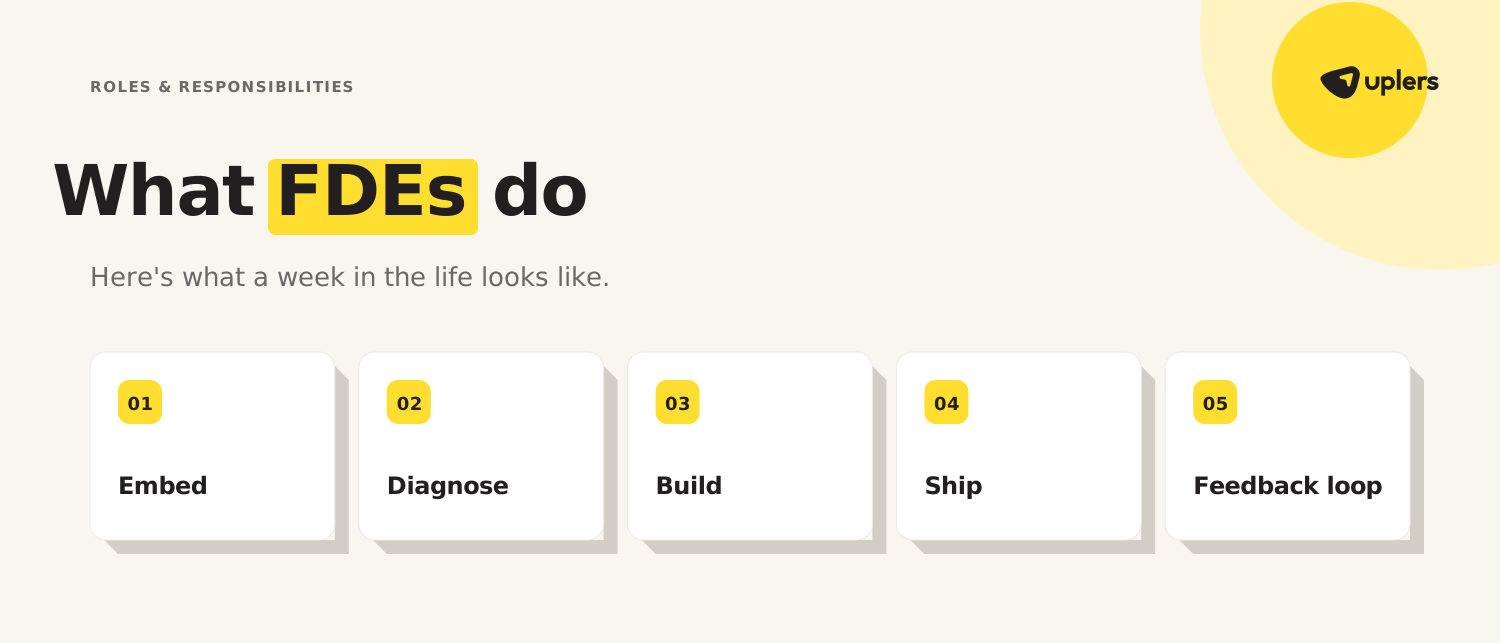
Here’s what a week in the life looks like:
Embed: They join the customer’s daily standup and understand the customer’s environment. They learn how decisions happen.
Diagnose: Customers rarely describe the real problem clearly. They’ll just say, “We need an AI assistant.” What they really mean is, “Our workflow is broken.” FDEs learn to diagnose before building.
Build: They own integrations, APIs, data pipelines, custom workflows, and production systems.
Ship: When SSO breaks, permissions fail, security teams intervene, and internal systems behave unpredictably, FDEs take charge and fix things.
Feedback Loop: Every pattern an FDE hits in the field, from every integration quirk to every workaround they build, becomes a signal for the product team. They are the best source of real-world product intelligence a company has.
The skills stack of a Great FDE
FDEs need to be competent across many things simultaneously, and that’s rare. They combine technical depth, communication, and domain expertise.
| Technical Depth | Communication | Domain Context |
| APIs | Stakeholder management | Fintech |
| Python | Executive conversations | Healthcare |
| Cloud | Trust building | Compliance |
| Data systems | Ambiguity handling | Enterprise ops |
Great FDEs can code, communicate, and navigate chaos. And that combination is rare.
For example, A brilliant backend engineer might freeze in customer meetings. A polished consultant may be unable to debug production systems. But the best FDEs have solved messy problems before. That’s why early startup engineers fit surprisingly well into this role.
No clean specs. No perfect roadmap. Just a “Figure it out” attitude.
Most strong FDEs usually bring:
Technical skills
- Full-stack engineering
- APIs and integrations
- Python and backend systems
- Cloud infrastructure (AWS, Azure, GCP)
- Data pipelines and ETL
- Authentication systems (SSO, SAML, OAuth)
- LLM and RAG experience
Human skills
- Translating technical ideas simply
- Building trust quickly
- Managing ambiguity
- Handling tough stakeholders
- Knowing when to push back
Who’s hiring FDEs in 2026?
To be honest, almost everyone who is serious about enterprise AI.
OpenAI: It launched the OpenAI Deployment Company in May 2026, a $4B subsidiary backed by 19 investment firms, built entirely around FDEs.
Google Cloud: The company is hiring hundreds of FDEs with published base salary bands of $127K – $265K before bonus and equity. It describes them as “builders expected to code, debug, and jointly ship bespoke agentic solutions directly within the customer’s environments”
Salesforce: It has committed to building a team of 1,000 FDEs. 40–50% of FDE movement is internal transfers, and the company has built a six-week onboarding program in September 2025
Anthropic: The company is currently advertising FDE positions with salaries ranging from $200,000 to $300,000. It seeks consulting experience and technical customer service backgrounds for the role.
Apart from these well-known names, other companies and consulting firms, such as Palantir, Databricks, Mistral, Cohere, Stripe, Ramp, Rippling, Notion, Deloitte, Accenture, KPMG, and BCG, are actively hiring for the role. As of May 30, 2026, JBC’s live job index shows 224 open Forward Deployed Engineer roles across 39 distinct companies. The role is required across infrastructure, applications, voice, video, vertical SaaS, and sovereign AI.
What the Market Signals Say
| Signal | What It Means |
| AI labs hiring FDEs | Deployment matters as much as models |
| Salesforce investing heavily | AI implementation is becoming a function |
| Consulting firms launching FDE practices | Traditional consulting is not enough |
| Startup hiring surge | Founders are hitting deployment friction earlier |
Which Industries actively hire Forward-Deployed Engineers?
Not every industry needs FDEs equally. The role is valuable when systems are complex, compliance matters, and mistakes are expensive.
| Industry | Why FDEs Are Critical |
| Fintech | Complex compliance, legacy banking infrastructure, and high-stakes data integrations. |
| Defense & Government | Classified systems, security clearances, and zero tolerance for failure. |
| Healthcare | HIPAA constraints, EHR integrations, and clinical workflow requirements. |
| Enterprise SaaS | AI products require deep customization to land in client environments. |
| Consulting / Big 4 | Deliver on AI transformation promises. |
One shift worth noting is that New York (35% of FDE postings) has surpassed San Francisco (11%) as the primary hub. The demand is concentrated in fintech and other highly regulated industries where FDEs help navigate complex compliance requirements alongside technical integration.
What FDEs earn in 2026
Companies aren’t paying for coding alone. They’re paying for:
- technical depth
- deployment ownership
- customer trust
- business impact
Because a failed deployment can cost millions in lost ARR. A single mistake can significantly increase the real cost of hiring an engineer.
Base salary is the least interesting number here. Equity is 55–70% of compensation at the top of the market. So, looking only at the base is like judging a house by the doormat.
| Level | Total Comp Range | Base Range |
| Mid-level FDE | $300K–$450K | $180K–$240K |
| Senior FDE | $450K–$550K | $220K–$280K |
| Staff / Principal FDE | $600K+ | $280K–$350K |
For more on the Forward Deployed Engineer salary, check out Uplers’ Salary Guide 2026.
How to hire a Forward Deployed Engineer
Despite FDE job postings growing by around 800% in 2025, the qualified candidate pool grew roughly 50%.
That ratio explains why hiring an FDE feels impossible. The mistake most hiring teams make is sourcing for engineering skills and missing the customer-facing dimension. The result is hiring a brilliant engineer who can’t debug production systems.
Some backgrounds that consistently perform well are:
- Early-stage startup engineers
- Backend engineers who deployed customer systems
- Solutions architects who enjoy coding
- Technical consultants tired of slide decks
The pattern worth noticing is that most good FDEs were already doing the job before the title existed.
Where to find the right Forward Deployed Engineer
Referrals from your existing engineering team tend to surface candidates who’ve already proven they can operate without a playbook.
Niche AI and infra-hiring communities are another strong source, since FDE-shaped people rarely call themselves FDEs in their LinkedIn headline.
If you don’t have the bandwidth to source and screen at this depth, platforms like Uplers screen candidates for exactly this mix, production experience plus customer-facing comfort, which can shorten the search considerably. Its 3.5M+ talent network consists of top 1% engineers, so you get startup-ready and ideal candidates.
What to screen for in Interviews
The Palantir and OpenAI format uses a decomposition test. It involves giving a complex, ambiguous problem and evaluating how the candidate structures it. The thinking process reveals more than the answer.
The prompt looks something like:
“A large bank wants to deploy your AI system. Their data is fragmented, compliance is strict, and workflows are unclear. What do you do first?”
Specific signals to look for:
- Have they shipped production code in a customer environment they didn’t build?
- Can they handle ambiguity?
- Can they stay calm under pressure?
- Can they tell a story about a time they had no spec, no clear owner, and still shipped something?
- Can they explain what they built to a non-technical person in two minutes, right now, in this interview?
Stage-specific guidance:
| Stage | Who to hire |
| Seed | Scrappy generalist. Often the founder or first engineer who wears the hat without the title. |
| Series A | First dedicated FDE hire. Best when you have 3 – 5 enterprise accounts with complex deployment needs. |
| Series B+ | Domain specialists with compliance-industry experience. |
At the seed stage, flexibility matters. As the startup scales, domain expertise starts winning. It is especially true in fintech, healthcare, and compliance-heavy industries.
When should startups hire their First FDE?
Not every startup needs one, at least not immediately. Hire an FDE if:
- Enterprise customers are growing.
- Deployment delays are slowing revenue.
- Onboarding needs to be customized every time.
- Integrations are getting painful.
Two quick tests:
“Is a single successful deployment worth $500K+ in ARR?” If yes, one FDE who closes one deployment pays for themselves on a single win.
“Is your CSM escalating the same technical blockers across multiple accounts?” If yes, you don’t need another CSM. Hire an FDE who can go in and fix the problem.
59% of companies hiring FDEs on Paraform are Seed through Series A. And 58% of FDE roles overall are at companies with 11 – 200 employees. This shows that Early is not too early if the problem is real.
When NOT to hire a Forward Deployed Engineer
This is the section most guides skip. It shouldn’t be.
Don’t hire an FDE if:
- You don’t have enterprise customers yet. An FDE without customers to embed with is an expensive engineer doing internal work with a fancy title.
- Your product can self-serve. If onboarding takes an afternoon and a YouTube video, you need better documentation, not an FDE.
- You want demos and deal support. That’s a Sales Engineer role.
- You need relationship management without technical depth. That’s a CSM.
- You need architectural guidance without code. That’s a Solutions Architect.
Sometimes founders think, “Everyone is hiring FDEs. We should too.” That’s the wrong reason to hire. An FDE solves deployment friction, not strategy confusion.
Quick rule of thumb
| Hire an FDE If… | Don’t Hire One If… |
| Enterprise complexity exists | Product is simple |
| High-value accounts matter | Mostly SMB motion |
| Deployments slow revenue | Self-serve works |
| Integrations are painful | Customers onboard easily |
What 40-50 Real Forward Deployed Engineer Job Descriptions Reveal
After reviewing dozens of FDE job descriptions, one pattern is obvious:
Most companies still misunderstand the role. Some write backend engineer JDs, while others describe consultants who code. However, a strong JD is optimized for one aspect- deployment ownership.
If you’re hiring an FDE, here’s what to care for.
What To Include in an FDE JD
- Start With The Problem
Don’t start with: We’re hiring a Forward Deployed Engineer.
Start with: Why this role exists.
Example: Enterprise customers love our product, but deployment complexity slows adoption. We need someone who can bridge customer workflows and engineering execution.
Good FDEs join to solve problems.
- Define Outcomes, Not Tasks
Weak JD: Build integrations
Strong JD: Own deployments from discovery to implementation to go-live.
What every strong FDE JD must include:
- customer discovery
- workflow diagnosis
- APIs & integrations
- production deployment
- debugging failures
- rapid prototyping
- product feedback loops
- reusable deployment playbooks
Simple rule: FDEs own the messy middle between pilot and production.
- Prioritize Capability Over Tools
Founders often overdo tooling.Bad: LangChain, Kubernetes, Pinecone, Docker, React, Go, Rust.
Good: Experience building production systems and solving customer deployment problems.
Focus on Must-have & AI-native teams:
Must-have
- APIs & integrations
- production debugging
- systems thinking
- customer communication
- ambiguity handling
AI-native teams
- LLM APIs
- RAG
- agent workflows
Question to ask: Can this person make messy systems work?
- Hire for Traits, Not Credentials
FDE sounds like: “The customer is blocked. Figure it out.”
Best hiring signals:
- Ownership: owns outcomes
- Ambiguity tolerance: no perfect specs needed
- Builder mindset: ships quickly
- Customer empathy: explains complexity simply
- Bias for reuse” builds systems, not chaos
Startup engineers perform well here as they’re already comfortable with ambiguity.
- Mention What Success Looks Like
Strong FDE JDs tell candidates what winning looks like.
Include:
30 Days
- Understand customer workflows
- Identify deployment bottlenecks
60 Days
- Own customer implementations
- Resolve integration challenges
90 Days
- Launch successful deployments
- Create reusable deployment patterns
Simple rule: By day 90, an FDE should be independently moving customers from pilot to production.
What NOT to include in an FDE JD
Skip startup fluff
Remove:
- Rockstar engineer
- 10x mindset
- Fast-paced environment
- Excellent communication skills
Nobody learns anything from these.
Skip giant tech lists
- Long tooling sections usually signal confusion.
- Candidates care more about:
- What problems am I solving?
not: How many tools are listed?
Skip impossible unicorn expectations
- Don’t ask for:
- engineer + consultant + PM + ML researcher + sales engineer
- Unless compensation reflects it.
- Strong candidates notice this immediately.
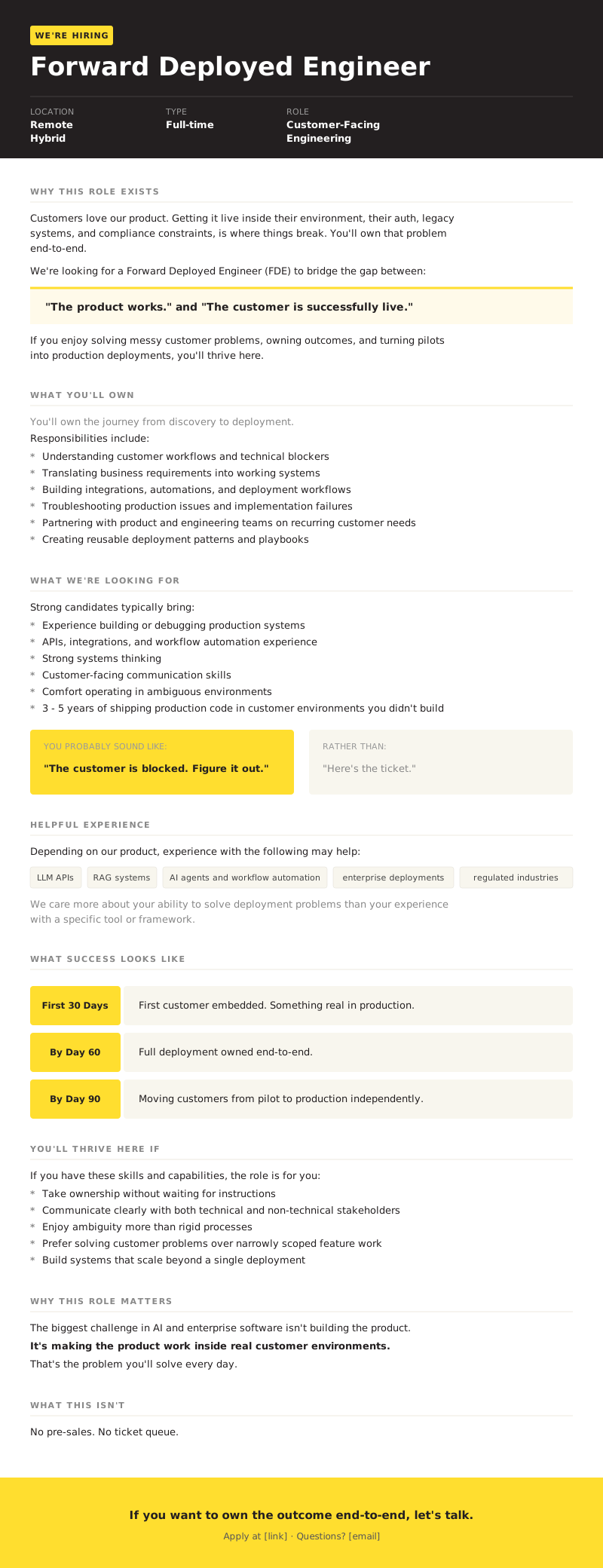
Here’s what an Ideal Forward Deployed Engineer JD should look like:
Conclusion
The biggest challenge in an AI startup is making the model work inside real systems.
That’s the problem the Forward Deployed Engineer solves. The role was first built at Palantir in 2011; now, everywhere AI is trying to go from pilot to production.
The role is here to stay. The only question is whether you hire for it deliberately or figure that out after a failed deployment.