Snippet:
- Salary is only the starting point of engineering hiring cost in India.
- Recruiter fees, EOR charges, payroll compliance, and onboarding significantly increase total spend.
- EOR costs are recurring and materially affect long-term hiring budgets.
- Founders who budget accurately plan for the full hiring stack before the first offer is made.
Most founders who’ve hired in India will tell you the same thing afterward: the salary was just the starting point.
You find a solid mid-level backend engineer at $4,000 per month. You convert it, the talent looks great, you put the number in the spreadsheet, and you move forward.
But then comes the platform fee, the EOR invoice, and employer-side statutory contributions on top of the CTC. You also start figuring out the equipment situation.
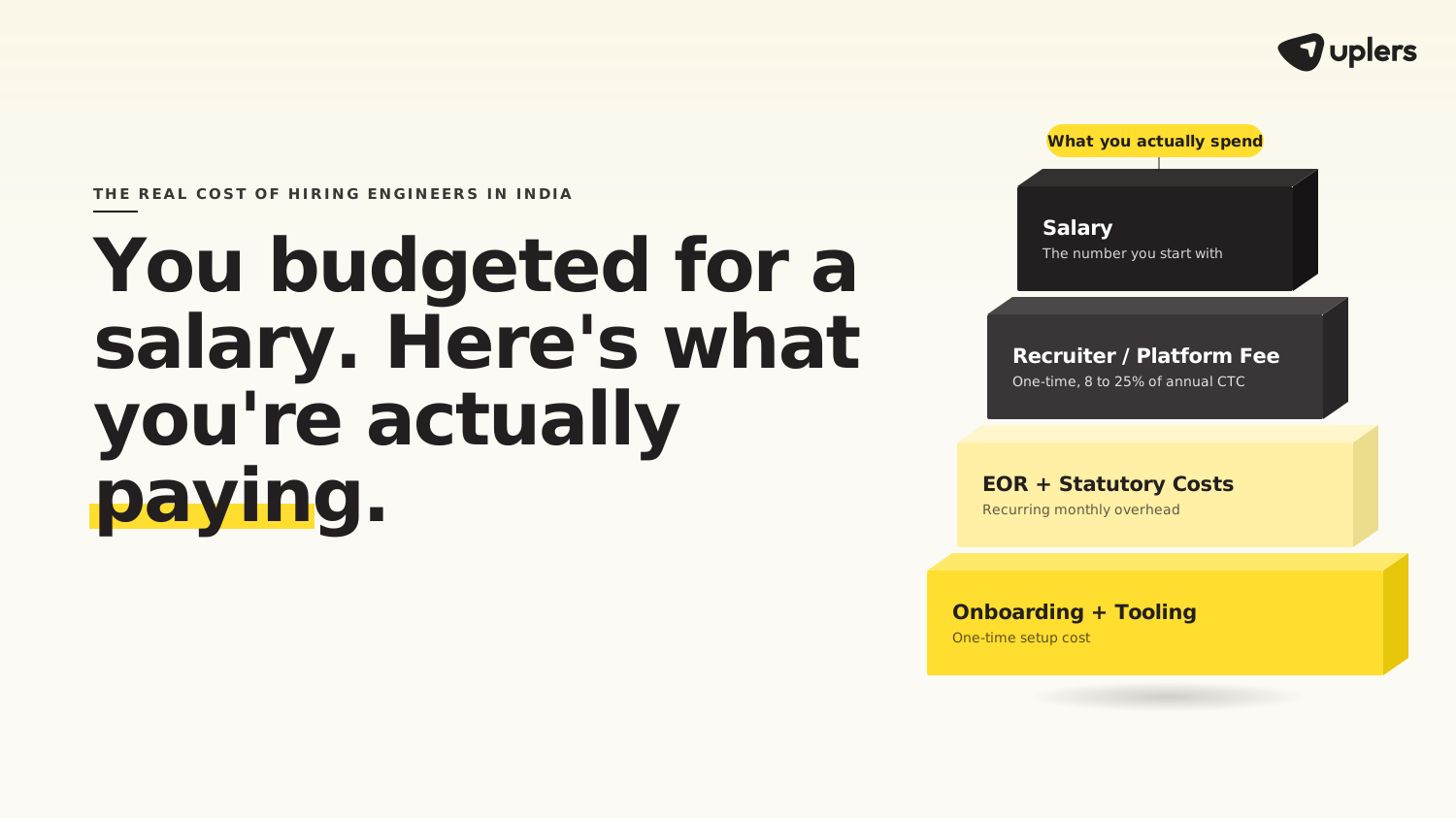
By the time the engineer is onboarded and productive, you’ve spent around 40% more than the number you started with.
This happens to almost every founder hiring for the first time. Not because the hire was wrong, but because the budget only had one layer in it.
There are multiple layers to consider. Here’s what each of them costs and where the math tends to break.
What Founders Budget vs What They Spend
You decide you want to hire an engineer and can afford their salary, multiply it by headcount, and call it hiring budget.
But then you realize there are hidden costs. Recruiter fees, EOR costs, employer contributions, equipment, payroll compliance, and delayed hiring because the first candidate did not work out.
None of these costs is shocking individually. However, the problem is that they compound. This is where budgets quietly drift.
A founder budgets for one number and ends up paying another. The reason is that engineering hiring has more moving pieces than most founders who are hiring for the first time account for.
The good news is that the cost structure is predictable once you know the layers.
The Salary Layer: What Engineers In India Earn In 2026
Strong engineers have ample global opportunities. Founders are now competing with remote-first startups, global capability centers, and AI-funded businesses hiring.
Salary Benchmarks by Role (2026)
These are broad market ranges (monthly). Compensation can vary based on city, specialization, product maturity, and whether the role is India-first or globally benchmarked. For a full salary breakdown, refer to Uplers Salary Guide 2026.
| Role | Junior (2 to 4 yrs) | Mid (4 to 7 yrs) | Senior (7+ yrs) |
| AI/ML Engineer | $2,500 to $3,500 | $3,500 to $4,500 | $4,500+ |
| Forward Deployed Engineer | $4,000 to $5,500 | $5,000 to $7,000 | $7,500+ |
| Backend Engineer | $2,000 to $3,000 | $3,000 to $4,000 | $4,000+ |
| Full-Stack Engineer | $2,000 to $3,000 | $3,000 to $4,000 | $4,000+ |
| Frontend Engineer | $2,000 to $3,000 | $3,000 to $4,000 | $4,000+ |
| DevOps / Platform Engineer | $2,500 to $3,500 | $3,000 to $5,500 | $6,000+ |
| Data Engineer | $2,000 to $3,000 | $3,000 to $3,500 | $3,500+ |
| Mobile Engineer (iOS/Android) | $2,000 to $3,000 | $3,000 to $4,000 | $4,000+ |
| QA / Automation Engineer | $1,500 to $2,500 | $2,500 to $3,500 | $3,500+ |
Salary Based on Project Type
The role title is only part of the cost equation. What you’re building determines how much engineering depth you need, which directly affects the salary range.
For example, a backend engineer maintaining an internal dashboard is not priced the same as someone building real-time payments infrastructure. Similarly, a full-stack engineer shipping a SaaS MVP has a different market range than someone working on enterprise integrations or AI-native products.
| Project type | What you need | Approx Salary Range (Annual) |
| Internal tool or dashboard | Mid-level full-stack, clear scope, standard stack | $16K to $23K |
| SaaS product (early stage) | Full-stack with product thinking, some ownership | $21K to $34K |
| Fintech / Healthtech | Higher because of compliance and reliability expectations | $30K to $55K |
| AI-native product | ML-aware engineers, prompt engineering, model integration | $26K to $47K |
| Infrastructure or platform work | Senior DevOps or platform engineer, strong systems background | $32K to $58K |
| Forward deployed / customer-facing | Deep domain knowledge, strong communication, high autonomy | $37K to $84K+ |
The biggest factor in salary is the level of technical complexity and ownership expected from the engineer. Founders hiring for speed often pay more. Founders hiring for reliability usually do too.
What Affects Engineering Salaries in India
Two engineers with the same title can sit in completely different salary brackets. Beyond role and seniority, here are 5 factors that affect the salary range:
Tech stack: Engineers with strong Python, Go or Rust backends command a premium over those working in more common stacks like PHP or older Node versions. Also, modern stacks involving LLMs, Kubernetes, event-driven systems, or heavy cloud infrastructure usually increase compensation expectations.
Product company vs service company background: Engineers from product background typically earn and expect more. They’ve worked in environments closer to what a US startup needs.
Ownership track record: An engineer who has shipped features end-to-end, made architectural decisions, and worked without constant direction is worth more than one who’s executed tasks in a well-defined role.
Product stage: Early-stage startups value engineers who can work across ambiguity. Growth-stage companies may pay more for specialization and execution depth.
Hiring model: Direct hiring, contractor models, and EOR-based employment can change total employer cost even if salary stays similar.
The Recruiter And Platform Fee Layer
Salary gets attention. Hiring fees usually show up later. And yet, this is often one of the highest one-time costs in the process.
How Most Recruiters Charge
Recruiter pricing in India usually follows one of two models.
Percentage-based Fee: This is the most common structure. Hiring platforms typically charge a percentage of a candidate’s annual compensation after successful hiring. Depending on role complexity and seniority, this ranges between 8% and 25% of annual CTC. It is a one-time fee. Most contracts include a 30 to 90-day replacement window.
Flat-fee Hiring: Some hiring platforms charge a fixed price regardless of compensation. This creates predictability for founders, especially when salaries increase. The cost may vary based on speed, screening quality, replacement terms, and access to talent.
What Uplers Charges
Uplers follows a transparent hiring model. It charges a one-time fee, which is a certain percentage of the candidate’s annual CTC.
Uplers has the top 1% talent network of 3.5M+ professionals. Every profile you receive has been screened based on your requirements, so you’re not paying to sort through resumes. You’re getting three to five shortlisted candidates and making a call from there.
If the hire doesn’t work out within the guarantee window, they replace the candidate. Check the current terms on our pricing page since these can vary by engagement type.
The EOR and Payroll Layer
Funders underestimate this cost when hiring from India.
What Is an EOR Service
Most US startups don’t have a legal entity in India. Without one, you can’t put someone on payroll. EOR solves that without requiring you to set up a company.
An Employer of Record (EOR) is a company that acts as the legal employer in India while the engineer works for your company.
They manage payroll, contracts, taxes, statutory compliance, and local employment obligations so founders can hire without setting up a legal entity.
The idea is you manage the work, they manage employment.
What EOR Costs on Top of Salary
Most EOR providers charge a recurring markup.
This is typically structured as:
- A monthly flat fee per employee
- A percentage markup on salary
- Or a blended model
In practice, founders usually see an added cost of around 8% to 20% on top of compensation, depending on hiring volume, benefits, country complexity, and service scope. It is beneficial when the headcount scales from two engineers to twenty.
What pushes the cost up is multi-state compliance, equity administration, benefits beyond statutory minimums and fast onboarding. Hiring multiple people through the same provider, or keeping the engagement standardized, can bring the cost down.
EOR vs Setting Up an Entity
For early-stage startups hiring one to ten people, EOR makes operational sense. You move faster. Compliance risk stays lower. HR and payroll overhead stay outsourced.
On the other hand, setting up a Private Limited company in India takes three to six months. Also, it demands $3,000 to $8,000 in legal and registration fees, and comes with ongoing annual filing, audit, and local director obligations.
As seen on India’s Ministry of Corporate Affairs website, timelines have improved but remain subject to state-level variation.
EOR makes sense when you’re hiring 8-10 engineers and don’t want a permanent Indian operational footprint. Once you go past ten people, the monthly EOR markup typically exceeds the cost of running your own entity. At that point, entity setup becomes the cheaper option.
Neither is automatically better. It depends on the headcount and how long you’re planning to hire in India.
The Statutory and Compliance Layer
These costs exist regardless of whether you use EOR or your own entity.
Provident Fund (PF)
The Provident Fund is India’s retirement contribution system. In eligible structures, employers contribute 12% of the basic salary to PF and employees contribute separately as well.
The important detail: PF is not always 12% of total compensation. It applies to the salary structure, usually the basic component.
It is a real monthly cost employers need to budget for.
Gratuity
Gratuity is a financial benefit provided by employers. Employees are eligible for gratuity on a pro-rata basis after completing one year of continuous service.
Even though the payout happens later, companies often account for gratuity accrual during employment.
Professional Tax and Other State-level Costs
Professional tax is a state-level levy on salaried employees. The employer deducts it and remits it to the state government. It varies by state. Individually, these costs are small. But operationally, they still matter.
The Onboarding and Tools Layer
This one catches founders off guard. The first month of an engineering hire usually includes more than payroll:
- Laptop or equipment allowance
- Development environment setup
- SaaS licenses
- Cloud access
- Security provisioning
- Internal tooling
- Slack, Notion, Jira, GitHub, Linear, Figma, or analytics access
- Learning tools or AI coding assistants
Remote teams spend more here than expected because distributed engineering teams rely more heavily on software infrastructure.
What the All-in Number Looks Like
Here is the easier way to think about hiring cost in India: salary is the base layer. A realistic hiring budget usually stacks multiple costs together.
| Cost layer | Typical range |
| Base salary | Market benchmark |
| Recruiter / platform fee | One-time, often 8 – 25% of annual compensation |
| EOR / payroll service | Recurring or flat monthly fee |
| Employer PF contribution | Based on salary structure |
| Gratuity accrual | 4.81% of basic salary annually |
| Onboarding and tooling | One-time setup cost |
Conclusion
Now that you are aware of the different costs involved, it’s time to ask yourself, “Does your budget reflect what engineering hiring in India actually costs in 2026?”
Founders who get this right prepare better even before the first interview. They make sure that salary, hiring fees, payroll structure, compliance, onboarding, and operational overhead are all part of the decision.
Because the fastest way to blow a hiring plan is not overpaying. It is under-budgeting for reality.