Snippet:
- Building an MVP or still validating product-market fit? Hire a Founding Engineer.
- Hire a CTO when you are scaling teams, architecture, and technical strategy.
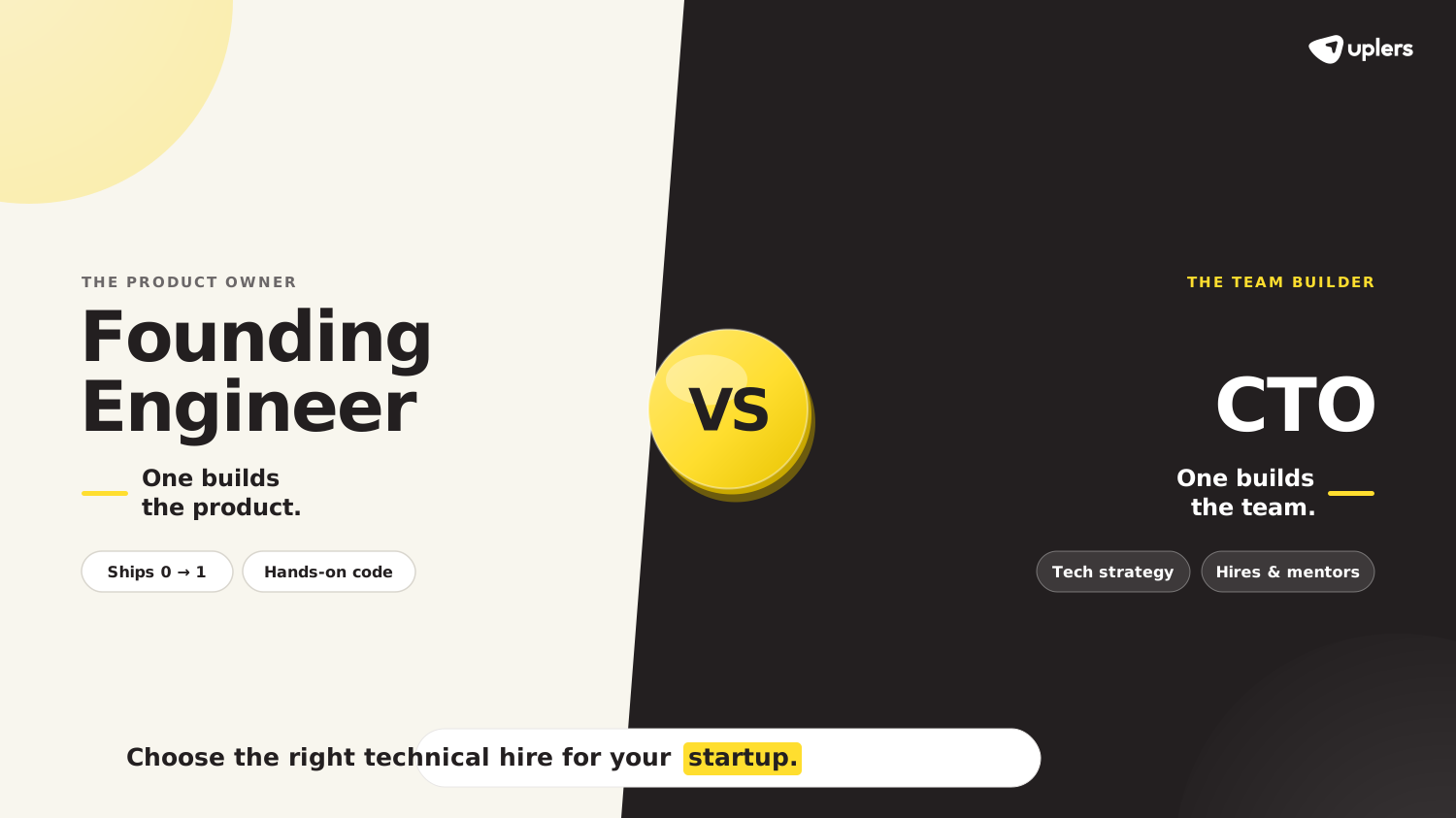
- Core difference is ownership. A Founding Engineer focused on execution; a CTO scales a team.
- Most startups hire a Founding Engineer first because early growth depends on shipping, learning, and iterating quickly.
- A Founding Engineer can become a CTO over time, but only if they’re ready to lead a team.
- Which one to hire depends on your startup’s current stage, biggest bottleneck, and growth plans.
A founder recently asked a question that is common in today’s startup ecosystem:
“I’m ready to make my first technical hire. Do I need a Founding Engineer or should I hire a CTO (Chief Technology Officer)?”
At first glance, it sounds like a simple comparison between two roles. But it isn’t.
It’s a crucial decision that shapes how quickly you build, how your product evolves, and how your engineering team grows over the next few years.
Get it right, and your startup gains momentum. Get it wrong, and you could end up hiring for tomorrow’s challenges while today’s biggest bottleneck remains unsolved.
One thing we have noticed across startup communities, founder forums, and hiring conversations is that many founders aren’t confused about who to hire. They’re confused about when to hire for each role.
The answer depends on what your startup needs today.
Let’s break it down.
| Startup Stage | Best First Hire |
| Idea / no product yet | Founding Engineer |
| Pre-seed | Founding Engineer |
| Seed | Founding Engineer (fractional CTO for oversight, if needed) |
| Series A+ | CTO becomes worth evaluating |
Founding Engineer vs CTO: What Is the Difference
Here’s the simplest way to think about it.
A Founding Engineer helps you build the company, whereas a CTO helps you scale the company.
Everything else, including their responsibilities, decision-making, and day-to-day work, flows from that one difference.
Both matter, just not at the same time.
What a Founding Engineer Owns
A Founding Engineer is your First Product Builder. They help you build momentum. On any given day, they’re writing production code, fixing bugs, shipping features, debating product decisions, and turning customer feedback into the next release.
Their priorities usually include:
- Building the MVP and core product
- Shipping features fast
- Choosing practical technologies
- Establishing the initial engineering foundation
- Working closely with founders on product direction
They reduce the time between “We have an idea” and “Customers are using it.”
One quick clarification: a founding engineer is not the same as a technical co-founder. A co-founder owns equity and decision-making across the whole business. A founding engineer is a hire, a well-compensated one.
What a CTO Owns
A CTO (Chief Technology Officer) is your Engineering Leader. Once the product starts growing, engineering becomes less about writing every feature and more about helping an entire team build efficiently. That’s where a CTO comes into the picture.
Their focus shifts toward:
- Defining the technical vision
- Scaling architecture
- Hiring and mentoring engineers
- Improving engineering processes
- Aligning technology with business goals
Side-by-Side Comparison
| Founding Engineer | CTO | |
| Primary responsibility | Ship the product | Lead the tech function |
| Right startup stage | Idea to Seed | Series A+ (or day one for deep-tech) |
| Decision-making | Implementation-level | Strategic, org-wide |
| Coding involvement | Full-time, hands-on | Partial, decreasing over time |
| Leadership | None required | Core part of the job |
| Hiring responsibility | Rarely | Yes, builds the team |
| Success metric | Product shipped | Team scaled, systems hold |
Why Early-Stage Startups Hire a Founding Engineer First
One hiring mistake we frequently see: founders hire for the company they hope to become instead of the company they’re building today.
It makes sense. Hiring a CTO feels like planning. But before product-market fit, your biggest challenge is not leadership but execution.
Speed Over Structure Pre-PMF
The faster you ship, the faster you understand your customers. The faster you learn, the better your product becomes.
Hiring a Founding Engineer means accelerating learning by following a simple process: ship, get feedback, throw it out if it doesn’t work, repeat.
If shipping is your bottleneck, hire someone who ships.
Founder Needs a Thought Partner
At one or two people, there’s no team to lead. Startups focus only on building a product. One day you’re refining your onboarding flow, the next you’re rebuilding a feature based on customer feedback.
A Founding Engineer works alongside you through those shifts. They are challenging product decisions, suggesting simpler solutions, and helping turn ideas into working features.
Product-Market Fit Changes Everything
Before product-market fit, your roadmap changes every week. Customer conversations reshape priorities, features get rewritten, experiments fail. That’s normal.
What matters is having someone who can adapt quickly and keep shipping. A Founding Engineer thrives in that environment because they’re close to both the product and the customer.
The startups that move fastest are mostly the ones with builders who can turn ideas into products without slowing down.
When Should You Hire a CTO Instead?
By now, you might be thinking, “So, should every early-stage startup hire a Founding Engineer first?”
Not always.
Founding Engineer may be the right first hire for most startups, but there are situations where bringing in a CTO early makes sense.
As a founder, you need to realize when execution stops being your biggest challenge and leadership takes over.
You’re Building a Deep-Tech Product
Some startups can’t afford to figure it out as they go.
If you’re building AI infrastructure, cybersecurity platforms, developer tools, fintech infrastructure, or highly regulated healthcare software, every early technical decision has long-term consequences.
A CTO brings the strategic thinking required to make architectural decisions that won’t slow you down later.
Your Engineering Team Is Growing
A second software engineer changes your workload. A tenth engineer changes your job.
Once multiple engineers are working on the product, someone needs to think about architecture, hiring, mentoring, technical standards, and engineering culture.
That’s when leadership becomes a full-time responsibility.
You’re Scaling, Not Searching
Once you have a real engineering team and a roadmap that needs coordinating with product, sales, and ops, the job shifts from “build fast” to “build so it doesn’t break at 10x.”
That’s a CTO’s actual sweet spot.
Hire for Today’s Problems
If you are still not sure, ask yourself one question:
What’s slowing us down right now?
If the answer is:
- We’re struggling to build the product.
- We need to launch faster.
- Our roadmap keeps slipping.
You’re probably looking for a Founding Engineer.
If the answer is:
- Our engineering team is growing quickly.
- Architecture decisions are becoming complex.
- We’re hiring engineers every month.
That’s when a CTO becomes the right investment.
Can a Founding Engineer Become Your CTO?
Absolutely. In fact, it’s a healthy, common path
But it’s not a promotion. The two are completely different jobs.
When the Transition Works
When a Founding Engineer enjoys building teams as much as building products.
That means they’re excited about:
- Hiring engineers
- Mentoring teams
- Making long-term technical decisions
- Building engineering processes
- Communicating with founders, investors, and stakeholders
They gradually spend less time writing code and more time enabling others to succeed.
When It Doesn’t
Not every great engineer wants to become a leader. Some enjoy solving difficult technical problems far more than managing teams.
And that’s perfectly fine.
Sometimes the better decision is keeping the founding engineer in a highly technical leadership role while hiring an experienced CTO as the company grows.
How to Decide Which Role Your Startup Needs Right Now
Think about your biggest bottleneck.
Here’s a simple framework we recommend.
| If you’re thinking | You probably need |
| We need to build our MVP. | Founding Engineer |
| We need someone to ship features faster. | Founding Engineer |
| We’re hiring multiple engineers. | CTO |
| Technical decisions are becoming harder to manage. | CTO |
| We’re scaling our product and infrastructure. | CTO |
Conclusion
One thing we’ve consistently observed across the startup ecosystem is that successful founders don’t ask, “Who is the most senior engineer I can hire?”
They want to know, “Who’s the right person to help us reach the next milestone?”
Sometimes, it can be a Founding Engineer who builds your first product. And at other times, it is a CTO who helps your engineering organization scale.
The right choice depends entirely on where your startup is today and where you want it to be over the next 12 months.
The strongest early technical teams aren’t built by chasing titles. They’re built by matching the right expertise to the right stage of growth.