Snippet:
- A product-background engineer isn’t defined by company name; it’s defined by whether they own outcomes or just complete assigned tasks.
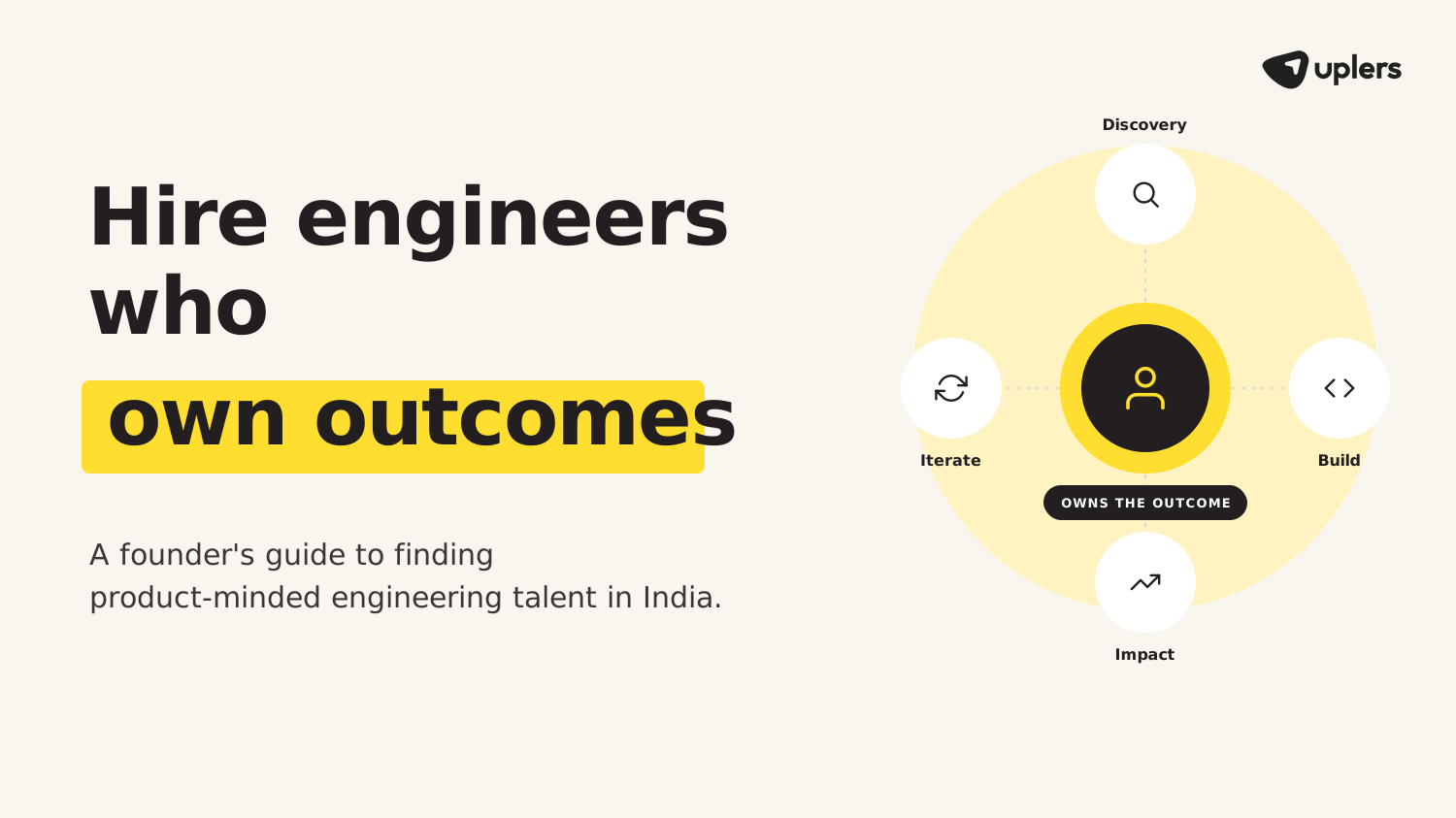
- Service engineers deliver to spec. Product engineers own outcomes. That distinction shapes how you source, screen, interview, and onboard.
- India’s product engineering ecosystem now spans SaaS, fintech, AI infrastructure, developer tools, and consumer apps, with many engineers building for global users.
- Pedigree gets you a shortlist. Resume signals, behavioral cues, and side projects tell you who’s worth an interview.
- The right interview tests ownership, curiosity, and judgment.
- Onboarding decides whether a strong hire compounds or stalls. The first 90 days matter as much as the hiring decision itself.
- Most costly hiring mistakes come from judging pedigree over scope, and speed over fit.
A candidate has an impressive résumé, years of experience, and clears every technical interview. You hire them, expecting momentum. Instead, they wait for detailed requirements, hesitate when priorities change, and rarely challenge assumptions.
So, what went wrong? Not their technical ability. Their previous environment expected something different from an engineer.
Many US startups hiring from India optimize for skills, experience, or cost first, only to discover a mindset mismatch after onboarding. Early-stage teams need engineers who can navigate ambiguity, think like product owners, and make decisions without constant direction.
India has become one of the world’s strongest engineering talent markets, and product-background engineers are only a subset of that talent network.
What makes a real difference is knowing how to identify, evaluate, and hire them.
This guide walks through what defines a product-background engineer, why startups increasingly hire them from India, how to recognize product thinking before making an offer, where to find this talent, and the hiring mistakes that cost founders the most time. Consider it a practical playbook built around the hiring decisions early-stage founders make every day.
Who Is a Product-Background Engineer?
Not every engineer who has worked at a product company is a product engineer. Many engineers with a few years of startup experience develop stronger product instincts than peers from globally recognized brands.
A product-background engineer is someone who has repeatedly built software where success depends on customer outcomes, not just completing assigned tasks. They’re expected to understand the problem before proposing a solution, collaborate across functions, and own what happens after deployment.
Product experience goes beyond the company name
Founders often use company names as assurance. Seeing experience at companies like Flipkart, Razorpay, Freshworks, or Zoho can be encouraging, but logos alone rarely tell the full story.
Two engineers from the same company can have completely different mindsets. One may have owned critical customer-facing features, collaborated closely with designers and product managers, and tracked business metrics after launch. On the other hand, another may have spent years maintaining internal systems with limited exposure to product decisions.
As you hire, don’t ask “Which company did they work for?” Try to understand “What decisions did they own, and what customer problems did they solve?”
Why product thinking matters more than technical skills alone
Most startups don’t fail because engineers can’t write code. They struggle because teams build the wrong features, move too slowly, or require constant founder involvement. Product-minded engineers reduce that dependency.
Suppose there are two engineers writing equally clean code but make opposite decisions when there is a gap in specification. One reaches out to the product manager to ask questions. The other doesn’t wait for complete specifications but makes a judgement call:
- Who is this feature for?
- What’s the success metric?
- Is there a simpler solution?
- What happens if adoption is lower than expected?
This isn’t a skills gap. The difference is what they were trained to expect from the job.
Product vs Service-Background Engineers: The Core Distinction
The way you source candidates, review résumés, conduct interviews, and structure onboarding all depends on understanding the environment an engineer learned in. So, here we go:
The one-line difference
Service engineers deliver to spec. Product engineers own outcomes.
That’s a brief but precise explanation of product vs service-background engineers, and almost everything else follows from it.
Neither engineer is more skilled. The questions asked of them, the approach expected, and the role itself are just different.
Service engineers focus on client requirements, predictable delivery, and contractual commitments. Product engineers are optimized for experimentation, customer adoption, and continuous iteration.
Quick Comparison
| Area | Service Background | Product Background |
| Core expectation | Execute a defined solution well. | Help define the solution. |
| First question | “What needs to be built?” | “What problem are we solving?” |
| Definition of done | Requirements completed. | Customer outcome achieved/ Feature moved a metric. |
| Response to ambiguity | Seeks clearer requirements. | Helps create clarity. |
| Success measured by | Delivery. | Product impact. |
| Ownership after launch | Limited. | Continues through iteration. |
When service-background engineers are the better hire
If the following scenarios stand true, go for a service mindset:
- Work is well-defined
- Migrate a legacy system without breaking anything
- Hit a hard compliance deadline
- Execution quality matters more than product discovery
- Roadmap is primarily execution, not experimentation
For example:
- Enterprise implementation projects
- ERP migrations
- Client-specific custom development
- Legacy modernization
- Large-scale testing and QA initiatives
These environments reward consistency, documentation, and predictable delivery. Many service-background engineers are disciplined and reliable inside a well-defined process. That’s the environment they were built for.
Why early-stage startups prioritize product experience
Seed and Series A startups rarely have the luxury of stable requirements.
Customer feedback changes priorities every week. Founders are still discovering product-market fit. Features launch, fail, and evolve fast. Ambiguity is the default operating condition.
Engineers are a part of the decision-making process. That’s why many early-stage founders deliberately prioritize and hire product backgrounds.
How to Identify Product-Minded Engineers
Pedigree gets you a shortlist. This is how you narrow that shortlist without wasting three interview loops on someone who looks right on paper.
Resume and LinkedIn Signals to Look For
ˀDon’t start with years of experience or company logos. Start with evidence of ownership to spot the right product-minded engineers. Look for outcomes, such as:
- Reduced checkout abandonment by 18%.
- Led the launch of self-serve onboarding.
- Owned the payments infrastructure migration.
Phrases like:
- Worked on authentication
- Developed APIs
- Fixed production bugs
signal execution for a scope someone else defined.
Also, repeated exposure to product cycles, such as feature launches, A/B tests, customer-facing releases, experimentation, and post-launch iteration, is a positive sign.
Behavioral Signals Founders Miss
Many founders focus entirely on technical screening and overlook how candidates describe their work.
Product-minded engineers naturally say:
- I owned…
- We discovered…
- Customer feedback showed…
- We decided not to build…
Notice what they measure, too.
Do they mention adoption, retention, latency improvements, or conversion rates without being prompted? Or do they stop after listing the technologies they used?
The difference is subtle but consistent.
Side-Project and Portfolio Signals
Strong product engineers ship a project end-to-end on their own. It can be:
- an open-source contribution,
- a SaaS side project,
- a Chrome extension,
- an internal developer tool,
- or even a failed startup.
Don’t focus on the success, but find out what happened next. Candidates who can explain user feedback, adoption, mistakes, and iterations almost always demonstrate stronger product instincts.
Where to Hire Product-Background Engineers in India
Once you know what you’re looking for, the “where” question gets a lot easier to answer honestly.
AI-Powered Hiring Platforms
Specialized hiring platforms reduce the time founders spend reviewing hundreds of irrelevant profiles. They filter candidates from their talent network based on pedigree, scope, ownership, and startup readiness before they reach you.
That’s particularly valuable for early-stage teams where founders have limited time to hire without compromising on quality.
Founder Communities and Peer Networks
Many high-performing engineers aren’t actively applying for jobs. You can connect with them through Slack groups, YC batch channels, and founder WhatsApp groups. These platforms ensure better referrals and higher response quality than most job boards.
Product Company Alumni Networks
Alumni communities from companies like Razorpay, Freshworks, or Zoho are a genuinely underused channel. Engineers from the same product-company network tend to refer people who share the same operating instincts, because they know exactly what separates a good hire there from a mediocre one.
Referrals from Your Existing Team
Once you’ve hired one product-minded engineer, referrals often become your highest-quality hiring channel.
Don’t ask for someone they know, but be specific. For example, “Do you know engineers who’ve owned customer-facing features in a startup environment?”
You’ll receive much stronger recommendations.
How to Filter Product-Background Engineers at Scale
Spotting product engineers is one thing. Filtering and vetting relevant engineers from 200 applicants is the real task. The goal is to create a shortlist worth interviewing without relying on intuition alone.
Filtering by Company Pedigree
Working at a respected product company is a useful signal, but it is not enough. The team, the role’s actual scope, and the company’s stage when the person was there all matter more than the logo.
Ask:
- Which team did they join?
- What stage was the company?
- How much ownership did they actually have?
Someone who spent three years launching customer-facing features at a 15-person startup may be a stronger fit than someone maintaining internal infrastructure at a global product company.
Filtering by Role Scope, Not Job Title
A Senior Software Engineer at a 12-person AI startup may own architecture, customer conversations, deployments, and incident response.
The same title inside a 1,000-person organization could represent a much narrower role.
Read the scope of what they actually did. How much ambiguity did they navigate? How much ownership did they carry?
Filtering Using GitHub and Portfolio
GitHub activity of a candidate should demonstrate engineering curiosity. Useful signals include meaningful commits, maintained projects, documentation, issue discussions, and thoughtful pull requests.
Look for one or two projects explained in enough detail that you can tell what decision the person made and why, including the tradeoffs they didn’t take.
Building a Filter Funnel for High Volume
Instead of making every résumé review a fresh decision, define a consistent filter.
For example:
- Product environment
- Ownership evidence
- Customer-facing work
- Metrics discussed
- Communication quality
Only candidates passing most of these filters move to interviews.
This approach reduces bias, speeds up hiring, and keeps evaluation consistent as applicant volume grows.
Designing an Interview Process to Test Product Thinking
Startup interviews mostly over-index on algorithms and framework knowledge. Those skills are crucial but hardly explain if someone can navigate ambiguity, challenge assumptions, or make product trade-offs.
Create an interview process that tests how candidates think- if you can trust them to make decisions when you are not in the room.
Evaluate three dimensions: Ownership, Curiosity, and Judgment
Structure the interview around three dimensions.
Ownership
Look for engineers who take responsibility beyond implementation. Ask what happened after launch, what they monitored, and whether they’d build the same solution again.
Curiosity
Strong candidates want to understand the problem before proposing a solution. They ask questions, explore edge cases, and challenge assumptions.
Judgment
Great product engineers understand trade-offs. They know when to prioritize speed over elegance, when technical debt is acceptable, and when it’s worth pushing back on a feature request.
Interview Questions That Reveal Product Thinking
- “Tell me about a feature you owned from idea to launch. Would you build it differently today?”
Listen for whether the answer ties back to user or business impact.
- “You’re handed a vague requirement. Walk me through your first 48 hours.”
The green flag is talking to users or stakeholders before opening an IDE.
- “Have you ever pushed back on a PM or a founder? What happened?”
You want a specific story, not a generic answer about communication.
- “What metrics did you track after your last major release?”
A real answer names actual numbers. “QA checked it” is not an answer to this question.
How to Onboard Product Engineers for Fast Impact
Even experienced product engineers need context before they can contribute effectively.
Structure the first 90 days
A simple framework works well.
Weeks 1-2: Build context.
Share customer interviews, product strategy, metrics, recent roadmap decisions, and why the company exists.
Month 1: Give ownership.
Assign one customer-facing feature that the engineer can own end-to-end, from technical planning through release.
Months 2-3: Close the feedback loop.
Expose engineers to customer conversations, analytics dashboards, support tickets, and product reviews. Product thinking develops faster when engineers see the consequences of their decisions.
What Accelerates the Transition
Here’s what helps most:
- Pairing new hires with product-minded teammates.
- Explaining business context alongside technical requirements.
- Including engineers in roadmap discussions.
- Sharing customer feedback early and often.
- Measuring outcomes instead of completed tickets.
These habits encourage engineers to think like product builders rather than task executors.
Know When It’s a Mismatch
By month 4, the trajectory is usually visible. If they’re asking “why” unprompted, taking ownership past their assigned scope, and showing curiosity about impact, the transition is working.
If they’re still waiting for detailed instructions on every task despite support and context, the issue may be fit.
Making that call early is difficult, but delaying it is more expensive.
Why Startups Specifically Hire Product Engineers from India
Earlier, the “why India” question used to have a one-word answer: cost. That’s no longer the case now.
Today, founders are relying on Indian engineers because the country’s product ecosystem produces engineers who’ve built software used by millions of customers worldwide.
Quality Is the Priority
For many founders, the reason to hire engineers from India starts with quality.
They have worked with Indian engineers for decades, already built alongside Indian engineers in Silicon Valley or distributed product teams. Hiring directly from India gives startups access to a much larger network of that engineering talent.
India added more new developers to GitHub in 2025 than any other country, roughly over 5 million, or about 14% of everyone who joined the platform globally that year.
India wins on quality and availability of engineers, which results in a mature product ecosystem in the country.
Companies like Flipkart, Razorpay, Freshworks, Zoho, and CRED have collectively trained a generation of engineers in product development, experimentation, and customer-centric decision-making.
Indian Engineers Are Building for Global Users
India’s SaaS market has already crossed $50 billion in ARR as of 2025. Over 70% of SaaS revenue is generated from global sales as Indian companies expand overseas. That means the engineers building those products are familiar with:
- Product analytics
- Feature experimentation
- User onboarding
- Subscription businesses
- Global compliance requirements
- Customer feedback loops
In other words, they operate in environments that resemble the challenges early-stage startups face every day.
Common Mistakes Founders Make When Hiring
Here are the patterns that repeatedly slow startups down:
- Judging candidates on tech stack or DSA performance alone, without evaluating product thinking or ownership.
- Overvaluing company pedigree while ignoring the candidate’s actual scope and impact.
- Skipping ambiguity-based questions that reveal product mindset and problem-solving.
- Assuming startup experience automatically equals product thinking.
- Ignoring async and overlap-hours workflow design for a distributed team.
- Skipping structured onboarding for the service-to-product transition.
- Hiring for speed over fit, resulting in costly mis-hires and slower execution.
- Under-investing in the first one or two hires who end up setting team culture.
Conclusion
Hiring product-background engineers from India is all about identifying engineers who think beyond implementation, make sound product decisions, and thrive in environments where priorities evolve quickly.
The founders who consistently hire well follow the same playbook: they understand the mindset they’re looking for, filter deliberately, interview for judgment instead of memorization, and invest in onboarding with the same care they invest in sourcing.
Get those fundamentals right, and your engineering team becomes a strategic advantage.