Snippet
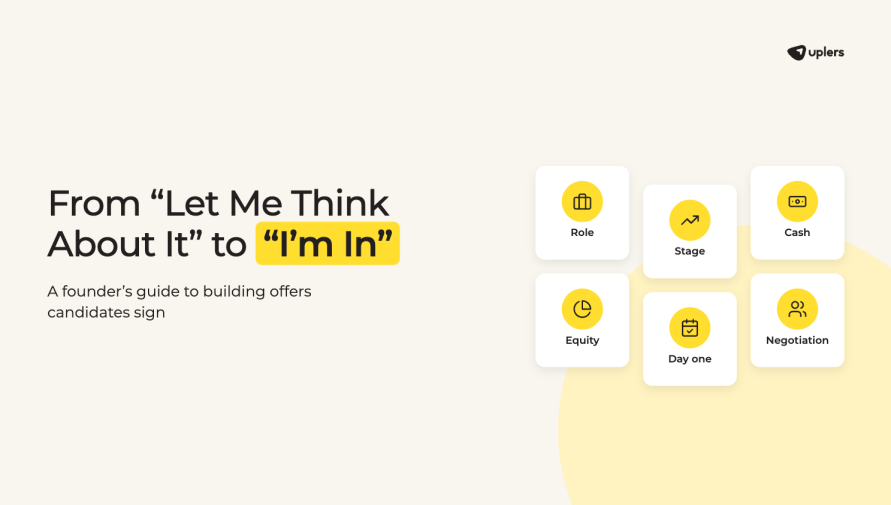
- Lead with the role: Show the candidate exactly what they’ll own, who they’ll work with, and what success looks like.
- Share where the company stands: Give a short, honest snapshot of your stage, runway, and traction.
- Price the cash near market: Show how you reached the number, with the full CTC breakdown in an annexure.
- Benchmark and explain equity: Set the grant against market data and explain it in plain English.
- Plan the path to day one: Cover the notice period, start date, and touchpoints until joining.
- Choose who negotiates: The founder tells the company story, and a neutral person handles the numbers.
You know this moment.
Six weeks of sourcing. Four interview rounds. Your team finally agrees on someone, and you’re already planning their first sprint. You send the offer at 6 p.m. and wait for their reply.
The next morning, the reply arrives: “Thanks so much. Let me think about it.”
Your first instinct is to raise the number. Hold that thought for a minute.
The candidate is reading your offer with five questions in mind:
- What will I own?
- Will this company last?
- Is the pay fair?
- What is the equity worth?
- What happens between yes and my first day?
Every unanswered question becomes a reason to wait, and the longer they wait, the more time other companies have to call. A bigger salary answers one of those five questions. A well-structured offer answers all of them.
Here’s how to build each part, and who should deliver it.
How to Build Each Part of Your Offer
Each part below answers one question your candidate is asking. Build them in this order, and the offer reads as one clear story
Lead With the Role
Big companies can outbid you on salary and brand. Scope is where you win, so as you write a JD, put it at the top of the offer.
Every startup promises “ownership,” so the word alone carries little weight. Specific scope stands out:
| Vague | Specific |
| “You’ll have huge ownership.” | “You’ll own the recommendation engine from architecture to production.” |
| “You’ll work closely with leadership.” | “You’ll report to the CTO and join weekly product reviews.” |
| “There’s plenty of room to grow.” | “You’ll hire the first two engineers on this team.” |
Attach a one-page “What you’ll own” note to the offer letter:
- Scope and decision rights
- The people they’ll work with every day
- Priorities for the first 90 days
- What success looks like at six months
Show Where the Company Stands
Every candidate who joins a startup takes a risk. Address that risk in the offer with a short, honest snapshot of the company.
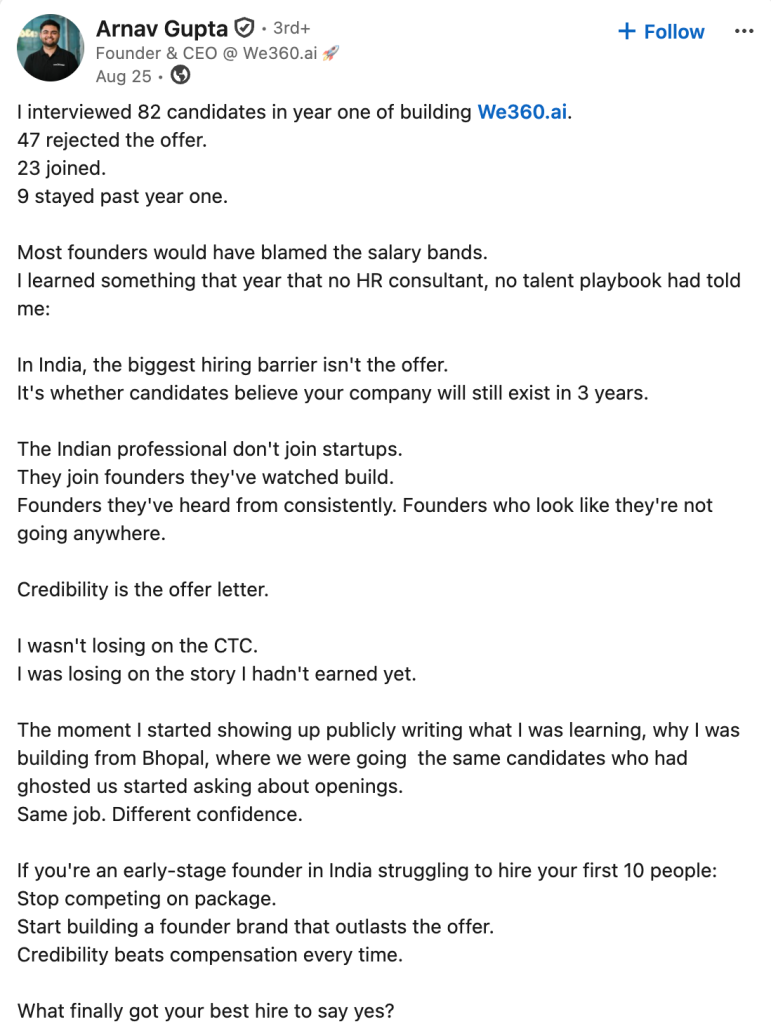
Arnav Gupta, founder of We360.ai, learned this while building his team. He interviewed 82 candidates in his first year and concluded that the question on their minds was whether the company would still exist three years later.
Your snapshot can cover:
- Stage and most recent funding
- Runway
- Traction you’re comfortable sharing, such as revenue, customers, or growth
- Your plan for the next 12 months
Two or three lines are enough. Once the candidate trusts the company, the numbers that follow carry more weight.
Price the Cash Close to Market and Show Your Math
Salary sets the floor for the decision. When it sits close to the market, the candidate can give real weight to everything else in your offer.
So should you compete on salary or on opportunity? Do both. Pay near the market so salary stays off their list of reasons to say no, and let the role and the upside do the persuading.
Set a salary benchmark and discuss expectations in the first conversation, and find out what the number means to the candidate:
You: “Is ₹40 lakh the number that makes this move worth it, or the number that makes it feel safe?”
Candidate: “Safe, honestly. I’m leaving a stable job.”
A “safe” number tells you the candidate is weighing risk. Section 2 answers that concern better than a few extra lakhs.
Next, watch for the CTC trap. Candidates tend to read CTC as take-home pay, and that gap is the most common reason for a rough first month. State the total CTC in the letter and put the breakdown in an annexure.
| Component | What to state |
| Fixed pay | Monthly and annual amounts |
| Variable pay | Target amount and how payout is decided |
| Employer contributions | PF, gratuity and insurance |
| Joining bonus or notice buyout | Amount and any clawback terms |
For better clarity on salary, go through Uplers’ Salary Guide.
Benchmark Equity and Explain It Clearly
Start with a benchmark. Carta’s data shows the median equity grant for a startup’s first engineer is 1.54%, and the median falls to 0.61% after just two more hires.
Equity is also carrying more weight in offers each year. Carta’s 2026 State of Startup Compensation covers more than 1 million employees across 60,000 startups. It shows median equity packages up 13% since January 2024, while salaries rose 5.1%. Carta also sees some companies giving their earliest employees more ownership as teams stay small. Carta’s data comes largely from US startups, so read it as a global signal.
Then explain it in plain English: Recruiting from Scratch analysed more than 500 startup offer letters. Offers that explained equity in plain English were accepted 78% of the time, compared with 61% for offers that listed only a share count. Candidates also signed faster: 3.1 days on average, compared with 4.8.
Here’s what a clear equity section includes:
| Item | What to state |
| Grant | Number of options and percentage of the company |
| Strike price | What they pay per share to exercise |
| Vesting | Schedule and cliff |
| Exit window | How long they have to exercise after leaving |
| Liquidity | Past buybacks or your buyback policy |
| Scenarios | What the grant could be worth if the company fails, has a modest exit or has a strong exit |
Leave forecasts out of the conversation. Lines like “These will be worth ₹5 crore” or “We’re heading for an exit” erode trust the moment a candidate questions them.
Plan the Path From Yes to Day One
In India, an accepted offer still has a long road ahead. The notice period is when counteroffers and competing calls arrive.
Research from Analytics India Magazine found that almost 1 in 3 engineering roles in India carry a full 90-day notice period. That’s three months of exposure.
Close the offer with a joining plan:
- A notice-period buyout, if your budget allows
- A firm start date
- Touchpoints during the notice period, such as a team intro, a first-week plan, or the laptop shipped early (here’s how a founder used a MacBook to do this)
Before they resign, ask one question: “What will you do if your current company counters?” The calm version of that conversation happens now.
Choose Who Holds the Pen
The person who delivers the offer shapes how the candidate reads it. Founders tell the company story best, and the numbers land better with someone who can stay neutral about them.
Veronika O. has run 42 offer negotiations this year. In a recent LinkedIn post, she describes a founder who insisted on handling an offer himself. He opened with 0.4% equity for his first engineer.
The candidate had been a founding hire before and knew a seed-stage first engineer should get closer to 1.5%. He skipped the argument. Three days later, he signed with a competitor that offered a fair rate without being asked.
That 1.5% matches the Carta median from Section 4. A benchmark would have saved this hire.
Veronika flags the opposite risk too: founders who panic at the first pushback and overpay, giving away equity on hire #1 that they’ll need by hire #10. Her point is that it’s very hard to negotiate the value of your own company calmly.
So split the conversation:
| Who | What they cover |
| Founder | The role and the company story (Sections 1 and 2) |
| Co-founder, talent lead or hiring partner | Cash, equity, and the joining plan (Sections 3 to 5), within a band you agree in advance |
When a competing offer comes up, the person handling the numbers asks: “If we matched the number, would you choose us?” A yes means you’re making a cash decision. Any other answer sends the founder back to the role and the company story.
Here’s how to keep candidates active and involved to reduce backouts.
The Offer at a Glance
Use this as a final check before you send the letter.
| Part | The candidate’s question |
| The role | What will I own? |
| Company snapshot | Will this company last? |
| Cash | Is it fair, and what will I take home? |
| Equity | What am I getting, and is it in line with the market? |
| Joining plan | What happens between yes and day one? |
| Delivery | Does this company understand the market? |
Conclusion
Your first ten hires will shape how your startup builds, sells, and grows for years. Each of them starts with an offer letter.
Before you send the next one, try a quick test. Hand the offer to someone outside your company and ask them to explain it back to you: the role, the risk, the pay, the equity, and the joining plan. Wherever they pause, your candidate will pause too.
Fix those gaps before the offer goes out. A clear offer saves you weeks of follow-up calls, a few lakhs in last-minute counteroffers, and sometimes the hire itself.
The best candidates have options. Make your offer the easiest one to say yes to.