Snippet
- Define the outcome, not the tech: Clarify the business problem and result you need first, then decide the role.
- Write specific JDs: Use precise titles and explain your environment, ownership expectations, ambiguity level, and what success looks like at 90 days.
- Check environment match: A skilled engineer from a service background may struggle in a product startup (and vice versa) because the two develop different strengths, ownership vs. execution.
- Screen for proof, assess real work: Look past resume keywords to actual evidence (projects, measurable outcomes); test tasks resembling the job, not trivia.
- Get a hiring partner: They can help you filter well and only hand you a few business-aligned profiles.
You need a new person joining your team as soon as possible so you post an open role and applications start pouring in. You think it is a good problem to have until you see the quality of applications. But still some of them make it to the interview and then fall flat there. And then there are those who pass every stage but end up being the wrong fit after joining.
Sounds familiar?
If you too feel like you have a wider pool of candidates than ever before but hiring feels harder than it did a few years ago then you are not alone. And we are here to tell you how to fix it.
Founder diagnostic table
Going through these hiring issues? Here’s where the actual problem is:
| If you’re seeing this | What’s probably wrong |
| Hundreds of irrelevant applications | Generic targeting or vague JD |
| Strong candidates not applying | Weak employer positioning |
| Good resumes but weak interviews | Poor screening process |
| Technically capable hires struggling after joining | Environment mismatch |
| Candidates disappearing midway | Slow hiring process |
| Constant hand holding after hiring | Ownership mismatch |
| Offers getting rejected | Expectations not aligned early |
Cost of a Bad Engineering Hire
A bad engineering hire costs you much more than the loss of a team member. It leads to:
- Delayed roadmap
- Lost productivity
- Technical debt
- Team frustration
- Missed deadlines
- Rehiring costs
- Leadership distraction
The U.S. Department of Labor reports that the average cost of a bad hire is at least 30% of the employee’s first-year expected earnings.
Quality vs Quantity: The hiring myth that wastes the Most time
If you think, more applicants should increase the chances of finding a great engineer. Then let me burst your bubble because it does not.
In practice, more applications often create more work rather than better outcomes.
A founder reviewing 500 applications may spend hours sorting through irrelevant profiles before finding a handful of qualified candidates.
Another founder may receive only 40 applications but discover that 20 of them are genuinely relevant.
Which founder is in the better position? The second one.
Why can more applications actually hurt hiring?
When candidate volume increases, it also means:
- Screening time increases
- Interview load increases
- Decision fatigue increases
- False positives increase
- Strong candidates receive less attention
Meanwhile, the best candidates often have multiple options. They’re unlikely to wait while you work through hundreds of applications.
This is why hiring quality often improves when candidate volume decreases.
One problem you need to tackle before making the Job Description
Many founders begin with a vague hiring requirement. They know they need help. They know something needs to be built. But they haven’t clearly defined the role itself.
This creates problems throughout the hiring process.
For example:
- “We need a developer.”
- “We need someone for AI.”
- “We need a full stack engineer.”
These sound specific. They usually aren’t. The problem is that founders often define technologies instead of outcomes.
Why role clarity matters
Consider the following examples.
Scenario A: A company says it needs an AI engineer. After a deeper discussion, it turns out they don’t need someone building machine learning models. They need a backend engineer who can integrate existing AI APIs into their product.
Very different hire.
Scenario B: Another company says it needs a data scientist. After fully understanding the requirement, they discover the immediate challenge is building reliable data pipelines. That’s a data engineering problem. Not a data science problem.
When the role itself isn’t clear, candidate quality suffers.
A simple framework before you make the JD
Before writing a job description, answer these questions:
- What business problem are we solving?
Not: We need a Python engineer.
Instead: We need someone to rebuild our payments infrastructure. - What outcome do we need? Examples:
– Launch a product
– Improve platform reliability
– Scale infrastructure
– Build internal tooling
– Introduce AI features
- What role is best suited to achieve that outcome?
Only after answering the first two questions should you define the role. Many hiring problems disappear when this step is done properly.
The most overlooked hiring filter: Environment match
There’s another filter besides skills, experience, compensation, and location that often gets ignored when you are evaluating a candidate.
We call this factor – environment match.
A candidate can have the right skills and still struggle because they have never operated in an environment like yours. Now, here is what we mean.
There are two different ecosystems that exist in the Indian talent market and the success of the hire depends on which one you hire from based on what kind of a company you are and what is the culture.
Service Ecosystem
The service ecosystem is what India is historically known for; companies that build and maintain software for others. Everything runs on fixed timelines, defined scope, and billable hours. Success means delivery on time, not necessarily innovation.
Product Ecosystem
The product ecosystem is relatively new but fast-growing. These are companies building their own products like SaaS, AI, fintech, developer tools, and more. Success here depends on innovation, scale, and user adoption.
This difference is massive yet often overlooked by global startups hiring from India. They interview engineers from service firms, find them skilled and affordable, and think they’ve found a great deal.
Here’s a simple way to understand the difference.
| Service | Product | |
| Purpose | Deliver what the client asks | Build what users need |
| Mindset | Execution | Ownership |
| Work model | Fixed scope, clear specs | Iterative, feedback-driven |
| Growth driver | Billable hours | Innovation, adoption |
| Salary expectation | Lower | Higher |
| Cultural fit for startups | Low | High |
This difference is uniquely Indian because outside India, people don’t even realize it exists. They assume hiring from India means hiring from one unified tech talent pool. But in reality, you’re hiring from two completely different worlds.
Many founders underestimate how much a candidate’s previous environment shapes how they work.
Product companies often require engineers to:
- Own outcomes
- Work through ambiguity
- Think about long term product decisions
- Collaborate closely with product teams
- Balance technical decisions against user needs
Service companies often require engineers to:
- Deliver against client requirements
- Work within defined scopes
- Manage stakeholder expectations
- Operate inside established delivery processes
- Prioritize execution consistency
Neither environment is better. Neither environment produces better engineers. They simply develop different strengths. The engineer who succeeds inside a 10 person startup isn’t necessarily the engineer who will thrive inside a 1,000 person organization.
What does this mean for your job description?
Explain the environment of your company and the role in your JD. More context means more candidates get filtered out. A candidate who is applying in volume will skip your company if he finds too many specific asks.
The right candidates need to know what kind of company they’re joining.
Include details such as:
- Company stage
- Team size
- Ownership expectations
- Level of ambiguity
- Decision making expectations
- AI usage expectations
- Customer interaction requirements
- Reporting structure
- What success looks like after 90 days
This serves two purposes. It attracts candidates who are excited by the environment. And it discourages candidates who aren’t.
Where most engineering hiring goes wrong and how to fix it
Read this to know which part of your hiring funnel is making you lose good quality candidates and how to fix that funnel.
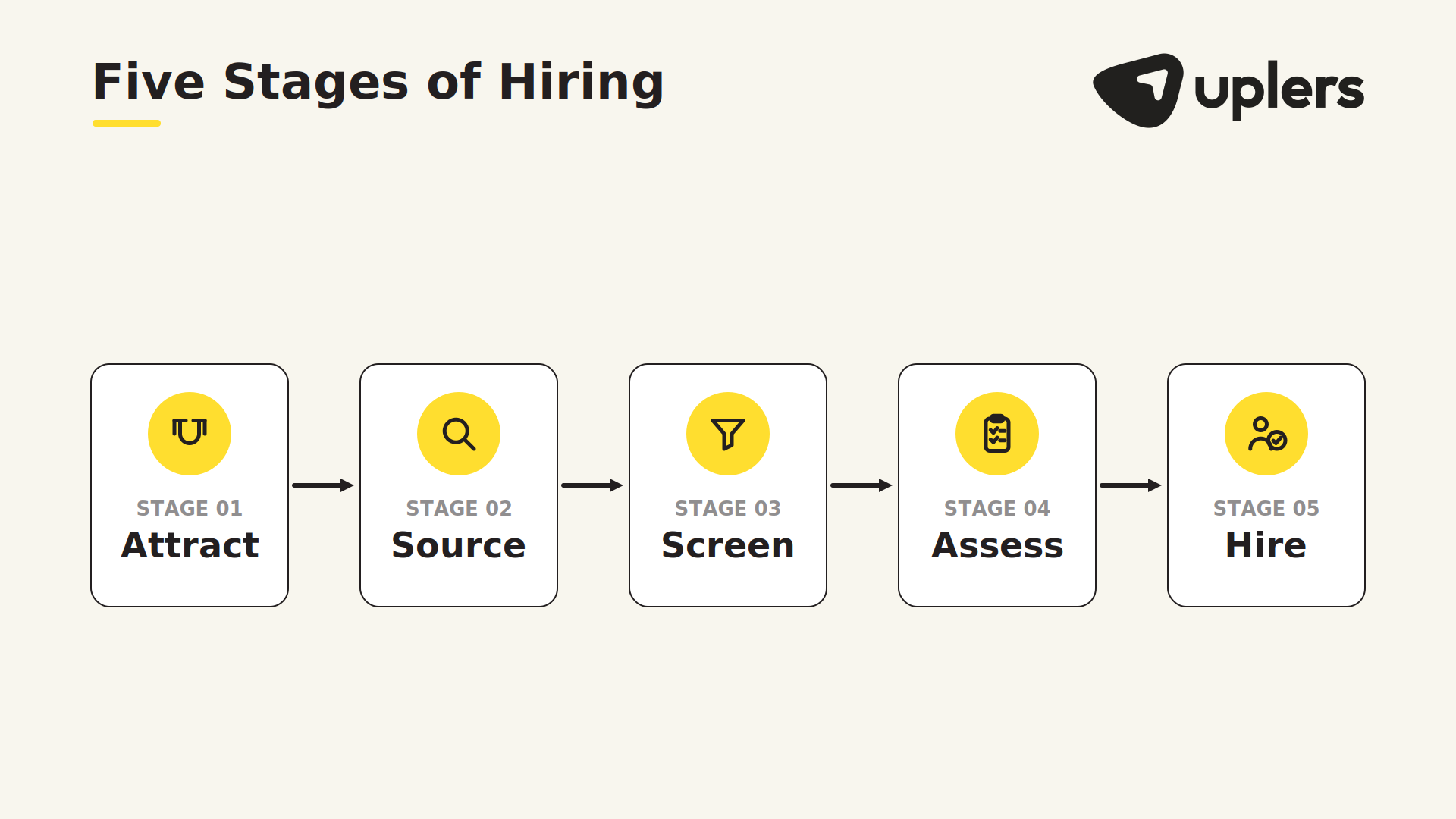
Stage 1: Attract
Mistake 1: Writing generic job descriptions: Don’t just write the tech stacks and years of experience. These JDs will attract everyone and resonate with no one.
Fix: Explain the context, not just the tasks: A stronger JD also explains the environment. Instead of writing: Build backend systems using Python.
Write: You’ll own the backend architecture for a B2B SaaS product used by logistics teams across North America.
In your first 90 days, you’ll lead the migration of our payments infrastructure and work directly with the CTO on platform scalability.
Before publishing a role, make sure your JD answers these 7 questions.
| Question | Example |
| What are we building? | B2B SaaS platform |
| What stage are we at? | Seed, Series A, Scale Up |
| Which environment do you need the candidate from? | O to 1. 1 to 10. Or 10 to 100. Product vs service background. |
| What kind of candidate will thrive in this organization? | List all the soft skills like someone who can work without handholding etc. |
| What does success look like? | Launch billing system in 90 days |
| How much ownership is expected? | Own features end to end |
| How much ambiguity exists? | High |
| How important is AI fluency? | Moderate |
| Is customer interaction expected? | Frequent |
Mistake 2: Using broad job titles. Titles like Software Engineer, Developer, Full Stack Engineer can attract huge volumes of loosely relevant applications. Specific titles create better filtering.
Fix: Use specific titles. Examples:
- Backend Engineer (Python, Payments Infrastructure)
- Frontend Engineer (React, Design Systems)
- Platform Engineer (AWS, Reliability)
- AI Product Engineer (LLM Integrations)
The goal is not to increase applications. The goal is to increase qualified applications.
Mistake 3: Not describing who will thrive in the role. This is one of the biggest gaps in engineering JDs. Many founders explain what the engineer will do. Very few explain what kind of person succeeds in the role.
Fix: Add a section on what kind of a person will thrive in this role.
For example: If you’re hiring for a 0 to 1 startup, say that you’re looking for someone who:
- Enjoys ambiguity
- Takes ownership
- Solves problems independently
- Builds systems from scratch
- Doesn’t require extensive process or direction
This helps candidates self qualify.
Mistake 4: Weak employer credibility. Strong engineers evaluate companies too. And also some startups are not as much in the public eye so you need to sell your vision to the candidate as much as they sell their skills to you.
Before applying, many candidates will look at:
- Founder backgrounds
- What they are building
- If they are funded. If not, what’s the plan
- The vision of the company
- Engineering culture
- Public reputation – if the company is big enough
Fix. Tell candidates about:
- Your vision
- Why you are building what you are building
- Your culture as a company
- How a candidate can thrive in your company
Credibility improves candidate quality before hiring even begins.
Stage 2: Source
Mistake 1: Depending only on job boards: The strongest candidates are often already employed and not actively applying.
Fix: Build multiple sourcing channels.
Examples:
- Founder networks
- Engineering communities
- Alumni networks
- Hiring partners matched to your startup stage
The more diversified your sourcing strategy, the less dependent you become on inbound applications.
If you are short on time, definitely go for hiring partners who specialize in hiring people for your stage of startup and who send you a few good quality applications over bombarding you with 100s of them.
Mistake 2: Waiting for candidates to find you. Many great engineers are not actively job hunting.
Fix: Use outbound sourcing. Go to job boards and look for people working in the similar industry or companies as yours. Reach out directly. Lead with:
- Why you’re reaching out
- Why the opportunity is relevant
- Why the role matters
Stage 3: Screen
Mistake 1: Reading resumes incorrectly. Resumes are marketing documents. Don’t take them as face value since:
- They might be stuffed with keywords
- They might be an exaggeration of actual work
- They won’t tell you how these people work
- They won’t tell you what impact they created
Fix: Look for proof. Examples:
- GitHub projects
- Open source contributions
- Technical writeups
- Side projects
- Measurable outcomes in the resume. No measurable outcome? Skip skip skip.
Stage 4: Assess
Mistake 1: Testing the wrong things: Many engineering interviews focus heavily on trivia. Yet very few founders complain that a hire failed because they couldn’t solve a whiteboard problem.
The complaints are usually different.
Examples:
- Lack of ownership
- Weak communication
- Poor decision making
- Inability to prioritize
- Failure to adapt
Fix: Assess work that resembles the role. The closer the assessment is to real work, the stronger the signal.
Mistake 2: Ignoring environment match
A candidate can clear technical interviews and still fail. Because they have never operated in an environment like yours.
Fix: Ask questions in interview such as:
- Tell me about a project you owned from start to finish.What decisions they made and why? Any tradeoffs? Keep asking why.
- Describe a time you worked without clear requirements.
- What was the hardest decision you made recently? And why?
- How do you handle conflicting priorities?
These questions reveal how candidates operate.
Mistake 3: Running unstructured interviews. Different interviewers evaluate different things. This creates inconsistent hiring decisions.
Fix: Create scorecards before interviews begin.
Define:
- Who will interview each round?
- What to ask them each and every time? So the base is set. The more you deviate, the more you will make a decision based on gut and good conversation vs judging on the same metrics.
- What disqualifies a candidate?
- What one small real problem you have and asking each candidate to solve it.
Consistency improves hiring quality.
Mistake 4: Ignoring AI Judgment. Today, many engineers use AI tools. The more important question is whether they know when AI is wrong.
Fix: Assess:
- Decision making with AI
- Validation processes of AI output
- Critical thinking
- Tradeoff analysis
Generating code is becoming easier. Evaluating code is becoming more important.
Stage 5: Hire
Mistake 1: Moving too slowly. Strong candidates rarely remain available for long. Founders often spend weeks debating decisions that should take days. And that;s how you lose good candidates because they are fielding so many good offers.
Fix
- Keep momentum between stages.
- Communicate quickly.
- Provide timely feedback.
Mistake 2: Waiting until the offer stage to align expectations. Many offers fail because important conversations happen too late.
Fix: Discuss early:
- Compensation: Your range should be well within the industry standards. Too low and you lose the good candidates. Here’s how to get it right.
- Growth opportunities
- Working style
- Ownership expectations
- Team structure
Conclusion
Hiring is no longer just a sourcing problem. At every stage of the hiring process, there are some solid things you can do to tighten up the process and ensure you get as good candidates as possible. These are not 100% full proof tricks but just something that we have observed and practiced in the last 5 years to reduce the chances of bad hire.
The founders who consistently hire strong engineers are rarely the founders reviewing the most applications. They are the founders creating the most alignment before candidates ever apply.