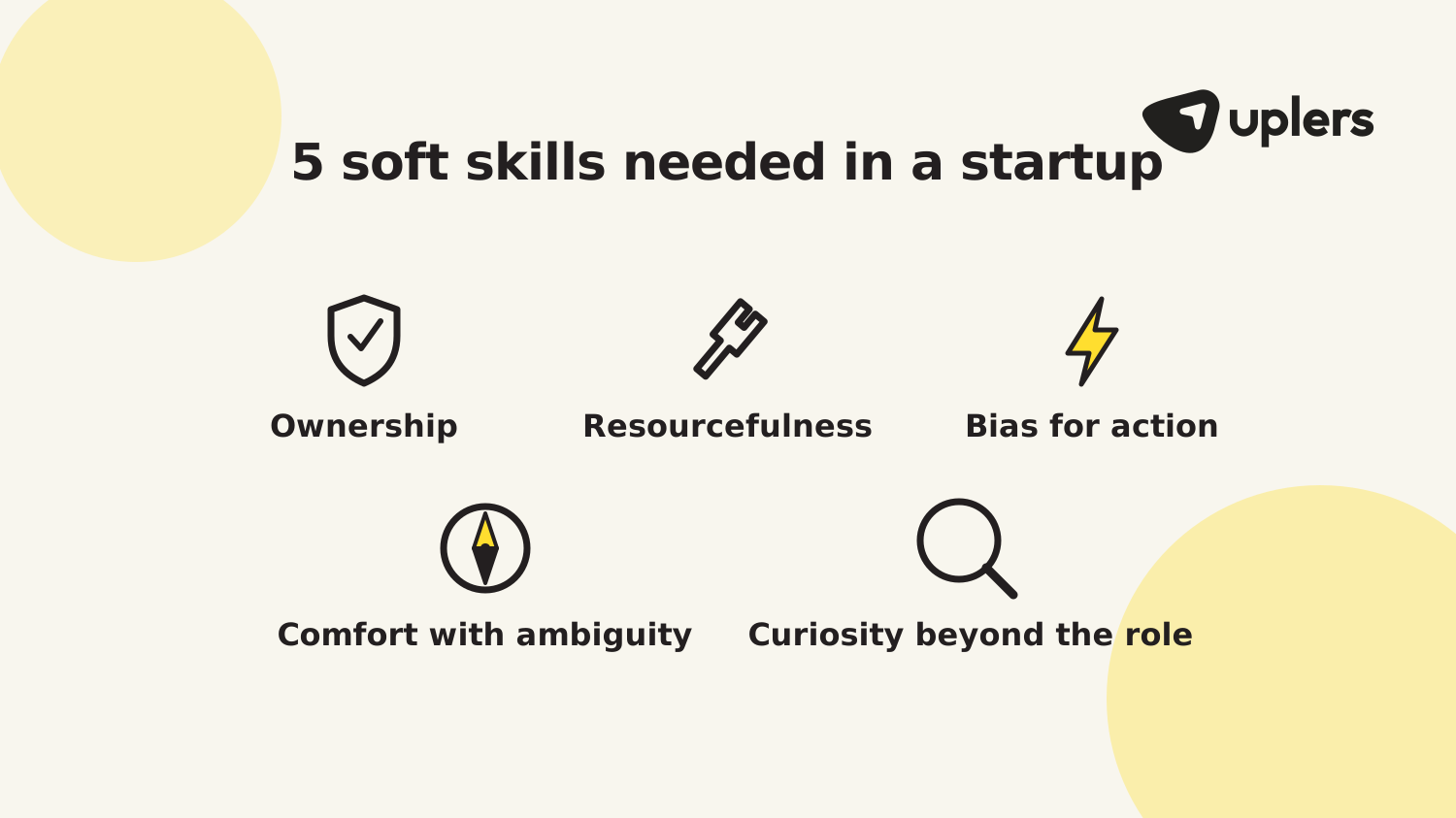
What soft skills should you screen for when hiring at a startup?
We all know that startup hiring is very different from hiring for say, an enterprise. We have done startup hiring for 5+ years and spoken to 100+ founders and we analyzed all our calls with them. We also analyzed the interview feedback we got, the offer to acceptance ratio, and the people who stayed for at least 90 days after joining.
From that, we figured out the top 5 soft skills that matter. A candidate does not be perfect at all 5 but should definitely demonstrate a mix of these. Some being non-negotiable, of course.
01 – Ownership
Ownership is the difference between someone who does what their role says and someone who treats the outcome as theirs, whether or not it was assigned to them.
In a company of 200 people, gaps get covered because there are enough people around to catch them. In a startup of 8, gaps just stay open unless someone decides to close them without being asked. Candidates who default to “that’s not my area” tend to leave those gaps exactly where they found them.
02 – Resourcefulness
At a startup, most problems show up without a playbook. Resourcefulness is the willingness to work through that anyway, trying a different approach when the first one fails instead of deciding the problem can’t be solved.
This is different from being relentless. Relentless people push harder at the same wall. Resourceful people go looking for a different wall.
03 – Bias for action
If candidates wait for the perfect set of instructions, SOPs, brief, approvals, and want to perfect each project before shipping then that’s simply not going to work.
Bias for action here means that you can take action quickly and improve on the go so as to not lose the momentum.
Candidates with a strong bias for action make a reasonable call with most of the information, not all of it, and adjust once more comes in.
04 – Comfort with ambiguity
Priorities at a startup can change overnight. A new manager, a lost client, a pivot nobody saw coming. Candidates who need a stable, well defined structure to do good work will struggle here. Not because they’re bad at their job, but because the ground keeps moving under work that was clearly defined yesterday.
Comfort with ambiguity here means you do not need weeks to recover from a change in the startup. It means you can be adaptable. Adaptability is a consequence for being comfortable with ambiguity.
05 – Curiosity beyond the role
This one is easy to miss because it doesn’t look like a skill in the usual sense. Candidates who ask about the business, the goals, and where the company is headed are usually the same people who later notice when their part of the work stops serving that goal and change things without being told.
Imagine having someone who abandons one campaign in the start of a new one because they figured it is not working instead of waiting for the monthly call for updates. That is the person you need.
We have already broken down how to actually evaluate these in a hiring process here.