





 “
Type “Can I move my delivery to Friday?” into a support chat today, and you expect the bot to find your order, check the courier’s open slots, and confirm the change before your coffee cools.
That single request touches a language model, an order database, a logistics API, and a set of rules about what the bot may change on its own. Every one of those pieces is a hiring decision.
The chatbot developer role has grown well past wiring an API to a chat window. It now combines AI engineering, product judgment, and the discipline to keep a live system reliable under real traffic.
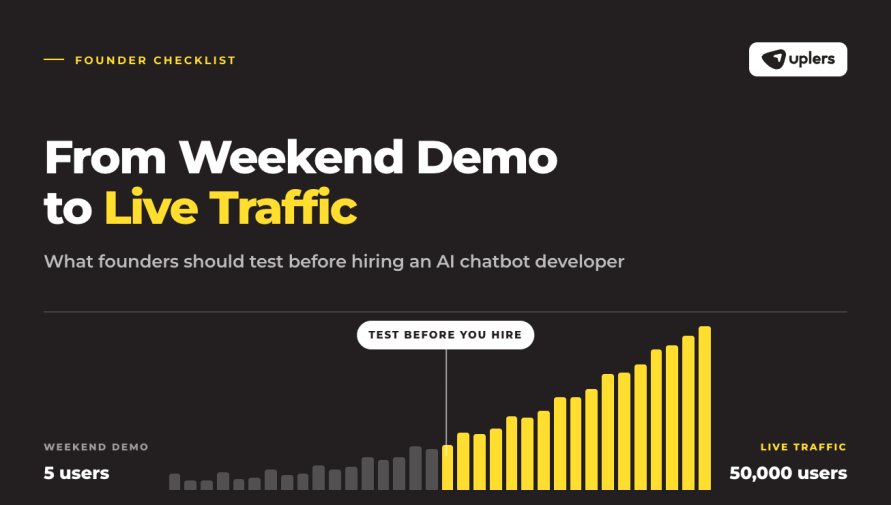
Here’s the catch for founders. A capable candidate can build an impressive demo over a weekend. But building a bot that holds up across thousands of customer conversations calls for a different skill set, and a standard interview hides that gap well.
This guide covers who chatbot developers are, which capabilities to screen for, how to test them, and where to look when you’re ready to hire chatbot developers for your startup.
Who Are AI Chatbot Developers and What Do They Build?
AI chatbot developers are engineers who design, build, and connect conversational AI to your product, your data, and the tools your team runs on. They turn a language model into something your customers can rely on every day.
How they differ from rule-based bot builders: A rule-based builder scripts every path a user can take through a decision tree. An AI chatbot developer works with language models, company knowledge, and live system connections, so the bot can handle questions nobody scripted in advance.
What they build:
| Chatbot type | What it does | Startup example |
| Support bot | Resolves common queries and passes complex cases to a human agent | A SaaS bot that fixes login issues and routes billing disputes to finance |
| Internal knowledge assistant | Answers team questions from company documents | An HR bot that answers leave policy questions from the employee handbook |
| In-product conversational layer | Lets users operate the product through chat | “Show me last month’s failed payments” inside a fintech dashboard |
| Task bot | Completes actions through APIs | Rescheduling a delivery or upgrading a subscription plan |
What to Look for When You Hire Chatbot Developers
A Gartner survey published in September 2026 of 3,566 customers found that only 27% would try a chatbot again after a bad experience. One weak release can cost you the channel, so screen every candidate against the capabilities below.
Technical Skills That Go Beyond Building Conversations
These engineering capabilities decide whether your bot gives correct answers, completes tasks, and keeps data safe.
| Capability | What strong work looks like | What you get |
| LLM and NLP fundamentals | Reads intent in vague, misspelled, and multi-part questions, and tracks it across follow-ups | Fewer “Sorry, I didn’t understand” dead ends |
| Prompt design and response control | Writes system instructions, grounding rules, and output validation that keep answers inside scope and in the right format | A bot that sounds like your brand and stays on topic |
| RAG and knowledge retrieval | Chunks documents sensibly, picks embedding models, and ranks results so the right passage reaches the model | Answers grounded in your help docs, policies, and product data |
| API and backend integration | Connects the bot to CRMs, databases, helpdesks, and payment systems, verifies the user before any action, and handles errors cleanly | A bot that updates orders and creates tickets by itself |
| Context and memory management | Separates in-chat context from stored user details, and decides what to carry forward, summarize, or drop | Coherent long conversations with stable response times |
| Quality testing and latency tuning | Keeps a test set of real user questions and reruns it after every prompt or model change | Measurable quality gains and fast replies |
| Data security and privacy | Sets access controls, masks personal data, guards against prompt injection, and ties retrieval to each user’s permissions | Each customer sees only their own data, even when someone tries to trick the bot |
Product Thinking: Can They Build for Real User Needs?
Technical skill gets a bot running. Product thinking decides whether customers keep using it.
- Problem first: A strong candidate asks which conversations the bot should own before naming a model or framework. Example: “Should it process refund requests, or only explain the refund policy?”
- Built around user journeys: They map where users arrive from, what they want in that moment, and the step where they drop off.
- A clear handoff point: They set rules for passing a user to a human, such as after two failed attempts or on any billing dispute, so users always have a way out.
- The right tool per step: Fixed workflows handle predictable steps like refunds or bookings, and the LLM handles open-ended questions. This mix keeps costs low and answers consistent.
- Success defined up front: They name the numbers to track from day one: resolution rate, escalation rate, and drop-off points.
Problem-Solving and Adaptability as AI Tools Change
AI tooling shifts every few months, and the developer you hire needs to stay effective through each change.
- Root-cause diagnosis: When the bot gives a wrong answer, they can trace whether the fault sits in the prompt, the retrieval layer, the source data, or an integration. This skill separates experienced builders from tutorial-level ones.
- Model-agnostic architecture: They structure the code so switching to a newer or cheaper model takes days instead of a rebuild.
- Selective tool adoption: They add a new framework when it solves a problem you have today.
- Log-driven iteration: They review real transcripts each week, group failures by pattern, and fix the most frequent ones first.
Startup Readiness: Can They Own the Chatbot Beyond Development?
Early-stage startups need one person who can carry the chatbot from idea to steady operation.
| Trait | What it looks like at a startup |
| End-to-end ownership | Takes the bot from requirements through architecture, launch, and the first months of live traffic without a tech lead filling gaps |
| Shipping in increments | Launches a narrow first version, such as answering your top 20 support questions, then expands based on usage data |
| Cost-conscious decisions | Matches model size to each task, caches repeat answers, and keeps per-conversation costs predictable as volume grows |
| Plain-language trade-offs | Tells you what a feature will cost in time, money, or accuracy, and shares progress without reminders |
How to Evaluate AI Chatbot Developers Before Hiring
Each test below maps to a capability from the previous section, so you can verify skills before you make an offer.
Walk Through a Past Chatbot Project
- Ask the candidate to explain one bot they built, including its purpose, its architecture, and the parts they personally owned versus the team’s work.
- Go below the interface. Ask how the bot handled context, where its answers came from, and what happened when a user went off-topic.
- Ask what failed after launch and what they changed in response. Specific fixes backed by numbers point to real production experience. Then pick one technical decision and ask why they made it. A strong answer links the engineering choice to a product requirement.
Run a Scoped Practical Exercise
Cap the exercise at three to four hours. You can pick one of two formats:
- Build task: “Build a bot that answers questions from this 10-page product document and declines anything outside it.”
- Debug task: Hand over a bot that gives wrong answers and ask them to find the cause. This format tests root-cause diagnosis directly.
Score the reasoning alongside the code. Assess the chunking approach, prompt structure, handling of out-of-scope questions, and the method they use to verify answer accuracy.
Ask Scenario Questions Based on Real Startup Situations
| Question | What a strong answer covers |
| “A customer screenshots a wrong answer and posts it on social media. What are your first three steps?” | Pulling the transcript, finding the root cause, fixing the prompt or source data, and adding the case to the test set |
| “API costs doubled last month while usage grew 20%. Where would you look?” | Tokens per conversation, context length, model choice, and caching gaps |
| “Sales wants the bot to handle refunds next week. What would you push back on?” | Payment API permissions, approval limits, fraud checks, and a human review step |
Red Flags to Watch For
- Can’t explain how the LLM, retrieval layer, and backend work together
- Has no method for measuring answer quality
- Proposes a complex multi-agent setup for a simple support use case
- Can’t name a bot they’ve run with real users
- Justifies choices by naming tools, with no link to product outcomes
Where to Find and Hire Chatbot Developers for Your Startup
Competition for these engineers rose sharply this year. Salesforce’s State of Service: AI Agents Edition (May 2026) found that 66% of service organizations now use AI agents, up from 39% in 2025, and each of those teams is hiring from the same talent pool as you.
| Channel | Best for | Watch out for |
| AI communities on GitHub, Hugging Face, and Discord | Spotting builders through public code and contributions | Strong contributors may prefer research over product work |
| Developer platforms and job boards | Reaching a wide pool fast | A heavy screening load for a small team |
| Referrals from founders and CTOs | Candidates with proven delivery | Limited volume |
| Specialized talent partners | Pre-screened shortlists matched to your stack | Depth of AI-specific filtering across providers |
The hard part is finding LLM depth, integration experience, and product ownership in one person, then screening for all three while you run the company.
How Uplers helps: Uplers is an AI hiring platform that helps startups hire engineers and AI specialists from India. It pairs AI-led screening with human evaluation, draws on a network of more than 3.5 million professionals, and delivers 3 to 5 evaluated profiles within 48 hours. You can hire full-time, on contract, or as an extension of your current team, then run the shortlist through the project walkthrough and practical exercise above before you decide.
Conclusion: Hire Developers Who Can Build More Than a Chatbot
Go back to that Friday delivery request. Your customer never sees the retrieval layer, the courier API, or the handoff rule behind the reply. They see one thing: whether the bot got it right.
Before your next interview, run every candidate through three filters:
- AI engineering depth: Can they make the bot accurate, connected, and secure?
- Product judgment: Can they decide what the bot should handle and when a human steps in?
- Ownership after launch: Will they keep improving it once real traffic arrives?
When you’re ready to hire chatbot developers who pass all three, Uplers can put a screened shortlist in front of you within 48 hours.