






 “
Post a job for an AI engineer, and three kinds of people will apply.
Some are researchers who can fine-tune a model but have never shipped a checkout flow. Some are web developers who added a chatbot to a side project last weekend. A small group can take a rough product idea, decide where AI fits, build every layer of the feature, and show you with numbers that it works.
You want someone from that third group. They are the hardest to spot on a résumé, because their current job title may not mention AI at all.
This guide shows you how to define the role, what to test for, and how to run a hiring process that finds the engineer who will own your AI feature from the first sketch to production.
What Is a Full-Stack AI Engineer?
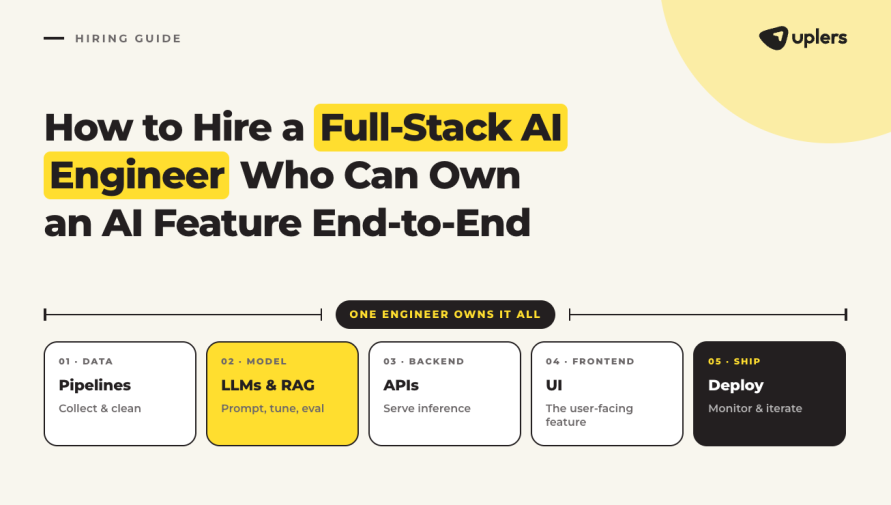
A full-stack AI engineer builds AI features inside your product and owns every layer those features touch. That includes the model, the data pipeline, the backend, the interface, and production monitoring. The job is shipping product, so model research and training foundation models stay with ML specialists.
How a Full-Stack AI Engineer Differs from a Full-Stack Developer
A full-stack developer writes logic that behaves the same way every time, so a passing test means the feature works.
A full-stack AI engineer builds on models that can answer the same question differently each time and can be wrong with full confidence. On top of building the feature, they measure how often the output is right, keep the cost of each request in check, and plan for the day a model provider changes its pricing or goes down.
What a Full-Stack AI Engineer Does in a Startup
In a startup, these engineers turn an AI idea into a feature customers use every week, and most companies find that step hard.
Deloitte’s 2026 State of AI in the Enterprise survey of over 3,000 business leaders found that only 25% of organizations have moved 40% or more of their AI experiments into production.
Turns a Product Problem into a Well-Scoped AI Feature
Before writing code, they decide whether AI belongs in the feature at all, then pick the simplest approach that does the job.
For example, a founder might ask for an AI agent that sorts incoming support tickets. A good engineer first tests whether a single model call with a clear list of categories does the job, because it costs less, responds faster, and has fewer ways to break.
This judgment protects your runway. Gartner predicts that over 40% of agentic AI projects will be canceled by the end of 2027 because of rising costs, unclear value, or weak risk controls. The same analysts note that many use cases sold as agentic today have no need for an agent. With the right person scoping the work, your engineering months go into features users will pay for.
Builds the Complete Feature Without Handoffs
One person owns the model layer, backend services, data flow, and the interface your users see.
Picture an AI support assistant. The same engineer builds the retrieval pipeline over your help docs, the API that serves answers, the chat UI that streams responses, and the handoff that routes hard questions to a human agent. You get one accountable owner and a prototype that reaches production in weeks.
Proves the Feature Works Before and After Launch
A strong AI engineer scores every change against a test set built from real user inputs before it ships.
Quality is the biggest blocker for teams shipping AI agents. LangChain’s State of Agent Engineering survey of 1,300+ professionals found that 57% have agents in production, and 32% named quality as their top barrier to shipping.
Say you want to cut costs by moving to a cheaper model. Your engineer runs the new model against the same test set, compares the scores with your current model, and shows you how much quality you would give up for the savings. You decide with real numbers in front of you, and regressions get caught before customers see them.
Keeps the Feature Fast, Affordable, and Reliable in Production
Once the feature is live, the engineer tracks latency, cost per request, error rates, and provider uptime. Then they act on what the numbers show.
- Caching repeated queries means you pay for each answer once.
- Simple requests go to smaller, cheaper models.
- A fallback provider takes over during outages.
- Alerts fire when cost or latency crosses a threshold you agree on.
Your margins and user experience hold steady as usage grows from 100 users to 100,000.
Skills to Look for in a Full-Stack AI Engineer in 2027
The best candidates pair AI depth with full-stack range, and the working habits a small team depends on.
AI Engineering Skills
| Skill | What strong looks like |
| Evaluation design | Builds test sets from real inputs, uses LLM-as-judge scoring with human spot checks, and runs regression tests on every prompt or model change |
| Agentic workflows and MCP | Connects models to tools and data through tool calling and the Model Context Protocol, with clear limits on what an agent can do |
| RAG and context engineering | Tunes chunking, embeddings, and retrieval, and measures retrieval quality separately from answer quality |
| Model selection and routing | Sends each request to the right model across providers based on cost, speed, and quality |
| LLM observability | Traces every request with its prompt, output, latency, and cost |
| AI security | Defends against prompt injection, blocks data leakage, and adds guardrails on outputs |
Full-Stack Engineering Skills
| Area | What to look for |
| Frontend | TypeScript with React or Next.js |
| Backend | Python with FastAPI, or Node.js |
| Database | Postgres with pgvector, so app data and embeddings share one database |
| AI interfaces | Streaming responses, partial output, and easy ways to correct or regenerate an answer |
| Infrastructure | Cloud or serverless deployment with CI/CD |
AI-Native Development Workflow
AI now writes a large share of production code, and developers know that code needs checking. Sonar’s 2026 State of Code Developer Survey of over 1,100 developers found that 42% of committed code is AI-generated or AI-assisted. In the same survey, 96% said they do not fully trust that code, yet only 48% always verify it before committing.
Your hire should be in that 48%. They use coding agents such as Claude Code or Cursor to ship faster, and they review and test every AI-generated change before it merges.
Startup-Ready Skills
- They ship a small first version within weeks and improve it based on real usage.
- They work from a rough problem statement without waiting for detailed specs.
- They talk to users directly and turn feedback into fixes.
Soft Skills That Matter
- Good candidates explain AI limits and trade-offs to non-technical founders in plain language.
- They check real outputs and real data before trusting a metric or a demo.
- New models and tools take them weeks to learn, which matters because the stack shifts every few months.
How to Hire a Full-Stack AI Engineer: Step by Step
Every stage of your hiring process should test one thing, which is whether the candidate can own a feature from the first brief to production.
Step 1: Define the Feature, Scope, and Success Metrics
Write a one-page brief before you post anything. It should name the feature, the user it serves, what “working” means in numbers, and which parts of the stack this hire will own.
A good brief reads like this. “Own our AI ticket triage. Route 85% of incoming tickets to the right queue in under two seconds, and own everything from retrieval to the agent-facing UI.”
This becomes your job description, your assessment, and your 90-day plan.
Step 2: Choose Your Hiring Model and Budget
| Hiring model | Best for | Trade-off |
| Full-time, in-house | AI at the core of your roadmap | Highest cost and the longest hiring cycle |
| Contract or freelance | One feature with a fixed scope | Product context leaves when the contract ends |
| Remote full-time | Long-term ownership on a startup budget | You need a clear time-zone overlap |
To set your budget, check what the role pays in your market and in India with the free Uplers Salary Comparison Tool. It compares salaries by role, experience, and talent tier. Budget for model and API costs on top of salary.
Step 3: Source Candidates Where Real Work Is Visible
Search by skills and shipped work, since many strong candidates have no AI term in their job title.
| Channel | When to use it |
| Hiring platforms | You want interview-ready candidates quickly, including remote talent |
| You want to search a large pool by skills and past companies | |
| Referrals and your network | You want candidates whose work someone you trust has seen |
| AI developer communities | You want engineers who are active in the tools your team uses |
Step 4: Run a Practical Assessment
Give candidates a build that mirrors your Step 1 brief. Keep it to a four-hour take-home or a 90-minute live session, and pay for take-home time.
A sample brief might say, “Build a Q&A feature over these 20 help-center articles, add 10 test questions, and show us how you would measure answer quality.”
| What to score | Weight |
| AI output quality and how they measured it | 30% |
| Frontend and backend integration | 25% |
| Edge cases, such as questions the docs cannot answer | 20% |
| Trade-offs explained in a short README | 15% |
| Ability to explain every line, including AI-generated code | 10% |
Be wary of a polished UI with no quality checks, a multi-agent setup for a simple lookup, or code the candidate cannot explain.
Step 5: Ask Interview Questions That Reveal Ownership and Judgment
The interview covers what a take-home cannot show, which is past ownership, production thinking, and product judgment.
| Question | What to assess |
| “Walk me through an AI feature you took from idea to production. Which decisions were yours?” | Ownership |
| “How did you measure quality before launch, and what was the number?” | Evaluation habits |
| “What broke in the first month after launch, and how did you find out?” | Production experience |
| “How would you cut the cost per request in half?” | Model selection and cost control |
| “Your main model provider goes down for an hour. What do users see?” | Reliability planning |
| “How do you protect this feature from prompt injection?” | Security awareness |
| “Users say the AI got worse last week, and nobody changed the code. What do you check first?” | Debugging and product judgment |
Watch for claims like “improved accuracy” with no numbers behind them, a vague personal role, or answers that brush past cost and reliability.
Step 6: Check References and Move Fast on the Offer
Ask each reference what this person owned end to end and what happened when one of their features broke.
Then move quickly. ManpowerGroup’s 2026 Global Talent Shortage Survey of 39,063 employers in 41 countries ranked AI skills as the hardest to hire for, ahead of engineering and IT for the first time. Aim to send your offer within a week of the final interview.
Step 7: Set Up the First 90 Days for Ownership
On day one, give your hire access to real data, the authority to make technical decisions on their feature, and a monthly model and API budget.
| Milestone | Goal |
| Day 30 | Baseline eval set built and current quality measured |
| Day 60 | First measurable improvement shipped to production |
| Day 90 | Monitoring and alerts live for quality, cost, and latency |
When Should a Startup Hire a Full-Stack AI Engineer?
The hire makes the most sense at one of these three points in your roadmap.
- You are launching your first AI product or a major AI feature, and its success depends on one person seeing it through.
- You have AI prototypes that work in demos, and nobody on the team can take them to production.
- Your AI roadmap is growing, and separate ML, backend, and frontend teams are still a year or more away.
When a Specialist Is the Better Choice
Some needs call for deep expertise in a single layer.
| If you need | Hire |
| New model architectures or original ML research | An AI research scientist |
| Training or fine-tuning large models at scale | A specialized ML engineer |
| Large-scale model serving and GPU infrastructure | An ML platform or MLOps engineer |
| Complex data infrastructure and distributed pipelines | A data engineer |
As your product grows, you can pair one of these specialists with your full-stack AI engineer.
Conclusion
Hiring a full-stack AI engineer is a bet on one person turning AI capability into a feature your users rely on every day.
Before you sign any offer, put one question to every finalist. Can they show you a feature they took from idea to production, walk you through the decisions they made, and prove with numbers that it worked?
If a finalist can do all three, you have found the person to own your AI feature.