Quantum computing keeps coming up in investor meetings and competitor announcements. You, meanwhile, have a product to ship and a runway that won’t stretch forever. So where does a quantum hire fit?
It depends on what you’re building. If quantum is your product, your timeline looks very different from a startup that’s only wondering whether quantum could speed up one part of its stack.
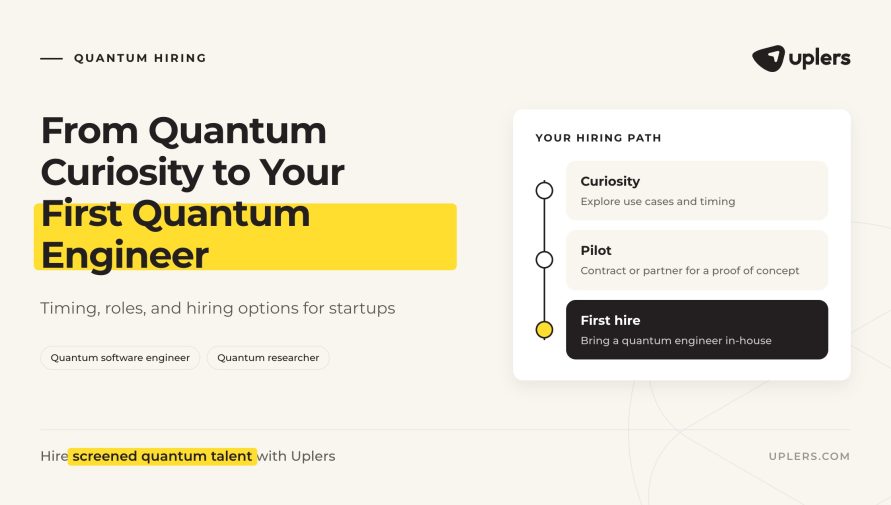
Hiring quantum computing engineers makes sense once you have a defined technical problem, a credible use case, and a next milestone worth paying for. If one of those is still missing, you have cheaper options. An outside expert or a short test on a cloud platform can fill the gap, and sometimes the smartest call is to wait until the business case gets sharper.
Who Are Quantum Computing Engineers and What Do They Do?
Quantum computing engineers design, build, and test the software, algorithms, or hardware that run on quantum computers. Before you plan a hire, it helps to know what the job involves day to day.
Most of their work happens on hybrid systems. A quantum processor handles one narrow part of a problem, such as a hard optimization step or a molecular simulation, and classical computers handle everything else. The engineer’s job is to decide which part belongs on quantum hardware and make the two sides work together.
At a startup, a quantum computing engineer’s week might include:
- Translating a business problem into a quantum model: A delivery-routing challenge or a chemistry question gets reframed as something a quantum algorithm can process.
- Writing and testing quantum circuits: Most of this work happens in Python with quantum SDKs, first on simulators and then on cloud-based quantum hardware.
- Cleaning up noisy results: Today’s quantum machines make errors, so engineers spend real time on error mitigation and repeated test runs.
- Comparing results with classical methods: They show the team whether the quantum approach is faster, more accurate, or neither.
- Connecting quantum components to the product: This means APIs, data pipelines, and integration with your existing codebase.
- Tracking new research and hardware: A new paper or a processor upgrade can change which approach makes sense.
In a large company, research, software, and hardware teams split these tasks between them. At a startup, your first quantum engineer often covers several at once and also explains findings to founders, customers, and investors. Clear communication matters almost as much as technical depth. Most candidates come from physics, computer science, or applied math backgrounds, and many hold a master’s or PhD.
Quantum Hiring Readiness Depends on Your Startup Type
Some growing startups need quantum engineers now. Some should run a small experiment first, and others can leave it for a year. Your product, technical goals, and stage decide which group you’re in.
Startups Building Quantum Products Need Specialist Talent Now
If you’re building quantum hardware, quantum software, algorithms, or developer tools, quantum expertise sits at the center of your roadmap. Your prototypes, platform features, and early customer commitments all wait on it.
Example: A team building a quantum software platform needs engineers who can design quantum workflows, work with frameworks like Qiskit or Cirq, and test performance before the platform reaches customers.
Specialist searches can take months, so open the role a quarter or two before the work needs to start.
Startups Exploring Quantum Applications Should Start With Targeted Experiments
Pharma, materials science, financial services, and logistics all have problems where quantum could eventually help. Your first job is to find out whether it helps with your problem.
Start small. A feasibility study or a tightly scoped proof of concept will tell you more than a job posting will. A contract specialist can help you frame the problem and read the results.
Example: A logistics startup with a scheduling bottleneck runs a 10-week proof of concept. It compares a hybrid approach such as QAOA with the solver it already uses. If the results hold up, the team has a solid case for its first quantum hire.
Startups Without a Defined Use Case Can Wait
If no customer problem, technical bottleneck, or product milestone points to quantum, a specialist hire becomes an open-ended research project. Those burn through money and leadership attention fast.
For now, build basic quantum literacy in your tech leadership and keep an eye on the field. When a specific question comes up, talk to an expert. A customer request or a new product idea is your cue to revisit hiring.
When Should a Startup Hire Quantum Computing Engineers?
Say you’ve spotted a possible use case. These four signals tell you whether it’s time to bring quantum expertise onto the team.
You Have a Problem Worth Testing With Quantum Methods
- Name the bottleneck. It might be a molecular simulation that takes days, or an optimization problem that slows to a crawl as it grows.
- Benchmark your best classical approach first. That gives you something concrete to measure quantum results against.
Quantum Expertise Sits on Your Product Roadmap
- Link the role to a prototype, product milestone, or customer requirement your current team can’t cover.
- For example, a quantum software startup may need someone to write algorithms, integrate quantum platforms, or build tools for other developers.
You Can Spell Out What the First Hire Must Deliver
- Pick one clear outcome, such as validate an algorithm, benchmark a workload, build a prototype, or assess feasibility.
- Set milestones for the first 6 to 12 months, with check-ins where you decide to continue, pivot, or stop.
Your Runway Covers the Research Timeline
- Budget for recruitment time, cloud compute, and research that may run longer than planned.
- Expect high salaries. Salaries for quantum computing engineers may range from $130,000 to $250,000 or more depending on role and seniority. Check Uplers’ Salary Guide for more details.
- Track progress through technical milestones, since revenue from quantum work can be years away.
Which Type of Quantum Computing Engineer Should Your Startup Hire?
“Quantum engineer” is a catch-all title. Your first hire should match the specific technical problem in front of you.
Getting this right matters because the talent network is small. According to QED-C’s State of the Global Quantum Industry 2026 report, the global pure-play quantum workforce reached nearly 16,500 professionals in 2025, up by about 2,000 in a single year (The Quantum Insider), alongside 11% growth in job and internship openings. With so few qualified people around, a sharply defined role makes your search faster and your shortlist stronger.
| What your startup needs | Role to hire | What they do |
| Research quantum approaches to a problem | Quantum algorithm engineer | Develop and evaluate quantum algorithms |
| Build software on quantum platforms | Quantum computing developer | Write quantum software, integrate SDKs, and build applications |
| Build quantum hardware or control systems | Quantum hardware engineer | Work on devices, control, measurement, and system integration |
| Solve molecular or materials problems | Quantum simulation specialist | Model and evaluate scientific problems |
When hiring quantum computing developers, look for people who’ve built software, APIs, integrations, or developer tools on existing quantum systems. If your open question is algorithm design or feasibility, a research-oriented engineer is the stronger pick. Titles shift from company to company, so write down responsibilities and expected outputs before you draft the job description.
Too Early for a Full-Time Hire? Start With These Alternatives
You can build quantum capability before you commit to a full-time salary. The OECD’s March 2026 paper, Building Business Readiness for Quantum Computing, defines quantum readiness as an exploratory, capability-building process and points to support options such as networking and collaboration platforms, business advisory services, technology extension services, grants for business research and development (R&D). For a startup, that translates into a few practical first moves.
| Where your startup stands | Too early for full-time? | Your first move | Signal to expand the team |
| Quantum is your product | No | Hire your first quantum engineer | Ongoing engineering work with clear milestones |
| Promising use case, no proof yet | Yes, for now | Bring in a contract expert for a feasibility project | Feasibility work shows a sustained engineering need |
| Early idea, tight budget | Yes, for now | Run a scoped experiment on IBM Quantum or Amazon Braket with expert guidance | Results justify further development |
| Research-heavy question | Often | Partner with a university lab and agree on IP terms upfront | Research points to a viable product path |
| No defined use case | Yes | Have one engineer take free courses such as IBM Quantum Learning | A specific problem shows up on your roadmap |
When waiting becomes too late: Once your use case is validated, a key customer asks for quantum capability, or your roadmap depends on quantum work, every month of delay costs you. Funding is also moving quickly. McKinsey’s Quantum Technology Monitor 2026 found that investment in quantum technology start-ups reached $12.6 billion in 2025, 6.3 times higher than in 2024. Competitors with that kind of backing can move from pilot to product quickly.
Cloud platforms make early experiments cheaper to run. You’ll still need someone with solid quantum skills to design them and make sense of the results.
Common Quantum Hiring Mistakes Startups Should Avoid
Run through these before you open the role.
- Hiring because quantum is trending: Start with a customer problem, technical bottleneck, or product opportunity worth investigating.
- Writing an overly broad job description: Algorithm research, software development, hardware engineering, and commercialization are separate jobs. Pick the one your project needs most.
- Reading too much into early results: A promising run on a small test problem may fall apart at production scale. Ask for results on workloads that resemble your own.
- Expecting immediate commercial returns: Track research progress on its own timeline, apart from product readiness and revenue.
Hiring Quantum Computing Engineers With Uplers: From Shortlist to Onboarding
Once you know what your first quantum hire needs to deliver, the next challenge is finding that person fast. Uplers helps startups hire engineering talent from India and manages each step, from defining the role to onboarding your new engineer.
- Defining the role: You share the job description, the technical problem you’re solving, and the kind of person you want on your team. Uplers’ AI JD Builder can help turn rough notes into a clear brief.
- AI-led matching: Uplers’ AI searches a network of 3.5 million+ professionals. It filters candidates against your job description, the skills the role requires, and the mindset and work style you’ve described.
- Recruiter review: Experienced recruiters then review each selected profile and confirm the fit, including startup experience and ownership mindset. You receive 3 to 5 interview-ready candidates within 48 hours.
- Interviews: You pick the candidates you want to meet, and Uplers arranges the interviews.
- Onboarding: Once you’ve made your choice, Uplers takes care of onboarding so your engineer can start contributing quickly.
Uplers also offers three hiring models: curated sourcing, full-service hiring, and contract talent. That fits the staged approach covered earlier. You can bring in contract talent for a feasibility project, then switch to full-service hiring for a permanent role once the results justify it.
Conclusion: Hire Quantum Talent When the Technical Need Is Clear
Quantum hiring is a strategic call, and the right timing looks different for every startup. Quantum product companies should hire now, application-focused startups should test first, and everyone else can stay informed and check back later.
Before you recruit, make sure you can answer three questions:
- What will this engineer build or validate?
- Why does that work matter to your business?
- How will you measure progress?
Solid answers to all three mean you’re ready to start hiring quantum computing engineers. If any answer is still fuzzy, a feasibility study or an outside expert is the cheaper first step.