A founder posts an “AI Engineer” job, gets a candidate who can fine-tune a BERT classifier but has never built a RAG pipeline, and wonders why the chatbot MVP is three months late. Or the reverse: they hire a prompt-engineering generalist to build a proprietary fraud-detection model, and it never ships.
The confusion is understandable.
Many founders assume AI Engineers and ML Engineers are interchangeable, only to realize later that they’ve hired the right talent for the wrong problem.
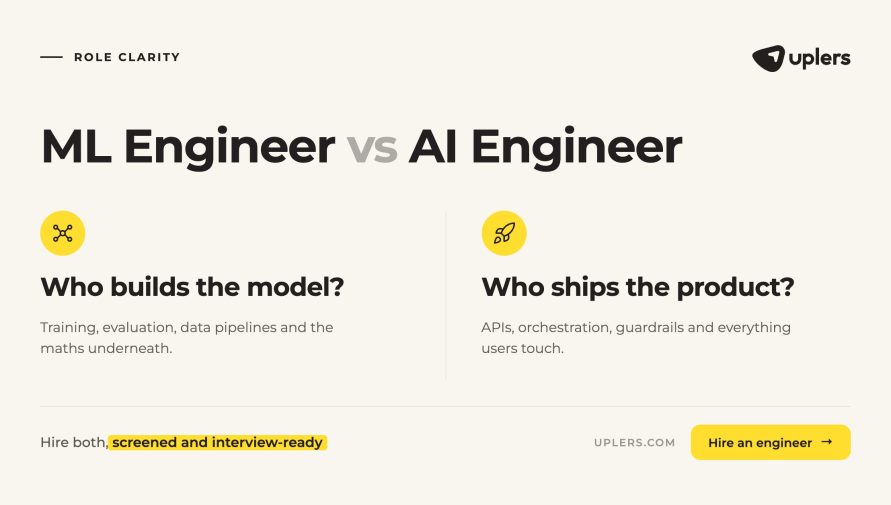
ML engineers build and train models. AI engineers build products on top of models, usually via APIs like GPT-5, Claude, or Gemini.
The distinction matters because most AI products today are built on a combination of foundation models, custom machine learning, retrieval systems, and application logic. Hiring the wrong role can delay launches, increase costs, or result in products that perform well in demos but fail in production.
This guide explains what each role does, where they overlap, and who owns what when shipping an AI product so that you can hire based on your product’s needs.
What Is an ML Engineer?
An ML engineer (Machine Learning Engineer) builds, trains, and deploys machine learning models. They own the model itself. If your product needs a custom prediction system, such as fraud detection, demand forecasting, or computer vision, trained on your own data, this is the person who builds it, end-to-end.
Core Responsibilities
ML Engineers own the model lifecycle, including:
- Preparing and labeling training data
- Training and fine-tuning machine learning models
- Evaluating model performance
- Deploying custom models into production
- Monitoring model drift and retraining models
Example
A fintech startup building a fraud detection system hires an ML Engineer to train models that identify fraudulent transactions with high accuracy.
Typical Skills/ Tools
- Python
- PyTorch or TensorFlow
- Scikit-learn
- MLflow or Kubeflow
- Feature engineering
- Statistics and MLOps
What Is an AI Engineer?
An AI engineer (Artificial Intelligence Engineer) owns the product layer. They build AI-powered applications using foundation models. They also integrate LLMs with business logic, retrieval systems, APIs, and user workflows to deliver production-ready AI experiences.
Core Responsibilities:
- Integrating LLM APIs like GPT-5, Claude, or Gemini
- Building RAG pipelines and AI agents
- Designing prompt workflows
- Connecting AI with databases and business systems
- Improving response quality, latency, and cost
Example
A SaaS company launching an AI support assistant hires an AI Engineer to build the chatbot, connect it to company documentation, and integrate it with Zendesk.
Typical Skills/ Tools:
- LangChain or LlamaIndex
- Vector databases (Pinecone, Weaviate, pgvector)
- OpenAI, Anthropic, or Gemini APIs
- Prompt engineering
- AI evaluation frameworks
- Backend development and API integration
Key Differences at a Glance
| Area | ML Engineer | AI Engineer |
| Primary focus | Build and optimize ML models | Build AI-powered applications |
| Works with | Training datasets, features, ML pipelines | LLMs, RAG, agents, APIs, business systems |
| Typical output | Production-ready ML model | AI feature or end-to-end AI product |
| Key technologies | PyTorch, TensorFlow, MLflow, Kubeflow | GPT-5, Claude, Gemini, LangChain, Vector DBs |
| Production ownership | Model training, evaluation, deployment | AI workflows, integrations, user experience |
| Success metrics | Accuracy, precision, recall, inference performance | Response quality, latency, cost, user satisfaction |
Whether you need an AI engineer or ML engineer, find the best talent from our 3.5M+ talent network.
Where the Roles Overlap
Although their responsibilities differ, AI Engineers and ML Engineers collaborate throughout the product lifecycle.
Evaluation & Testing
Both roles measure quality but at different layers.
- ML Engineers evaluate model performance using metrics like accuracy, precision, recall, and F1-score.
- AI Engineers evaluate application performance, including relevance, groundedness, consistency, and task completion.
Example: An AI customer support assistant needs accurate retrieval (AI Engineer) and, if it uses a custom intent classifier, high model accuracy (ML Engineer) is required.
Here’s a guide to evaluate and hire the right AI engineer for your lean team.
Production Monitoring
Production success depends on both roles.
- ML Engineers monitor model drift, inference latency, and prediction quality.
- AI Engineers monitor hallucinations, response latency, token costs, and workflow failures.
Uptime and reliability are shared ownership regardless of which layer breaks.
Data Management
Both engineers work with data but not the same data.
- ML Engineers manage training datasets, feature engineering, and labeling.
- AI Engineers manage knowledge bases, embeddings, retrieval pipelines, and context passed to LLMs.
Founder takeaway: One improves how the model learns; the other improves what the model knows at runtime.
Who Does What When Shipping an AI Product
The easiest way to understand these roles is to see who owns each stage of the product lifecycle.
Discovery and Prototyping
Most AI startups begin with foundation models, not custom ML. An AI Engineer can quickly validate ideas by integrating GPT-5, Claude, or Gemini into a working prototype.
Example: Building an AI meeting assistant? An AI Engineer can connect an LLM, process transcripts, and generate meeting summaries within days.
Check if your AI engineer is AI-native or just using resume padding.
Custom Models and Fine-tuning
If off-the-shelf models don’t deliver the accuracy your product needs, an ML Engineer takes over.
Example: A healthcare startup developing a disease-risk prediction system needs an ML Engineer to train and evaluate custom models on clinical datasets.
Production Deployment
Monitoring responsibilities split as described above. Ownership here is really about release infrastructure: the ML engineer owns the model-serving pipeline and retraining cadence; the AI engineer owns feature flags, prompt version control, and rollback for the application layer.
Example: A customer-support SaaS launches a chatbot on Claude in week one (AI engineer). Six months later, support logs reveal the bot mishandles a specific product category 30% of the time. Rather than keep patching prompts, the team fine-tunes a smaller model on their own resolved-ticket data for that category. Now the ML engineer owns that slice, while the AI engineer still owns the orchestration layer routing traffic between the general model and the fine-tuned one.
| Product Stage | ML Engineer | AI Engineer |
| Prototype with existing models | Supports | Owns |
| Prepare data | Training data & feature engineering | Retrieval data & embeddings |
| Train or fine-tune models | Owns | Supports |
| Build RAG pipelines & AI agents | Supports | Owns |
| Integrate AI into the product | Supports | Owns |
| Deploy and monitor | Shared | Shared |
Do You Need Both Roles? A Hiring Framework for Founders
The answer depends on how your AI product creates value:
Early-stage Startups
If you’re building with GPT-5, Claude, Gemini, or similar foundation models, hire an AI Engineer first. They can quickly validate ideas, build MVPs, and launch AI features without training custom models.
If your product relies on proprietary predictions, such as fraud detection, demand forecasting, recommendation systems, or computer vision, hire an ML Engineer first.
Scaling Startups
As your product matures, adding the complementary role becomes essential.
For example, an AI meeting assistant may start with an AI Engineer building summarization and action items. As customers demand personalized insights or proprietary recommendation models, an ML Engineer helps create capabilities that foundation models alone can’t deliver.
Enterprise Teams
Larger organizations typically separate responsibilities.
ML Engineers own model development and optimization, while AI Engineers focus on AI applications, orchestration, integrations, and user experience. Clear ownership reduces deployment bottlenecks and improves iteration speed.
Conclusion
ML Engineers and AI Engineers solve different problems but contribute to the same goal: shipping reliable AI products. Choose an AI Engineer to build AI-powered applications with foundation models, and an ML Engineer when proprietary models drive your competitive edge.
Hiring the right role at the right stage saves time, reduces rework, and accelerates product delivery.